The 25-Directory Citation Audit: What Consistent NAP Is Actually Worth
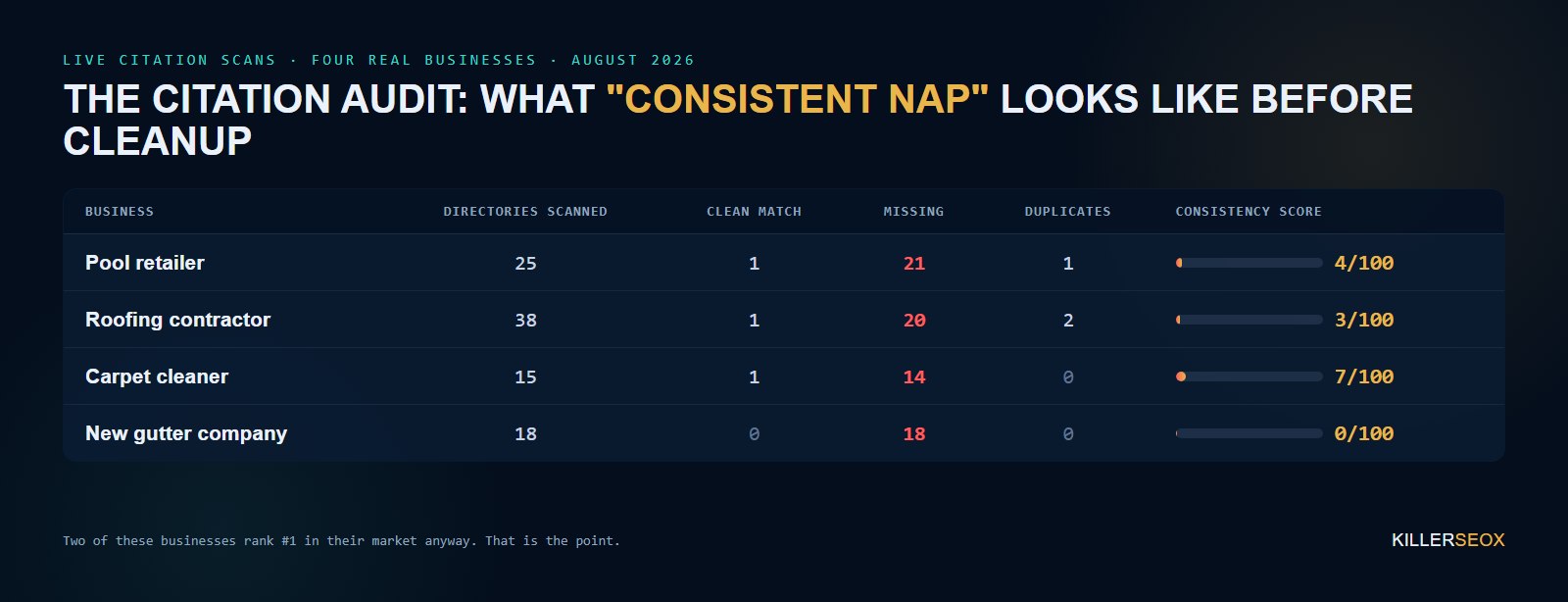
This month our platform ran citation scans across the businesses we manage, checking 25 directories and more for each one. The consistency scores came back at 4, 3, 7, and 0 out of 100. In most of this industry, those numbers open a sales call: your listings are a disaster, here is a monthly citation management package, sign here. So before anyone panics, one more number. Two of those four businesses rank number one in their market anyway.
That is the whole tension of citations in 2026. The scans found real problems worth fixing, including a phone number sitting on a completely different company's page. They also proved that a terrible citation score does not stop a business with a strong profile, real reviews, and real content from winning. This post walks through what a citation audit actually checks, what ours found on real businesses, which problems genuinely cost you calls, and the one situation where citations really do come first.
- A local citation audit scans business directories for your name, address, and phone (NAP) and labels every listing matched, mismatched, duplicated, or missing. Most businesses that have never done one score under 10 out of 100.
- Citations are a foundation, not a lever. Two of our clients rank #1 in their market with consistency scores of 4 and 7, because the profile, reviews, and content do the heavy lifting.
- The problems that actually hurt are duplicates that split your reviews, call tracking numbers leaking into directories as your real phone, and stale data on pages customers still find. Missing listings are the cheapest problem you have.
- AI assistants read directories when they recommend businesses, so your NAP is now part of what ChatGPT and friends believe about you.
- A brand new business with no Google Business Profile should ignore citations entirely until the profile is claimed and verified. Citations point at an entity. No profile, no entity.
What does a local citation audit actually check?
A local citation audit scans business directories, Yelp, BBB, Facebook, Nextdoor, YellowPages, MapQuest and the rest, for your name, address, and phone number, then labels each listing as matched, mismatched, duplicated, or missing against your canonical NAP. The output is a consistency score and a prioritized fix list.
A citation is any page that lists your business name, address, and phone number. The audit starts with one decision that sounds trivial and is not: what is the canonical version? One exact business name, one address format, one phone number. Every listing on the internet gets graded against that record.
Our scans cover a core set of 25 general directories, and more where a trade has its own ecosystem. For a roofing client we check 38, because roofing has vertical directories (BuildZoom, GuildQuality, Houzz, HomeAdvisor and peers) that matter more in that trade than half the general list. Each listing found gets one of four labels. Match means the NAP agrees with canonical. Mismatch means the listing exists but something disagrees, a wrong number, an old suite, a name variant. Duplicate means the directory holds two or more records for one business. Missing means nothing there at all.
One honest caveat about automated scanning: it misses things. On that roofing client, a human pass this week found about a dozen live listings the automated scan never surfaced, mostly on the trade directories. Treat any scan as a floor, not a census. The labels it does return are accurate. The listings it cannot see still exist and still carry your data, right or wrong.
What did the scans find on real businesses?
Consistency scores of 4, 3, 7, and 0 out of 100 across four businesses. Each established client had exactly one clean matching listing, 14 to 21 directories with nothing, a duplicate or two, and one had its phone number on a different company's page. This is what normal looks like before cleanup.
The table in the hero image is live data from this month, names withheld. A pool retailer we run: 25 directories scanned, one clean match, 21 missing, one duplicate, score of 4. A roofing contractor: 38 checked, one clean match, 20 missing, two duplicates, plus a mismatch I will come back to, score of 3. A carpet cleaner: one match out of 15, score of 7. And a gutter company that opened recently: zero listings across all 18 directories checked. A perfect zero.
The strangest find was on the pool retailer. The scan surfaced their phone number on another pool company's neighborhood page, a business they have no connection to today. Nobody types a competitor's name into a directory search to check for their own phone number, which is exactly why nobody had ever seen it. Directory data rots in weird ways: old relationships, old scrapes, and data brokers repeating each other for years.
Here is the part the citation-package sales call leaves out. That pool retailer with the score of 4 is the same business AI assistants name about 90 percent of the time when asked for recommendations in its market, a number we track weekly across six AI models. The carpet cleaner with the score of 7 averages positions 5 through 12 across its suburb town pages. Rough citations did not stop either one.
Do citations still matter for local SEO in 2026?
Yes, as a foundation, not a growth lever. Consistent NAP confirms to Google and to AI assistants that every mention of your business points at one real entity, and duplicates or wrong numbers actively hurt. But past the core directories, adding more citations does not move rankings. Your profile, reviews, and content do.
In 2012, citation volume was a genuine ranking tactic and the industry has been selling it on that memory ever since. Today the evidence in our own fleet says the causation is thin: businesses with miserable scores rank first in Maps and get named by AI assistants, because the signals that decide those results live elsewhere, in the Google Business Profile, the review velocity, and the site's actual content.
So why audit at all? Three reasons that have nothing to do with rankings juice. First, entity confirmation. Google builds a map of every business from mentions across the web. When your name, address, and phone agree everywhere they appear, that map is confident. When three phone numbers circulate, it is not, and confidence is what gets you into results Google is willing to stand behind. Second, AI assistants read directories. When someone asks ChatGPT for a roofer, the answer is assembled partly from Yelp pages, BBB profiles, and directory data. We have watched that mechanism from both sides while checking what ChatGPT says about a business, and a wrong number in that pipeline can end up spoken aloud to a customer. Third, customers actually land on these pages. A directory listing with your old number is not an SEO problem. It is a missed call from someone holding a credit card.
What this means for your budget: citation work is a cleanup project with an occasional re-check, not a monthly subscription. If you are paying every month for citation building and the deliverable past month two is a spreadsheet of the same listings, ask what changed last month. The honest answer is usually nothing.
Want to know what the internet says about your business?
The free audit reads your rankings and AI visibility in about 60 seconds, no card and no signup. It is the fastest way to see whether your real problem is citations or something bigger.
Run my free auditWhich citation problems actually cost you money?
Three of them: duplicate listings that split your reviews and blur Google's picture of your business, call tracking numbers leaking into directories as your permanent phone, and stale hours or addresses on pages customers still find. Missing listings, the thing audits flag most, are the cheapest problem on the list.
Duplicates are the expensive one. Two Yelp records for one business means your reviews split between them, and neither looks as strong as the real total. It also means Google has to guess which record is canonical, and Google guessing is never a position you want to be in. Both established clients in our scan carried duplicates, and neither knew.
Tracking numbers are the sneaky one. The roofer's scan flagged a mismatch on a major professional directory: a marketing call tracking number visible right next to the real business line. Tracking numbers are great on ads, where they belong. But directories get scraped and re-syndicated by data aggregators, so a tracking number that touches one listing quietly propagates as if it were your real phone. Cancel that tracking line in two years and some directory somewhere is handing out a dead number with your name on it. The rule is simple: tracking numbers on ads and landing pages, never on directories, and on your Google Business Profile only as a primary line with the real number kept in the additional phone field.
Stale data is the silent one. Old address, old hours, an old owner's cell. Every one of those pages is findable by a customer, and each wrong fact costs you exactly one phone call at a time, forever, in a way no analytics dashboard will ever show you.
Missing listings, by contrast, are just unclaimed ground. Worth filling for the core directories and your trade's verticals, since each one is a page you control and a link pointing home. But nobody is losing calls to a listing that does not exist. Prioritize accordingly: kill duplicates first, purge tracking numbers second, correct stale data third, and only then go build the missing core.
What comes first for a new business with no Google Business Profile?
The profile, full stop. A new business scanning zero for 18 across directories is normal and fine. Citations exist to confirm an entity, and without a claimed, verified Google Business Profile there is no entity to confirm. Claim it, verify it, fill it completely, then build the core directories once, correctly.
That gutter company with the perfect zero is not a failure story. It is a brand new business, and a zero is what new looks like. The failure mode is what the industry does with that zero: sell a 50-directory citation blast to a business whose Google Business Profile does not exist yet. That is pouring foundation around a house nobody has built. The citations have nothing to point at, and half of them get built from whatever name and number variant the salesperson typed in, which becomes tomorrow's cleanup project.
The order of operations for a new local business is short. Claim and verify the Google Business Profile, with the exact name, address, and phone you intend to use for the next decade. Pick your categories honestly. Then, and only then, build the core general directories plus the two or three verticals that matter in your trade, all from the same canonical record. Done once and done right, that is an afternoon of work, and a new business starts with the one advantage the established ones in our scan would pay for: no duplicates, no rot, no history to clean up.
From there the work that actually grows a local business is the work we write about every week: a profile that earns reviews, pages built for the towns you serve, and content that answers what your customers actually ask. That is the layer where rankings move. We run this exact stack for our own clients, and the same tooling, including the citation scanner behind the numbers in this post, ships on every KillerSEOx account, free tier included.
Quick answers
How many citations does a local business actually need?
Should I use a call tracking number on my business listings?
How do I fix a duplicate business listing?
How often should you re-run a citation audit?