Service and Town Pages Still Win Local SEO. Here's the Right Way to Build Them
Location pages have a terrible reputation, and most of them deserve it. You've seen the pattern: one page cloned thirty times, the town name swapped out, nothing else changed. Google has been burying that stuff for years. So when people ask me whether town pages are still worth building in 2026, they expect me to say no.
The data says otherwise. We maintain 28 service and town pages for one home services client in a midwestern metro, and I pulled the last 30 days of Search Console for every one of them this week. The pages are winning, but they're winning in specific places for specific reasons, and the same data shows exactly where they lose. This post is both halves: where these pages earn their keep, and the build that separates a ranking page from a clone Google skips.
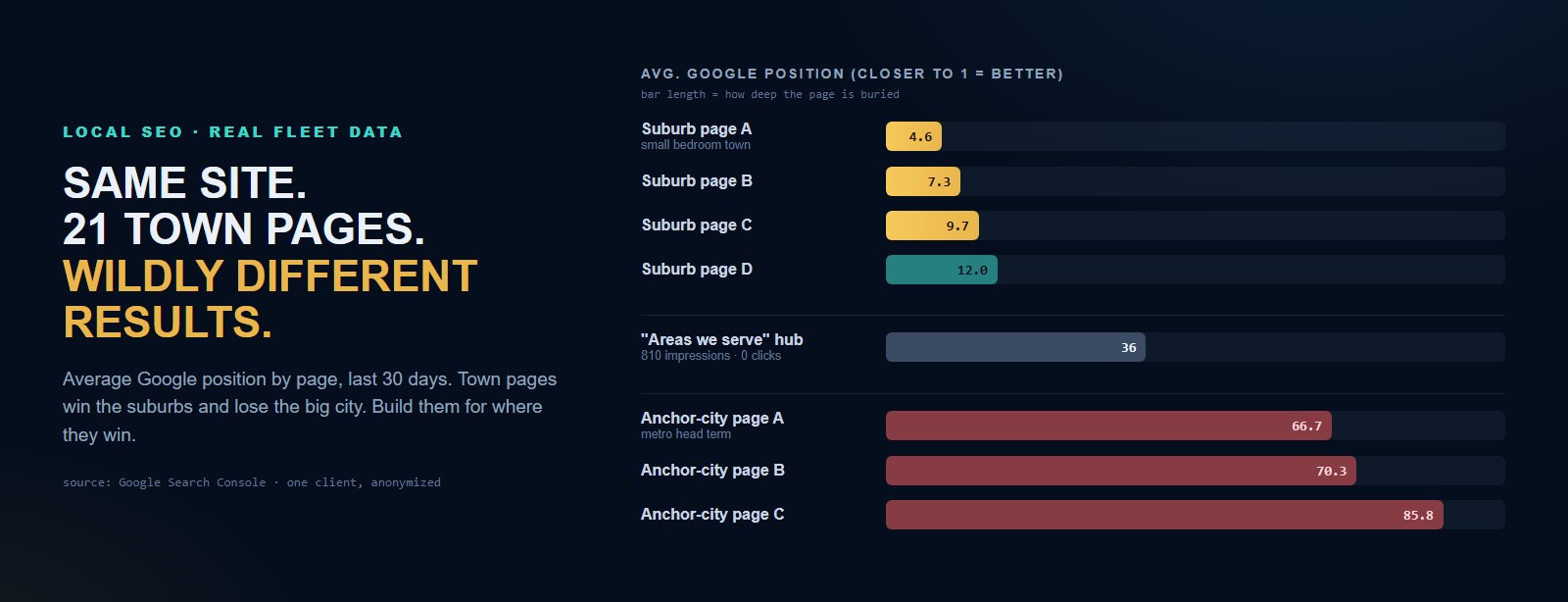
- Town pages still rank in 2026: across 21 pages with impressions on one client site, the small-suburb pages average Google positions between 5 and 12 while the same site's big-city pages sit at 67 to 86.
- Proximity sets the ceiling. A town page wins where the business can plausibly be the local answer. It will not out-page the whole metro's head term, and building more clones won't change that.
- Name-swap clone pages are exactly what Google's doorway and scaled-content policies target. Every page needs facts that are true only for that town: its own intro, its own FAQs, real evidence of work done there.
- The "areas we serve" hub is a router, not a ranker. Our client's hub pulled 810 impressions at position 36 with zero clicks. Its job is passing links to the town pages, not winning searches itself.
- Page-level averages hide wins. One town page averages position 21 overall while its money query sits at position 8. Track each town's queries separately or you'll cut pages that are actually working.
Do service and town pages still work in 2026?
Yes, when each page is genuinely about its town. Across one client's 21 town pages with impressions last month, suburb pages average positions 5 to 12 and several rank for "service plus town" searches at position 8 or better. Cloned pages with swapped town names are the version that died, and deserved to.
Here's the thing nobody selling "we'll build you 50 city pages" will tell you: the question isn't whether town pages work. It's whether YOUR town pages give Google a reason to rank them. Google's systems got very good at telling the difference between a page about Belton and a page about nothing with "Belton" typed into it.
The client site I pulled data from serves a two-state metro area. In the last 30 days the site drew 9,537 impressions, and the town pages did real work in that total. One page for a small bedroom suburb averaged position 4.6. Another sat at 7.3, a third at 9.7, a fourth at 12. These are pages for towns most people outside that metro have never heard of, and that's precisely the point. In those towns, this business is a completely plausible top answer, and Google agrees.
Where do town pages win, and where do they lose?
They win in suburbs and smaller towns, where competition is thin and the business is plausibly local. They lose against the metro's anchor city, where the same site's pages sit at positions 67 to 86. The big-city term is a different fight won with authority, reviews, and your Google Business Profile, not another page.
Same site. Same service. Same template, same phone number, same crew. Look at the spread:
| Page type | Avg. position | What that means |
|---|---|---|
| Small-suburb pages (best four) | 4.6 / 7.3 / 9.7 / 12 | Page one. Winning. |
| Mid-size suburb pages | 14 to 26 | Pages two to three. Climbing. |
| Anchor-city pages | 67 to 86 | Nowhere. Wrong tool. |
| "Areas we serve" hub | 36 | 810 impressions, zero clicks. It's a router. |
That bottom half matters as much as the top. The pages targeting the metro's two biggest cities pulled over 400 impressions between them and sat around position 70. Not because the pages are worse. Because a big city's head term is contested by every established player in the market plus the directories, and a single service page was never going to out-muscle that. The town page is a precision tool for winnable geographies. Point it at a head term and you've brought a scalpel to a demolition job.
One more pattern from the data, because it changes what you'd build next: the second-biggest town in this client's service area put up 426 impressions at position 50 with zero clicks. Real demand, visible in the impression count, and a page that's not yet close. That's not a delete candidate. That's the page most worth strengthening, because the demand is proven and position is the only problem.
Why do name-swap pages fail?
Because Google's doorway-page and scaled-content policies specifically target near-identical pages produced in bulk to catch searches, and its systems compare your pages against each other. When thirty pages differ only by town name, none of them is about any town, and Google ranks none of them.
The name-swap page fails a test you can run yourself in ten seconds: cover the town name and read the page. Could a local tell it's about their town? If the answer is no, you didn't write a page about Belton. You wrote a page about yourself and mail-merged it.
Google formalized this years ago with its doorway pages policy, then sharpened it in 2024 with the scaled content abuse policy, which is aimed at exactly this move: many pages, near-zero added value per page, produced to soak up search variations. The penalty risk is real, but honestly it's not even the main problem. The main problem is that clones just don't rank. You spend the money to build 40 pages and get the visibility of two.
There's a second-order cost too. Every thin page dilutes the site. Google's helpful content signals evaluate sites, not just pages, so a pile of clone pages drags down the pages that were earning their spot. We've had to prune and consolidate exactly this kind of legacy buildout on client sites, and rankings improved when pages were removed. Fewer, realer pages beat more, thinner ones. Every time.
What goes on a town page that actually ranks?
Facts that are only true for that town: a locally specific intro, the county, real jobs or reviews from there, answers to that town's actual questions, links to nearby town pages, and LocalBusiness schema listing the area served. If a paragraph could be pasted onto the next town's page unchanged, it isn't done.
The winning pages in that data set aren't magic. They follow a build we apply to every town page, and every element exists to make the page true for one town only:
- A town-specific opening. Not "we proudly serve [town]." Something a local would nod at: where the town sits in the metro, what kind of housing stock it has, the honest answer to "will you actually come out here?" Our best-ranking pages open by addressing exactly that.
- The county and the geography. Searchers and search engines both use them. County names show up in real queries, and they anchor the page to a place a clone can't fake.
- Proof you work there. A job from that town, a review from a customer there, a photo taken on a street a local would recognize. One real proof point outranks four paragraphs of adjectives.
- That town's questions, answered. Every town page we build carries its own FAQs, not copies. Pricing to reach the edge of the service area, scheduling realities, the services that town actually orders.
- Links to neighboring towns. Each page links its real neighbors, which builds an internal lattice that matches how the metro is actually laid out. The hub page routes into all of them.
- LocalBusiness schema with areaServed. Machine-readable confirmation of what the page claims. This matters double now that AI assistants read schema when deciding which businesses to recommend. The AIO on-page checklist covers that build in detail.
Notice what's not on the list: word count targets, keyword density, a map embed pasted in to look local. Length is an output of having something to say about the town, not an input you pad toward.
A word on the hub page, because almost every site gets its job wrong. The "areas we serve" page on this client's site pulled 810 impressions last month at position 36 and earned zero clicks, and that's fine. Nobody hires a company off a page that lists thirty towns. The hub exists to hand internal links and crawl paths to the town pages, so treat it that way: a clean list of linked towns with a sentence of real context each, not a landing page you decorate with service copy and expect to convert. The town pages close. The hub routes.
Want to see where your town pages actually rank?
The free audit checks your rankings, your pages, and what six AI models say about your business, in about 60 seconds. No card, no signup.
Run my free auditHow many town pages should you build?
Start with the five to ten towns where you already do jobs and competition is beatable, and build those pages properly. Add towns as each page proves itself with impressions. Do not multiply every service by every town on day one. Demand decides which pages exist, not a spreadsheet of combinations.
The tempting math is services times towns. Eight services, twenty towns, 160 pages, and a vendor happy to invoice for all of them. Resist it. Our client's 28 pages exist because that's roughly the real service footprint, and even there, the data now tells us which handful deserve the next round of investment and which are fine as they are.
The sequence that works: build the towns where you already have jobs, reviews, and a short drive. Watch Search Console for eight to twelve weeks. Pages that pull impressions but sit on page two get strengthened with proof and FAQs. Towns that show demand you can't yet serve well get a business decision before they get a page. And the anchor city gets a different strategy entirely: your homepage, your Google Business Profile, reviews, and authority built over time. That's a campaign, not a page.
A service earns its own page in a town only when the demand shows up in the data. Until then, the town page covers the full service menu and does it well. One good page about a real place beats four thin ones about the same place cut different ways.
How do you know if your town pages are working?
Track each page's queries in Search Console, not the site average. One of our client's town pages averages position 21 overall while its money query sits at position 8. Judge each page on impressions, its best commercial query, and clicks, then strengthen proven-demand pages and leave the winners alone.
The averages will lie to you if you let them. That position-21 page looks mediocre in a report. Underneath it, the exact "service plus town" query a ready-to-buy customer types sits at position 8, on page one, doing its job. Kill that page because of its average and you've killed a working asset.
This is the same trap I wrote about in the rankings post: blended numbers hide the movement that matters. For town pages the checklist is short. Per page, per month: impressions (is there demand?), the best commercial query's position (are we winnable?), and clicks (are we getting chosen?). Three numbers, and together they sort every town page into strengthen, hold, or rethink.
We run this loop for over 20 businesses nationwide, and it's the loop the platform runs automatically: rank tracking per town and per service, Search Console wired in, and an action queue that flags which page earned the next hour of work. Whether you use our software or a spreadsheet, close the loop. The businesses winning the suburbs aren't guessing which pages work. They know, page by page, and they build where the data points.
Quick answers
Are city pages considered doorway pages by Google?
Should every service get its own page in every town?
Why does my town page rank in one suburb but not the next one over?
Do I need a Google Business Profile in each town to rank a town page?