Why Your Rankings Moved, and Why Nobody Can Tell You Why
A business owner calls his SEO company because his rankings dropped. They tell him it was probably an algorithm update. He asks which one. Nobody knows. That conversation happens every week, and it is almost never an algorithm update.
Most of the time the rankings did not do what the report says they did. The report showed one number per keyword, and that number was three different numbers averaged together. When one of them moves and the other two hold, the average shrugs. When two move in opposite directions, the average sits perfectly still while your phone rings less. That is the whole problem, and it is fixable in about ten minutes of setup.
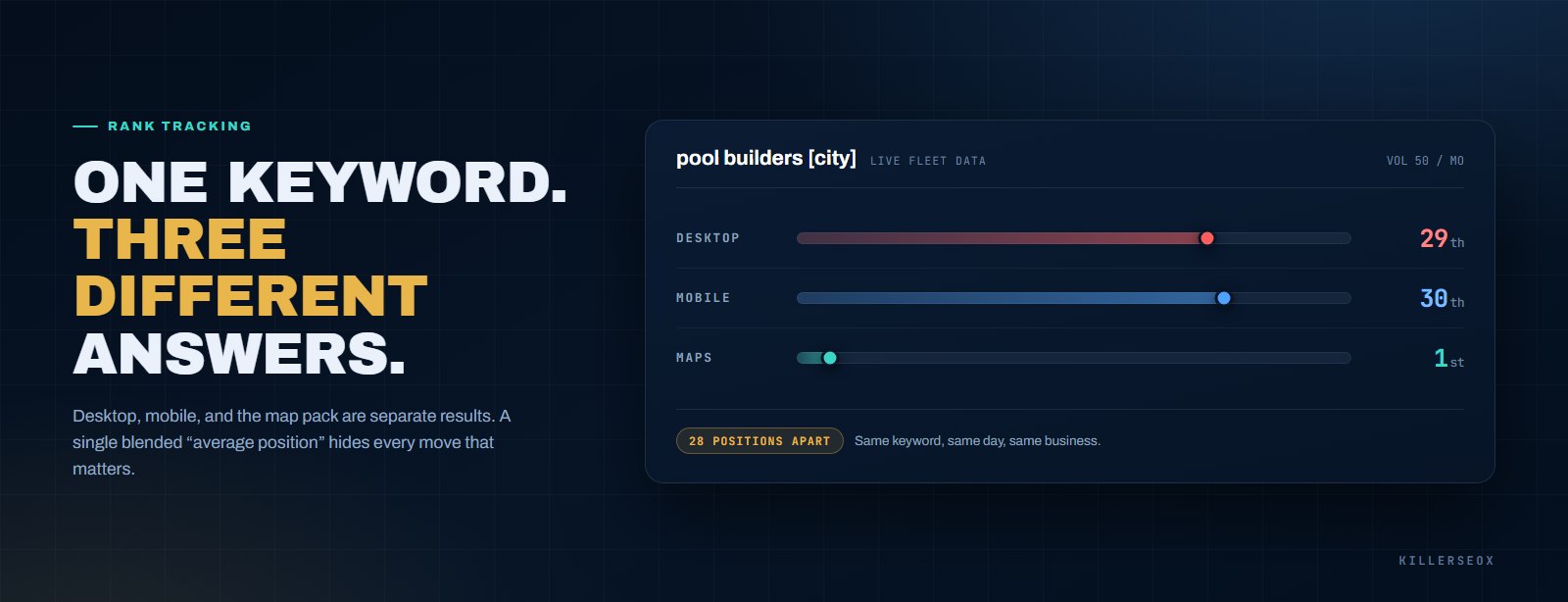
- Desktop, mobile, and the map pack are three separate result sets. The same business can rank 29th on desktop and 1st in Maps on the same day for the same keyword.
- Across the 193 keywords we track with both desktop and mobile positions, 30 currently sit five or more spots apart, and 20 recently moved in opposite directions on the two devices.
- Of the 104 keywords we also track in the map pack, 49 percent hold a Maps position more than 10 spots away from their desktop position. One in five ranks top three in Maps while sitting off page one organically.
- A blended average position is why nobody can explain a drop. Split the channels and most drops explain themselves in a minute.
- Check weekly, not daily. Daily checking turns normal fluctuation into false alarms and burns trust on nothing.
Why did my rankings change when nothing on my site changed?
Because your site is only one of the inputs. Competitors publish and earn links, Google reshuffles results by device, your Google Business Profile gets edited or flagged, reviews slow down, and the results page itself changes shape. Rankings move constantly without you touching anything.
Owners tend to assume rankings are a scoreboard of their own effort. They are not. They are a comparison against everyone else who wants the same customer, recalculated every day, on a page whose layout keeps changing under everyone.
So the honest answer to "what changed" is usually not one thing. It is that a competitor two towns over finally claimed their profile, or an AI Overview appeared above the results and pushed the map pack down, or Google started serving a different mix on phones than on laptops. None of that shows up in your site's files. All of it shows up in your phone volume.
Here is what makes it worse. The report most owners get cannot distinguish between those causes, because it collapsed the evidence before anyone looked at it.
What is a blended average position actually hiding?
It hides the channel that moved. A single average position per keyword mixes desktop, mobile, and map pack results into one figure. A real move on one channel gets diluted by two flat ones, and two moves in opposite directions cancel out completely, so the number reads stable while your leads fall.
Take a real example from a Cincinnati pool retailer we run. The keyword is "pool builders" plus their city. On the day I pulled this, they sat 29th on desktop, 30th on mobile, and 1st in the map pack. Same keyword, same business, same afternoon.
Average those and you get something around 20th, which describes nothing that exists. Report that number to the owner and he learns nothing. Tell him he owns the map pack and is invisible in the organic results, and he immediately knows two things: his profile and reviews are working, and his website has no authority for that term yet. That is a decision he can act on this week.
The cancellation problem is worse than the dilution problem. We track a Cape Cod builder whose "carpentry services" ranking climbed from 17th to 8th on desktop while their map pack position slid from 7th to 11th. Their organic listing broke onto page one and their map pack listing fell out of the top ten in the same window. Blended, that reads as a small improvement. Split, it is a clear signal that the website work is landing and the profile needs attention.
How different are desktop, mobile, and Maps in practice?
Far more different than most reports admit. Across the keywords we track with both desktop and mobile positions, roughly one in six sits five or more spots apart right now, and about half of the keywords tracked in Maps hold a map pack position more than ten spots from their desktop position.
I did not want to argue this from anecdotes, so I pulled the numbers straight out of our own platform across every business we track. This is live data from real local and regional companies, anonymized because it is theirs and not mine to publish.
| What we measured | Result |
|---|---|
| Keywords tracked on both desktop and mobile | 193 |
| Sitting 5 or more positions apart on desktop vs mobile | 30 (15.5%) |
| Keywords also tracked in the map pack | 104 |
| Map pack position 10 or more spots from desktop position | 51 (49%) |
| Top 3 in Maps while ranking outside the top 10 organically | 21 (20%) |
| Recently moved on one device while flat on the other | 30 |
| Recently moved in opposite directions by device | 20 |
Read the third and fourth rows together and you get the finding that surprises people most. Half of the keywords we watch in the map pack are more than ten positions away from where the same business ranks organically. One in five is a top three map result attached to a website nobody finds on page one. Those businesses are winning and losing the same keyword simultaneously, and no single number can say that.
The movement rows are the ones that end the "algorithm update" conversation. Thirty keywords moved on one device while the other stayed completely still. An algorithm update does not politely restrict itself to phones. A device specific move points at something you can name, usually page speed on mobile, a layout change, or the local pack expanding on small screens.
A few individual cases are worth seeing. A Cincinnati window cleaning company watched one service keyword go from 70th to 36th on mobile while desktop crawled from 35th to 33rd, and the map pack jumped from 36th to 10th. A New Hampshire roofer went from 19th to 6th on mobile for a town level repair keyword while desktop actually slipped a spot, 6th to 7th. In both cases the blended number would have looked like mild improvement. The real story was a mobile breakthrough worth real money.
Want to see your own three numbers?
The free audit checks your rankings, your map pack presence, and how six AI models describe your business. No card, no signup.
Run my free auditWhy does the map pack move on its own?
Because it is ranked on different inputs. The map pack runs mostly on your Google Business Profile, your proximity to the searcher, your reviews, and your citations. Your website matters far less there, so profile edits, category changes, review droughts, and competitor suspensions move Maps while your organic listings sit still.
This is the part that costs local businesses the most, because the map pack is usually where the calls come from. Someone searching on a phone sees three map results, a couple of ads, and maybe an AI summary before a single organic link. Falling from 3rd to 4th in that pack can cut your calls noticeably while your organic position does not budge.
The common causes, in the order we find them:
Somebody edited the profile. Often Google itself, through a suggested edit from a user or an automatic category adjustment. Hours, categories, and the primary category especially. Check the profile's edit history before assuming anything else.
Reviews went quiet. Recency matters in the pack. Three months with no new reviews while a competitor collects twenty is enough to swap positions without any other change.
A competitor came back. Suspended profiles get reinstated. A business that reopens or finally verifies their listing enters the pack, and everyone below them shifts down one.
The search moved, not you. Map pack results are heavily proximity weighted, so your position varies by where the searcher is standing. This is why checking on your own phone from your own office is the least reliable test you can run, and why grid based heatmaps exist.
None of these are algorithm updates. All of them are findable in an afternoon, if your tracking told you the map pack was the thing that moved.
What should you check when rankings move?
Work from the specific to the general. Identify which channel moved, then which keywords, then whether they share a target page. A move isolated to one page or one channel has a local cause you can fix. Only when a drop is spread evenly across everything should you start thinking about an algorithm update.
Here is the order I actually use, and it takes about fifteen minutes:
1. Which channel moved? Desktop, mobile, or Maps. If you cannot answer this, stop and fix your tracking first, because everything downstream is a guess.
2. How many keywords moved? One or two is a page level issue. A third of your set is a site level issue. All of them at once, across every channel, is the only pattern that genuinely suggests a broad update.
3. Do the movers share a target page? If six keywords dropped and they all point at the same service page, go read that page. Something changed on it, or something now outranks it, or it lost internal links in a redesign.
4. What did you ship? Line the date up against your own change log. Redesigns, plugin updates, redirect changes, and page consolidations cause more ranking drops than Google does. Everyone forgets the site went through a theme update three weeks ago.
5. Then look outward. Check whether a competitor published something new, whether the results page grew an AI Overview, and only then whether an update rolled out. Doing this step first is how people end up blaming Google for their own redirect.
That order matters because it puts the causes you control ahead of the ones you do not. Most drops die at step three or four.
How often should you be checking?
Weekly, on the same day, on all three channels. Daily checking exposes you to normal fluctuation and produces false alarms. Monthly checking means a real drop costs you three weeks of calls before anyone notices. Weekly gives you a trend line you can line up against your own work.
Positions move a little every day. Personalization, testing, and location all wobble the number, and a business that checks daily will find something alarming most mornings. Nothing burns an owner's trust faster than five false alarms before a real one.
A weekly series does something a snapshot never can. It shows the shape of the change. A slow four week slide is a competitor out-publishing you. A cliff on one date is something that happened on that date, and now you have a date to investigate. That distinction is worth more than the positions themselves.
This is exactly the tedious part we built KillerSEOx to handle. It checks desktop, mobile, and the map pack separately every week, keeps every historical position so you can see the shape, and puts your AI assistant visibility on the same screen, because customers are increasingly asking a model instead of scrolling results. If that side of search is new to you, start with what AIO actually is.
You do not need our software to do this properly. You need three numbers per keyword instead of one, checked on a schedule, written down. But if you would rather it just be done, run the free audit to see where you stand today, or start on a free account and watch the trend build. Agencies running this across a client roster should look at the plans, since the per client math changes fast past a handful of sites.
Quick answers
Why do my rankings look different on my phone than in my report?
How much can desktop and mobile positions really differ?
Should I worry about a drop of two or three positions?
Why did my map pack ranking drop when my website rankings held?
How often should rankings be checked?