The Math of Reselling SEO Software vs Building Your Own Stack
Every agency owner runs this math eventually, usually right after paying the invoice for the fourth SEO tool that month. Keep stitching subscriptions together, or put one platform under your own brand and mark it up. I have lived both sides of that decision, because we built the platform we now let other agencies resell.
Full disclosure before a single number: we sell white label SEO software, so I have a horse in this race. What I can do is use our real published pricing instead of hypotheticals, show you the arithmetic that actually matters, and tell you plainly when building your own stack is the smarter move. Because sometimes it is, and I will get to that.
- A DIY agency SEO stack means four to six separate subscriptions covering rank tracking, AI visibility, audits, citations, and reporting, plus the hours someone spends stitching exports together every single month.
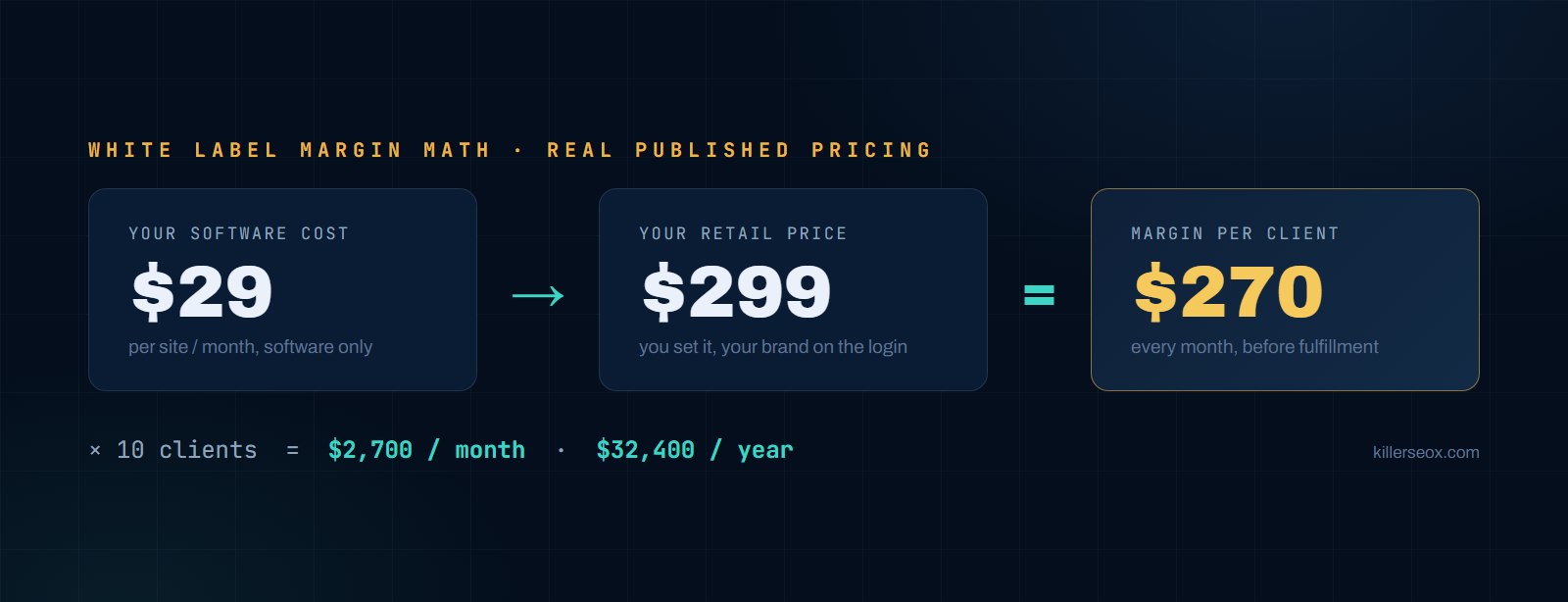
- The white label math at our published pricing: a $29 per site software cost against a $299 retail price is $270 of monthly margin per client, which is $2,700 a month at ten clients and $32,400 a year.
- That margin is not free money. Resellers who put a logo on a dashboard and disappear churn out. The software margin funds the service business, it does not replace it.
- Building your own stack makes sense when tooling is your actual product or you need data nobody sells. We know because we built one, and it turned us into a software company.
- Before signing any white label deal, check the exit: who owns the historical data, whether you can export it, and whose name is on the sending domain.
What does building your own SEO stack actually cost?
Plan on four to six separate subscriptions to match what one platform bundles: rank tracking across desktop, mobile, and Maps, AI visibility monitoring, site audits, citation scanning, and a reporting layer. The licenses alone add up to a real monthly bill for a small roster, and the stitching hours cost more than the licenses.
Here is the actual shopping list for delivering modern SEO to a client roster. A rank tracker that separates desktop, mobile, and the map pack, because a blended average position hides every change worth acting on. A site audit crawler. A citation tool that checks the directories that matter. Review monitoring. Some way to produce a report a client will actually open. And the newest line item, the one that was on nobody's bill three years ago: something that tracks what ChatGPT and five other AI models say about each client when a customer asks who to hire.
Each of those is a separate vendor with separate pricing logic. One charges per keyword. One charges per seat. One charges per domain, another per report. None of those pricing models care about your margins, and every one of them scales against you as your roster grows. Adding client number eleven should be nearly free. On a stack of point tools, it is another round of per-unit fees across five products.
Then there is the cost nobody invoices you for. Every tool has its own login, its own export format, and its own opinion about what a location is. Someone at your agency becomes the human API, pulling six CSVs into one spreadsheet the first week of every month. At three clients that is an annoyance. At fifteen it is a part-time job, and it is the part of the month your best person enjoys least. The deliverable still looks like six tools stapled together unless somebody also builds a report layer on top.
What does white label SEO software cost instead?
A white label platform bundles the tracking, audits, AI visibility, citations, and client reporting into one per site subscription that runs under your brand. Ours starts at $29 a month per site, software only. You set the retail price, and your clients see your logo, your domain, and your name in the From line.
The reason the economics work is boring and structural. A platform vendor spreads infrastructure cost across every agency on the system, the same way nobody runs their own email server anymore. The SERP data, the AI model queries, the crawlers, the uptime monitoring: one build, many agencies. You could never justify that build for one roster, and you never have to.
Most agencies who ask us about this arrive with sticker shock, because the established enterprise platforms in this space typically start their agency plans near four figures a month before a single client is added. That pricing made sense when the buyer was a fifty-person agency. It makes no sense for the shop with eight clients that just needs the machine to run under its own name.
One thing I want on the record: we are not reselling someone else's engine with our sticker on it. We run our own agency on this exact platform, eighteen live client businesses on it as I write this, and the results on our homepage come from that fleet. When your white label SEO software is also the vendor's daily driver, the bugs get found before your clients find them.
Where does the reseller margin actually come from?
From the spread between your software cost and your retail price, multiplied across the roster. At our published numbers, $29 software against a $299 retail price leaves $270 per client per month. Ten clients is $2,700 a month and $32,400 a year, before you sell any fulfillment on top of it.
This is straight arithmetic from pricing we publish on our own site, so you can check every cell of this table yourself.
| Clients on the platform | Your software cost /mo | Retail at $299 /site | Monthly margin | Annual run rate |
|---|---|---|---|---|
| 5 | $145 | $1,495 | $1,350 | $16,200 |
| 10 | $290 | $2,990 | $2,700 | $32,400 |
| 25 | $725 | $7,475 | $6,750 | $81,000 |
Now the part the margin calculators never mention. That $270 per client is not passive income, and anyone selling it to you as passive income is selling you churn. The client is not paying $299 for software. They are paying for a strategy, a quarterly conversation, and a human who is accountable when the phone stops ringing. The software does the grunt work of tracking, auditing, and reporting so the human hours go into judgment instead of spreadsheet assembly.
The agencies we watch succeed with this all run the same play: software margin covers the boring operational floor, and they sell the outcome on top. The ones who churn out bought a login, forwarded it to clients, and went quiet.
Pitch with the audit, not a brochure
Run the free audit on a prospect's business, live, in the meeting. When the AI names their competitor instead of them, the deal explains itself. No card, no signup, 60 seconds.
Run a free auditWhen does building your own stack make sense?
Build when tooling is your actual product, when you need data nobody sells, or when you are large enough that dedicated ops staff beats license fees. For a typical agency under about fifty clients, the subscriptions plus integration hours cost more than reselling, and the maintenance never ends.
I can speak to this one first-hand, because we built KillerSEOx instead of licensing someone else's engine, and the honest version of that story is a warning label. Building meant becoming a software company. Engineers on payroll. SERP data APIs metered by the query. Six AI models to poll on a schedule that never sleeps. Email deliverability, uptime monitoring, a billing system, and a roadmap that eats every planning meeting. We made that trade on purpose, because the software itself is a product we sell. If your product is client results, every one of those hours is an hour not spent on clients or sales.
There are two honest cases for staying off a platform. The first is scale: past a certain roster size, with real engineering capacity in-house, owning the stack buys you control and custom data no vendor will build for you. The second is the opposite end: if all you truly need is a monthly rank export for three clients, a single cheap tracker is fine. Do not buy a platform you will not use. The expensive mistake is the middle path, half-building a stack out of point tools and paying for it monthly in both licenses and stitching hours while calling it saving money.
What should you check before signing a white label deal?
Check that the brand is yours end to end: the dashboard, the client emails, the login domain, and the reports. Then check the exit terms: who owns the historical data, whether you can export it, and what happens to client logins if you leave. Cheap software with a hostage clause is expensive.
These are the questions I would ask any vendor, including us. Where does the sign-in email come from? If every code and report your clients receive is sent from the vendor's pooled domain, your brand rides on someone else's sending reputation, and one bad actor on that pool lands your reports in spam. The right answer is your own verified domain, with your name in the From line.
Does the vendor's name appear anywhere a client can see it? Check the login screen, the report footers, the email signatures, and the URL your clients bookmark. Then read the pricing schedule for per keyword and per report overages, because a $29 headline with metered add-ons is a different product at scale.
And ask the uncomfortable one: what happens on the day you leave? Two years of ranking history is an asset. If it cannot be exported, it is not yours, and the vendor knows it. A platform confident in its product will let you walk with your data, because it plans to keep you with the product instead of the lock.
How do you price SEO when the software costs $29?
Price the outcome, not the bill of materials. Clients buy rankings, calls, and someone accountable, and they do not itemize your software line any more than they price a website by the hosting bill. Set retail on the value of a customer in the client's market, then let the software carry the operational floor.
The $29 number rattles some agency owners. If the software is that cheap, how do I justify $299 or more? The same way every service business always has. A plumber's invoice is not a markup on pipe. Your client is not buying keyword checks three times a week, they are buying the jobs that come in because of them. In a market where one new customer is worth four figures, a few hundred a month for the machine plus a human who steers it is an easy yes.
Our own direct retail is public: $99 to $349 a month per site depending on tier. Agencies that resell price above that, because they add the strategy call, the local knowledge, and the relationship. That spread is the service premium, and it is exactly what keeps clients for years instead of quarters.
If you want to see what the machine does before you brand it, start a free account and put one site on it. If you want the whole conversation, the white label page covers the branding, the client onboarding, and the optional fulfillment behind it. Either way, do the math in this post against your own roster before you sign anything, including with us.
Quick answers
What is white label SEO software?
How much does white label SEO software cost?
Is reselling SEO software profitable?
Will clients know the software is white labeled?
What is the difference between white label SEO software and white label SEO services?