What an SEO Action Engine Actually Does All Week
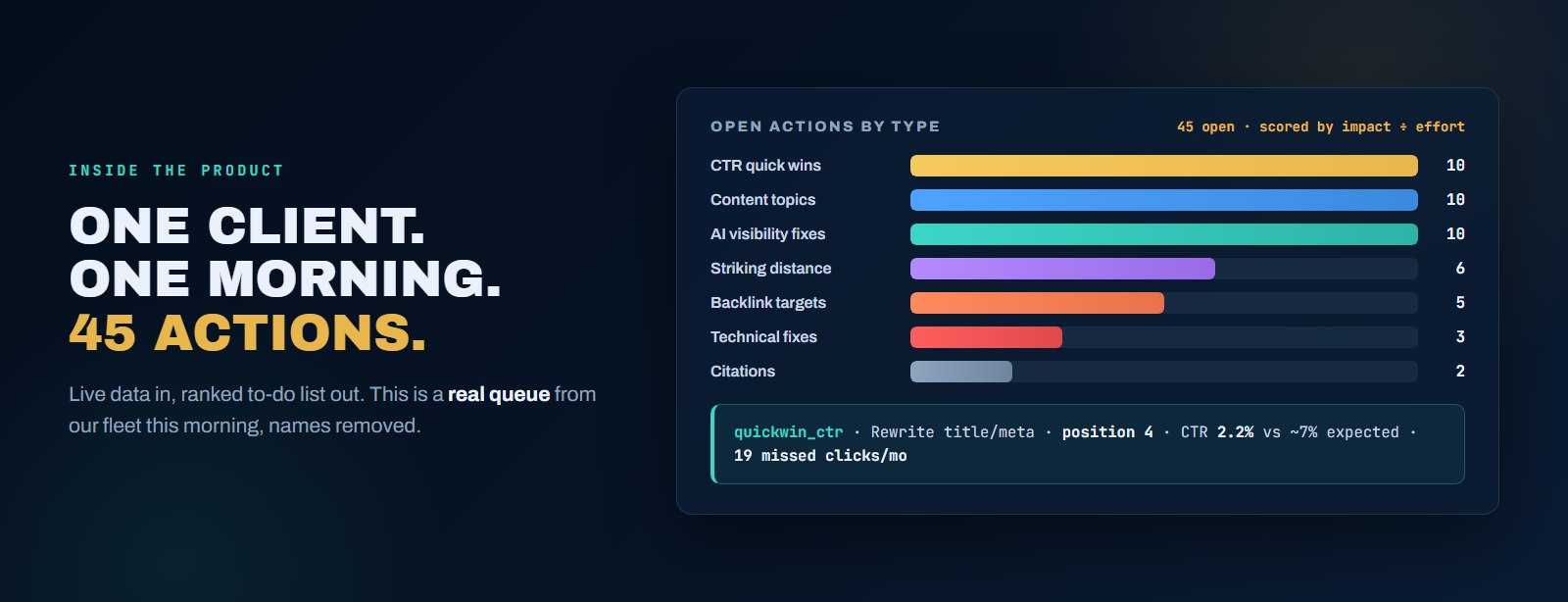
This morning, before I finished my coffee, one client's dashboard was holding 45 open actions. Not 45 charts. Not 45 metrics. 45 specific things to do, each with the numbers explaining why it made the list. That queue is what an SEO action engine produces, and this post walks through a real one.
Most SEO tools are very good at telling you what happened. Rankings moved, traffic dipped, a competitor gained. Then they stop, and you're left staring at charts trying to reverse-engineer what to actually do about any of it. The action engine is the part of KillerSEOx that closes that gap, so I'm going to show you exactly what it generated for our fleet this week, with the real numbers and the client names removed.
- An SEO action engine converts live data (rankings, click-through rates, audits, AI model answers, citations) into a ranked to-do list with the evidence attached to each item.
- One real client's queue this morning: 45 open actions across 8 types, including 10 CTR quick wins, 10 content topics, 6 striking-distance keywords, and 10 AI visibility fixes.
- CTR quick wins are usually the cheapest traffic available: one client ranks position 4 for a city keyword with a 2.2% click rate where roughly 7% is normal, which is 19 missed clicks every month from a title tag.
- Actions are scored by impact against effort, so a 20-minute title rewrite on a page-one keyword outranks a whole new page for a keyword sitting at position 67.
- The loop only works if actions get closed and re-measured. Done actions feed the weekly report, and the next data pull proves whether the fix moved anything.
What is an SEO action engine?
An SEO action engine is software that reads your live SEO data and writes a prioritized to-do list from it. Instead of showing you a ranking chart, it produces instructions like "rewrite this title, you're position 4 with a 2.2% click rate and 19 missed clicks a month," ranked by impact against effort.
The difference is the output format. A rank tracker outputs positions. An audit outputs scores. An action engine outputs work: a specific page, a specific problem, the numbers that prove it, and a rank in the queue. You never have to translate a chart into a decision, because the translation is the product.
I built this into KillerSEOx because I watched the same failure happen for years across the businesses we manage. The data was always available. The work never got picked. Owners and even agency staff would open a dashboard, feel vaguely informed, and close it without doing anything, because "average position slipped 0.7" is not an instruction. "Fix the title on your patio page" is.
If you've read my earlier post on why rankings move and nobody can tell you why, this is the other half of that argument. Tracking is table stakes. The value lives in what the tracking tells you to do next.
Where does the work list come from?
Every action traces to a live data feed: weekly rank pulls across desktop, mobile, and Maps, Search Console click-through rates, technical site audits, weekly AI model answer runs, and directory citation scans. Each feed generates its own action type, so the queue always says which data produced which instruction.
Nothing in the queue is invented. Every action type maps to a feed we're already pulling:
Rank pulls find striking-distance keywords. Every keyword gets checked weekly on desktop, mobile, and the map pack. Anything sitting roughly between position 4 and 15 is close enough that a push pays off, so the engine flags it. One client had 6 of these open this morning.
Search Console finds CTR quick wins. For every query you already rank for, there's an expected click-through rate at that position. When your actual rate runs far below it, your title and meta description are losing clicks you already earned. Real example from this morning: a page at position 4 for its city keyword pulling 2.2% of clicks where roughly 7% is normal for that spot. That's 19 clicks a month lost to a boring title. Another client ranks position 1 for a cost question and still captures 12.6% against an expected 30%, which is 25 missed clicks. These are the cheapest wins in SEO, because the ranking work is already done.
Demand data finds content topics. The engine cross-references what people search with where you currently stand. This morning's queue included a near-me term with 90,500 monthly searches, keyword difficulty 0, and the client sitting at position 55. That's a page begging to be built, and it surfaced from data, not from a brainstorm.
Audits find technical fixes. Speed, indexing, schema, broken pages. I'll be honest here: our own marketing site has an open action right now for Largest Contentful Paint at 5.7 seconds, flagged as poor. The engine doesn't spare its own maker, which is exactly what you want from it.
AI model runs find visibility gaps. We ask six AI models real buyer questions every week and record who gets named. When a client is mentioned by 0 of 6 models for a question like "who does bathroom remodeling near me," that becomes an action with a target, not a sad statistic. I covered how those answers get formed in the ChatGPT post and the broader playbook in the AIO explainer.
Citation scans find directory problems. One client's queue holds a single action to build 20 missing directory citations with canonical name, address, and phone data. Unglamorous, and it feeds both Google and every AI model that reads those directories.
What does a real client queue look like?
One client's live queue this morning: 45 open actions. 10 CTR quick wins, 10 content topics, 10 AI visibility fixes, 6 striking-distance keywords, 5 backlink targets, 3 technical fixes, and 2 citation items. Every action carries its evidence: the position, the search volume, the missed clicks, or the model count.
The hero image on this post is that actual queue, drawn from the dashboard this morning with the client's name removed. 45 actions sounds overwhelming until you notice what the format does for you. Each row is self-justifying. The content topic says "90,500 searches a month, difficulty 0, you're at 55." The quick win says "position 4, 2.2% against 7%, 19 missed clicks." You don't have to trust the tool's judgment, because the evidence rides along with the instruction.
That evidence line matters more than people expect. When an agency hands you a task list with no numbers attached, you're buying on faith. When every line shows its data, you can check the math yourself, argue with it, or hand it to whoever does the work. Transparency is a feature, not a courtesy.
And no, nobody is expected to clear 45 actions in a week. The queue is a ranked menu, not a homework assignment. The whole point of the scoring is that the top of the list is worth more than the bottom.
Want to see your own action queue?
The free audit reads your rankings and AI visibility in about 60 seconds, and the free tier builds your queue from your own data. No card, no signup for the audit.
Run my free auditHow does it decide what to do first?
Every action gets an impact score and an effort score, and the queue sorts by the ratio. A title rewrite on a page already ranking fourth scores high because the payoff is near and the work is 20 minutes. A new page for a position-67 keyword scores lower because the payoff is far and the work is hours.
The sort order is the opinion. Anyone can list 45 problems. The engine's actual job is arguing about sequence: missed clicks per month for the quick wins, search volume against difficulty for the topics, distance from page one for the striking-distance pushes. Cheap and near beats expensive and far, almost every time.
This is where human intuition reliably gets it backwards. Owners want to chase the big keyword at position 67 because the volume number is exciting. The engine keeps pointing at the boring title tag on the page that already ranks, because that's where the next 19 clicks actually live. Do the near thing first, fund the far thing with the results.
The scoring also keeps the queue honest over time. When a fix lands and the click rate recovers, the action closes and everything below it moves up. When new data arrives, new actions enter wherever their score puts them, not at the bottom of a pile in somebody's inbox.
What happens after an action is done?
A closed action feeds the client's Recent Wins list and the weekly report, and the next data pull tests whether it worked. If the click rate recovers or the position climbs, the win is visible in the same numbers that flagged the problem. If nothing moves, that's visible too, and the item gets rethought.
This is the part most tools skip, and it's the part I care about most. A to-do list that never gets re-measured is just a guilt list. Because every action was born from a metric, closing it creates a natural experiment: the same feed that flagged the problem either shows recovery next week or it doesn't.
Both outcomes are useful. When the fix works, the report writes itself, and the client sees cause and effect instead of a wall of charts. When it doesn't, we learn that this page, this keyword, or this format needs a different approach, and the queue gets smarter. I'd rather show a client one closed action with a measured result than twenty completed tasks with no scoreboard.
That's also why the weekly report leads with work completed and what moved, not with vanity metrics. Agencies reading this: that one change, reporting actions closed against numbers moved, will do more for your client retention than any dashboard redesign. It's the reporting style we sell through the white label program, and it's built on the action engine underneath.
Do you still need a human in the loop?
Yes. The engine finds, scores, and tracks the work, but a human still writes the titles, builds the pages, and judges brand fit. What the engine removes is the expensive part nobody admits to: the hours of analysis deciding what deserves attention this week. The judgment stays yours. The triage is automated.
I run marketing for a living and I'll say it plainly: software that claims to do all of SEO for you is either lying or producing work you wouldn't want your name on. The engine doesn't write your title tag. It tells you which title tag is bleeding clicks, hands you the query data, and gets out of the way.
What it genuinely replaces is the analyst hours. The looking, comparing, cross-referencing, and prioritizing that used to eat the first half of every week now happens before you log in. Whether the doing then falls to you, your staff, or our team depends on the plan you pick, and the honest starting point is the same either way: a free account and your own queue, built from your own data.
45 actions were waiting for one client this morning. Some number of actions is waiting to be generated from your site's data right now. The difference between businesses that climb and businesses that plateau is rarely knowledge. It's whether the next specific thing to do is sitting in front of them, scored and ready, every single week.
Quick answers
Is an SEO action engine the same as an SEO audit?
What is a striking-distance keyword?
How many of the actions should I actually do?
What does it cost to see my own action queue?