How to Rank in AI Overviews: What the Cited Pages Have in Common
Every time we publish a post, we do something most SEO shops skip: we pull the live Google results for that post's target keyword and write down whether an AI Overview appeared and exactly who it cited. It started as bookkeeping. A few weeks in, it turned into the most useful dataset we have, because it answers the question everyone is asking right now: who actually gets cited in these things, and what did their pages do to deserve it?
This post is that dataset, opened up. Since August 11 we have recorded the AI Overview state for 13 informational queries in our own niche, plus a set of commercial local searches from the client side of our tracking. The pattern in who gets cited is clearer than I expected, and it is very good news if you run a normal-sized business or agency site. Here is what the citations show, and how to write pages that earn one.
- AI Overviews fire on almost every informational query we test: 12 of 13 since August 11. They almost never fire on commercial searches like "pool company near me," which still get the local pack and regular results.
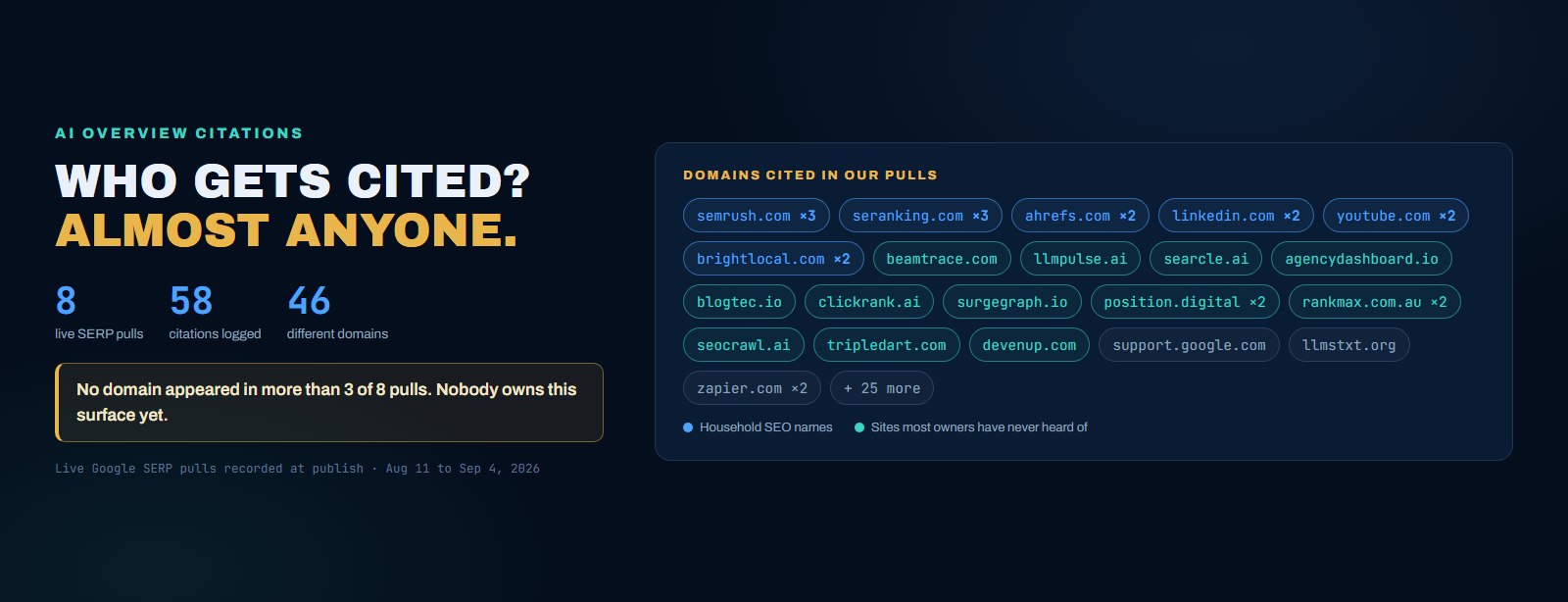
- Across the 8 pulls that returned full citation lists, we logged 58 citations from 46 different domains. The most-cited names, Semrush and SE Ranking, each appeared in only 3 of the 8. Nobody owns this surface yet.
- Citation is not ranking. In our pulls, pages outside the organic top 10 get cited, LinkedIn posts and YouTube videos get cited, and top-5 organic results routinely get skipped.
- The cited pages share a shape, not a size: a direct answer stated in a few liftable sentences under a heading that matches the question, backed by specific facts the model can quote.
- You can measure this instead of guessing: record whether an AI Overview fires for your target queries, note who it cites, and re-check weekly. The lists change fast, which means the door keeps opening.
Do you need a big site to get cited in an AI Overview?
No. Across 8 recorded AI Overview pulls in our niche, 58 citations went to 46 different domains, and no domain appeared in more than 3 of the 8. Small tools, niche agencies, single-topic sites, LinkedIn posts, and YouTube videos all earned citations alongside the big names, and often instead of them.
This is the finding that changed how I think about the whole surface. When AI Overviews launched, the fear was that Google would hand the answers to the same ten giant publishers and everyone else would go dark. Our pulls say the opposite is happening, at least in the search-and-marketing niche where we test weekly.
Some of the domains Google cited in our pulls: beamtrace.com. llmpulse.ai. searcle.ai. agencydashboard.io. blogtec.io. clickrank.ai. surgegraph.io. I have been in this industry a long time and I had not heard of half of them. An Australian agency, rankmax.com.au, got cited on two separate US queries. A domain called position.digital showed up twice. Meanwhile Semrush, the biggest brand in the space, appeared in 3 of 8 pulls, and Ahrefs in 2.
Read that again as a business owner: the most powerful domain in the niche gets cited about a third of the time, and the rest of the citations scatter across sites your size. Classic rankings never worked like this. Page one for a competitive term is a years-long authority grind, which is why we coach clients to optimize for AI answers as its own discipline instead of treating it as a byproduct of SEO. The citation surface is still being handed out. That is a window.
Which searches actually trigger an AI Overview?
Informational questions trigger them; buying searches mostly do not. In our records, 12 of 13 how-and-what queries fired an AI Overview. The one that did not was a tool-intent search, and the commercial local queries we track, like a service plus a city, returned the local pack with no AI Overview at all.
Before you chase this, aim at the right targets. We logged the AI Overview state for every focus keyword we published against since August 11. Queries like "how to check keyword ranking," "what is average position in Google Search Console," "ai visibility tool," and "white label seo reports" all fired one. So did today's target, "how to rank in ai overviews." Twelve of thirteen.
The exception tells you the rule. "Free rank checker" fired nothing, because someone typing that wants to use a tool, not read about one. And on the commercial side, the local searches our clients live on, service plus city, returned a local pack in slot one and regular results underneath, no AI Overview anywhere. We broke down that split in AI Overviews vs the local pack, and it has held in every pull since: Google answers questions with AI and transactions with the map.
So the play is not "get the AI to replace your service pages." Those win through the pack and classic rankings. The play is owning the questions your buyers ask on the way to the purchase. A roofer does not get cited for "roofing company Nashua." He gets cited for "how much does a metal roof cost," and the citation is what puts his name in the buyer's head two weeks before the buying search happens.
Does ranking number 1 get you cited?
Not reliably. Citation and ranking are correlated but separate decisions. In our pull for this exact query, Google's own developer documentation sat at organic position 5 and was not cited, while a LinkedIn post at position 10 and several pages outside the top 10 entirely were.
Here is the pull we ran for this post's own keyword, "how to rank in ai overviews," recorded the morning we published:
Look at what is missing. The number 3 organic result: not cited. Google's own documentation at number 5: not cited. Semrush at number 7: not cited. And look at what is included: pages that classic SEO would call losers, sitting past position 10, quoted in the answer box above everything.
The same pattern runs through the older pulls. On "what is average position in Google Search Console," the overview cited Google's support page, which you would expect, and then a handful of small SEO tools you would not. On "ai visibility tool," it cited Zapier and business.com next to two domains with a fraction of their authority. The model building the answer is not walking down the rankings and quoting the top three. It is hunting for sentences that answer the question cleanly, wherever they live.
What do the cited pages have in common?
Four things, consistently: they answer the query's question directly in a few self-contained sentences, they put that answer under a heading that matches how the question is asked, they back it with specific facts or numbers rather than generalities, and their structure is clean enough to parse: short sections, real headings, lists, tables.
Open the cited pages from any of our pulls and the family resemblance is obvious. Not design, not domain age, not word count. Shape.
They answer the question, then explain. The winning pages state the answer in the first few sentences under the relevant heading, complete enough to stand alone, then spend the rest of the section earning it. Pages that wind up through three paragraphs of context before answering do not get quoted, because there is no clean block to quote.
Their headings are the question. Not "Ranking Insights for the Modern Era." Literally "How often do Google rankings change?" The model matching a query to a passage gets a running start when the heading is the query. It is the same reason we write most of our own section headings as questions, including on this page.
They contain something specific. This is the one most advice misses. That LinkedIn post got cited because it made a concrete claim. The small tools get cited because their pages carry real numbers, screenshots, and steps. Generic advice has no sentence worth lifting: "check your rankings regularly" appears on ten thousand pages, and the overview needs exactly none of them. A page that says 23 of 120 weekly checks moved five or more spots has a fact the answer can hang on. First-hand data is not decoration here. It is the entry fee.
They parse cleanly. Short sections, real HTML headings, lists where lists belong, an FAQ where the leftover questions go. Nothing exotic. The on-page checklist we run for AIO covers the full structure, and none of it is beyond a normal business site.
Find out if AI mentions you before your competitors ask
The free KillerSEOx audit checks how your business shows up in Google and across six AI models, and grades your site's answer-readiness. About 60 seconds, no card.
Run my free auditHow do you write a page that gets cited?
Pick a question your buyers actually ask, confirm an AI Overview fires for it, then publish the most extractable answer on the internet: the answer stated plainly under a question heading, specific facts only you can supply, clean structure, and an FAQ for the follow-ups. Then re-check the query and see if you made the list.
Here is the sequence we run, the same one this post came from:
- Pick questions, not keywords. Start from what buyers ask on the way to hiring you: cost questions, comparison questions, how-long and how-often questions. Your sent emails and your last twenty customer calls are a better source than any keyword tool.
- Confirm the surface exists. Search the question. If an AI Overview fires, you have a target and a list of who you have to beat. If the local pack shows instead, that question belongs to your GBP work, not a blog post. This one check keeps you from writing for a surface that is not there.
- Answer in the open. Put the complete answer in the first sentences of the section, under a heading phrased as the question. If your answer only makes sense after reading the whole page, the model cannot use it and neither can a skimming human.
- Bring facts nobody else has. Your prices, your timelines, your job photos, your numbers. Everything the overview cited in our pulls carried something concrete. This is also, not coincidentally, exactly what Google's helpful-content guidance asks for, so the same work serves both systems.
- Close with the leftover questions as a real FAQ with schema, and keep the structure boring: headings, lists, short sections.
Notice what is not on the list: domain authority, backlink campaigns, site size. The 46 domains in our citation log say those are not the gate on this surface. The gate is doing the above better than the pages currently cited, and for most questions we test, the bar is honestly not high.
How do you know if it is working?
Track it like a ranking, because it is one. Keep a list of your target questions, record whether an AI Overview fires and who it cites, and re-check weekly. The citation lists in our pulls change week to week, so a miss today is not a verdict, and a citation today is not permanent.
The uncomfortable truth about this surface is that almost nobody measures it. Owners hear "AI is answering searches now" and either panic or shrug, and both reactions come from the same place: no data. Meanwhile the measurement is cheap. Search your ten target questions, write down who the overview cites, repeat next week. The week-to-week churn we see in the lists is the opportunity: Google keeps re-deciding who to quote, which means every re-decision is a chance to get picked.
We automate exactly this for our clients and ourselves. Every account gets its buying questions checked across six AI models weekly, plus the Google side, rolled into a weekly AI visibility report that shows which questions you win, which you lose, and who is winning them instead. That is the loop this whole post came out of: we would not publish advice on getting cited if we were not recording the citations ourselves.
If you want the baseline without building the tracking, the free tier includes it: your visibility across the six models and an answer-readiness audit of your site, no card and no trial clock. Start with where you stand today, then go write the most liftable answer to the next question your customers ask.
Quick answers
Can you pay to appear in an AI Overview?
Do you need llms.txt to show up in AI Overviews?
Are AI Overviews stealing traffic from websites?
How long does it take to get cited in an AI Overview?