AI Overviews vs the Local Pack: Where Your Customers Actually Click Now
Search a service and a city on your phone right now. Before you reach a single traditional website listing you will pass an ad or two, then a map with three business names, ratings, and call buttons. On other searches, a paragraph written by Google's AI sits on top instead. The blue links you have spent years optimizing start somewhere below all of that.
We track rankings and AI answers every week for the twenty or so businesses we manage, which means we get to watch where the results page actually sends people instead of guessing. This post is the anatomy of that page in 2026: which searches get an AI Overview, which get the local pack, where organic really starts, and the numbers from our own tracker that show why judging your visibility by one of those surfaces will steer your marketing budget into the wrong work.
- Commercial local searches (a service plus a city) return a local pack at the top and no AI Overview. On our live pull this morning, the first traditional organic result on one of those searches sat at position 4 on the page.
- AI Overviews fire on informational questions, not on hire-someone searches. That is where content can win a citation, and competitors are already collecting them: an AI answer in one client's market cites a national franchise they compete with directly.
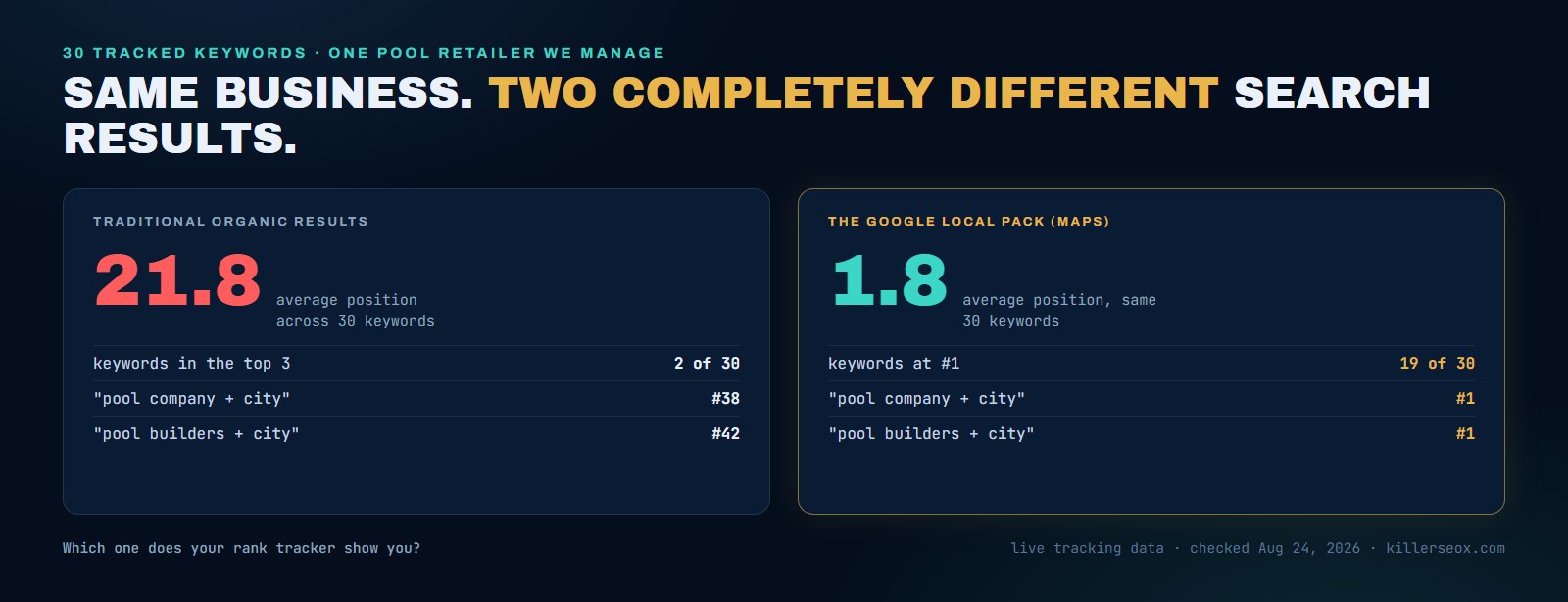
- One pool retailer we manage averages position 1.8 in the map pack across 30 tracked keywords, with 19 sitting at number 1. Its organic average on the same keywords is 21.8. Same business, two completely different search realities.
- The local pack ranks on Google Business Profile signals: categories, reviews, citations, and proximity. Your organic position barely moves it, which is why pack work and website work are different jobs.
- Measure all three surfaces plus AI answers before you spend. A rankings-only view of that pool retailer says mediocre. The full view says they own their market.
What does a Google results page actually look like in 2026?
It depends on intent. Commercial local searches lead with ads and the local pack, and traditional organic starts around position 4 on the page. Informational questions lead with an AI Overview citing a handful of sources. The classic ten blue links exist on both, but they start lower than most owners realize.
We pulled live results this morning for a commercial search in one of our clients' markets, "pool company" plus their city. The local pack held the top spot: three businesses, ratings of 5.0, 4.8, and 4.8, review counts of 46, 253, and 82, each with a call button. The first traditional organic listing appeared at position 4 on the page. No AI Overview appeared at all.
Then we pulled an informational query, and the page flipped. An AI Overview sat on top, a synthesized answer citing nine sources, and no map in sight. Two searches, one market, two completely different pages. Neither looks much like the results page your SEO instincts were trained on.
That flip is the single most useful thing to understand about search this year. Google is not showing everyone the same page with new decorations. It reads intent and swaps the entire top of the page: hire-someone searches get the map, learn-something searches get the AI. Every dollar you spend on visibility lands on one of those surfaces, and they are won with different work.
What is the Google local pack, and why does it win the click?
The Google local pack is the map box with three business listings that tops most local commercial searches. It runs on your Google Business Profile, not your website: categories, reviews, citations, and proximity decide who shows. It wins the click because it answers the whole question, who is near me and can I trust them, without a single website visit.
The pack earns its position honestly. A customer searching "pool company" plus a city is not looking for an essay, they want three vetted options with star ratings and a phone number. Google hands them exactly that above everything else, which is why the businesses in the pack collect the calls while page one of organic argues over the leftovers.
What surprises owners is what the pack does not care about. It is largely indifferent to your website's organic rank. We wrote up why desktop, mobile, and the map pack are three different results, and the pack is the most different of the three: it is a separate index ranked by Google Business Profile signals. Right categories, review velocity and responses, consistent name, address, and phone across the directories that feed Google (we covered what that is worth in the 25-directory citation audit), and how close you physically are to the person searching.
That last one matters more than owners want to hear: the pack you see from one side of town is not the pack from the other side. A single Maps number is an average of neighborhoods you win and neighborhoods you have never appeared in.
Do AI Overviews show up for local searches?
Rarely on commercial ones. Across our fleet's tracking, service-plus-city searches return a local pack and no AI Overview, while informational questions in the same markets trigger AI Overviews regularly. So content cannot win you the hire-me search, and your Google Business Profile cannot win you the AI citation. You need both, for different searches.
This is the split that keeps getting flattened in the "AI is killing SEO" panic. When we check the commercial money terms our clients live on, the AI Overview almost never appears; Google still hands those searches to the map. When we check the questions customers ask on the way to hiring, how to fix this, what does that cost, is this normal, the AI Overview fires constantly.
And those AI answers are not citing nobody. In one client's market, the how-to answer cites YouTube seven times and a national franchise our client competes with directly. The franchise's how-to article earned it a spot inside the AI's answer, in front of a customer who will shortly need exactly what our client sells. That citation was winnable. Somebody else won it.
The AI surface also extends past Google. We check how often six different AI models name each client in buying-intent answers, because ChatGPT and friends have no local pack at all: when a customer asks an assistant who to call, the answer is three names and you are either one of them or invisible. One retail client gets named in 90 percent of those answers. That is a surface most local businesses have never once measured.
Why does one business rank 38 and 1 on the same keyword?
Because organic and the local pack are separate rankings with separate signals. One pool retailer we manage sits at organic position 38 for "pool company" plus their city, and number 1 in the map pack for the identical search. Across their 30 tracked keywords: organic average 21.8, map pack average 1.8, with 19 keywords at pack number 1.
Here is the full picture from our own local rank tracker this week, and it is the reason this post exists. The pool retailer's organic numbers read like a struggling account: average position 21.8, two keywords in the top 3, nine in the top 10. The map pack numbers for the same 30 keywords read like a monopoly: average position 1.8, every single keyword in the pack's top 10, 27 of 30 in the top 3, and 19 parked at number 1.
"Pool builders" plus their city: organic 42, pack number 1. "Swimming pool installation": organic 34, pack number 1. "Pool installers": organic 32, pack number 1. If you judged this business by an organic rank report, you would prescribe six months of aggressive SEO to fix a problem their customers cannot see, because their customers are choosing from the map, where this client is the first name in town.
The reverse mistake is just as expensive. A business that is pack-strong and organic-weak looks fine until customers start their research earlier: comparison searches, cost questions, neighborhood-specific queries where service and town pages still do the ranking. A tracker that shows one blended number hides both failure modes. Ours shows desktop, mobile, and Maps side by side per keyword precisely because of accounts like this one.
Which surface are you actually winning?
The free KillerSEOx audit checks your Google rankings and what six AI models say about your business, in about 60 seconds. It's the same check we run on every client.
Run my free auditWhere should a local business put its effort now?
Match the work to the surface. Win the local pack with your Google Business Profile, reviews, and citations. Win AI Overviews and assistant answers with informational content that answers real customer questions. Keep organic honest with service and town pages. Then measure all three, because the surface you skip is the one a competitor is quietly taking.
For the pack: treat your Google Business Profile like a second website. Exact categories, services listed, photos, posts, and a review ask built into how you close every job, with responses to what comes in. Clean up the directory listings that feed Google's confidence in your data. None of this is glamorous, and it is the highest-leverage local work there is.
For the AI surfaces: publish real answers to the questions your customers ask before they hire, priced honestly and specific to your trade. That is what gets cited, in Google's AI Overviews and in the assistants. The mechanics of being quotable, extractable answers, entity schema, llms.txt, are in the AIO on-page checklist, and the strategy behind the whole discipline is in our AI optimization guide. This is the wedge most competitors have not touched: the citations in your market are being handed out right now, mostly to national sites, because local businesses have not shown up to claim them.
For organic: it still matters, it just is not the whole scoreboard. Organic wins the researcher, the comparer, and the customer outside your pack radius. Service and town pages, a real blog, and internal links that make sense remain the play.
The thread through all three: measure before you spend. One number told us the pool retailer was mediocre. Thirty keywords across three surfaces told us they own their market on the surface that closes jobs, and that their next dollar belongs on the surfaces they have not claimed yet. Every KillerSEOx account, including the free tier, tracks desktop, mobile, Maps, and six AI models side by side, so the picture you act on is the whole page your customer actually sees.
Quick answers
What is the Google local pack?
Do AI Overviews appear for local searches?
How do I get my business into the Google local pack?
Do people still click regular organic results?