SEO Pricing: The Per-Client Math for Agencies
Ask ten agency owners what they charge for SEO and you get ten numbers. Ask them why, and most of the answers boil down to a guess somebody made years ago and never revisited. I price SEO for a living, we publish our numbers on the pricing page, and the math behind them fits on a napkin. This post is that napkin.
Here is the frame. Every SEO retainer is three costs stacked on top of each other: the software that watches the account, the content that feeds it, and the human judgment that decides what happens next. Price below the stack and you quietly stop delivering one of the three. Price way above it with nothing extra in the stack and a competitor eventually does the same work for less. So the honest way to answer "what should I charge" is to know your per-client cost to the dollar, then decide what your judgment layer is worth on top. We will do both, with real numbers.
- SEO pricing is a three-layer cost stack: software, content, and human judgment. Every pricing failure is one of those layers getting silently dropped to protect a number.
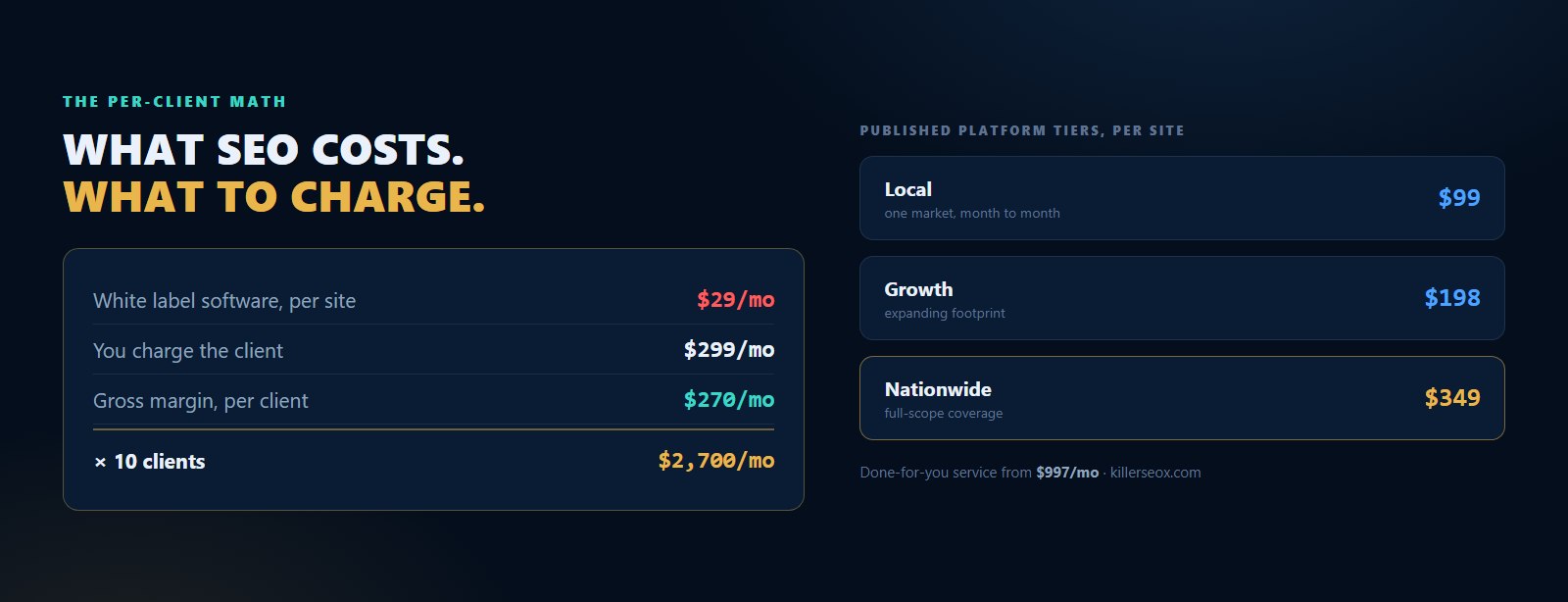
- Real published software pricing runs $29 a month per site white label to $349 a month for a full nationwide plan. Our own tiers are $99, $198, and $349 per site, and done-for-you service starts at $997 a month.
- The monthly retainer beats hourly, project, and performance pricing because SEO compounds monthly. Hourly punishes your own efficiency, and performance deals reward vanity wins over revenue keywords.
- The worked example: white label software at $29, retail at $299, and the gross margin is $270 per client. At ten clients that is $2,700 a month before your time, and your time is the number that decides whether you keep it.
- Reporting should not be a line item. When the platform builds the branded report and live dashboard automatically, reporting is your proof layer at near zero labor, and report day for ten clients is a settings page.
How much does SEO cost in 2026?
Software runs from about $29 a month per site (white label) to a few hundred dollars for a full platform plan. Our published tiers are $99, $198, and $349 a month per site. Human service costs more: our done-for-you tier starts at $997 a month, and agency retainers price above software because you are buying labor and judgment, not just tooling.
The reason SEO pricing feels opaque is that "SEO" names two different purchases. One is software: a platform that tracks rankings, checks AI visibility, audits the site, and queues the work. That market has real, published prices. Ours are on the pricing page: $99 a month per site for a local plan, $198 for growth, $349 for nationwide scope, month to month, no contracts.
The other purchase is service: people operating that machinery for you and making the calls. That is why the same three letters can cost $99 or several thousand a month and both can be fairly priced. Our own done-for-you tier, where our in-house team works the account by hand, starts at $997 a month. The gap between $349 and $997 is not software features. It is payroll and accountability.
When a business owner asks me why one quote was $300 and another was $3,000, that is the answer: one quoted the software layer, the other quoted the whole stack. Neither is lying. They are selling different products, and the buyer's job is to figure out which one they were actually offered.
What are the main SEO pricing models?
Four: monthly retainer, hourly, one-time project, and performance-based. The retainer wins for ongoing SEO because the work compounds monthly. Hourly punishes efficiency, project pricing abandons the site right as momentum starts, and performance deals push vendors toward easy vanity rankings instead of the keywords that produce revenue.
The monthly retainer is the default for a reason. Rankings move in weeks and months, content compounds, and the maintenance work never actually ends. A flat monthly fee matches the shape of the work, gives the client a predictable bill, and gives you predictable revenue to staff against.
Hourly billing has a structural flaw: it charges more when you are slow. As your systems get better, the same outcome takes fewer hours and your invoice shrinks. We run automated action queues that work every account all week, and under hourly billing that efficiency would be a pay cut. Nobody should build a business where improving the product lowers the price.
One-time projects make sense for a genuine one-time job, a site migration, a technical cleanup, an audit. As a substitute for ongoing SEO they fail predictably: the fixes ship, nobody feeds the site afterward, and six months later the rankings drift back while the client concludes SEO does not work.
Performance pricing sounds fair and selects for the wrong behavior. If I only get paid when rankings hit page one, my incentive is to pick keywords I can win easily, not keywords that make you money. The vendor carries the risk, so the vendor picks the battles, and the battles get picked for winnability. Pay for outcomes on ad platforms where attribution is clean. In SEO, pay for the program.
What does it cost to deliver SEO per client?
Three layers. Software: $29 a month per site white label. Content: one to two posts a week on the client's site, produced to a standard a reader trusts. Judgment: the human hours spent reading the account and deciding what happens next. The first is published, the second is a known quantity, and the third is where agencies lie to themselves.
Start with the layer that has a sticker price. White label SEO software runs $29 a month per site under your own brand: rank tracking, AI visibility, audits, the action queue, and branded client reporting. That number is published, so your cost basis is not a mystery, and I walked through the full buy-versus-build comparison in the reselling math post if you are weighing running your own stack instead.
Content is the second layer. The accounts we manage get one to two posts a week, each one built to answer a real query, linked into the money pages, and structured so AI assistants can quote it. Whether you write it in-house, contract it out, or run it on a platform, put a real number on it per client per month. Content is the layer agencies cut first when a retainer is underpriced, and it is the layer the client can least afford to lose, because it is the one that compounds.
The third layer is judgment, and it is the one nobody itemizes. Somebody has to read the account monthly and make calls. Real example from our own fleet this week: one construction contractor shows an average tracked position of 34, which reads like failure, next to 2,321 Google clicks in 28 days, which is the strongest traffic in its cohort. The tracker watches head terms while the site wins long-tail searches nobody thought to track. Software surfaced both numbers, but deciding what that means, and what to do next quarter because of it, is a human sentence in a report. That sentence is what the retainer actually buys.
Add the three layers and you have your per-client delivery cost. For a typical local account run on white label software with a steady content cadence, the software is $29, the content is whatever your source costs, and the judgment layer is an hour or two of real attention a month if your tooling queues the work for you. Most agency owners who do this exercise for the first time discover their cheapest retainer is unprofitable and their most expensive one is underpriced. Both discoveries pay for the napkin.
Want the cost side of your stack to be one number?
KillerSEOx white label runs the tracking, AI visibility, audits, the action queue, and branded client reports for $29 a month per site. See the white label SEO software program, or run a free audit on any client site in about 60 seconds.
Run a free auditWhat should you charge per client?
Cost stack plus your judgment premium, anchored to deliverables the client can see. The worked example we publish: software at $29, retail at $299, gross margin $270 per client, $2,700 a month at ten clients before your time. Charge for the visible program, and let an automatic reporting layer prove it monthly.
Here is the worked example straight off our own agencies page. Take the $29 white label cost, charge the client $299 a month, and the gross software margin is $270 per client. Ten clients is $2,700 a month. That is the floor case, software-only economics, before you price in content and your own hours, and its point is not "charge $299." Its point is that the spread between a known cost and a defensible retail price is where an agency lives, so you should know that spread per client the way you know your rent.
What makes a price defensible is not the number, it is what the client can see for it. A retainer priced against visible deliverables survives renewal conversations that a vague "ongoing optimization" retainer does not. The client should be able to point at posts that published, fixes that shipped, rankings and AI answers that moved, and a report they actually open that says so in ninety seconds. Every deliverable your platform can produce automatically raises what your hours are worth, because the client sees a program running, not a person scrambling.
And price your reporting at zero, deliberately. Reporting is not a product, it is proof. On our platform the branded report and the live white label dashboard generate themselves, which means the proof layer costs you nothing to produce and the whole retainer's credibility rides on it anyway. An agency that spends a weekend a month assembling PDFs is paying payroll to produce the one deliverable software does better.
When should you charge more?
When scope genuinely expands: more territory, more competition, more surfaces to win. That is why our own plans step $99, $198, $349 by scope, not by feature gating. A nationwide services company is a different job than a one-town shop, and pricing that pretends otherwise underdelivers one client or overcharges the other.
Scope is geography first. A business chasing one town needs its map pack, its service pages, and its local citations handled. A business chasing a region or the whole country needs town-by-town coverage, more content, more tracking, and more judgment calls per month. Same discipline, more of it. That is exactly why our published tiers step from $99 to $198 to $349 by scope rather than gating features, and your retainers can follow the same logic without inventing a new pricing philosophy.
Scope is also surface count now. In 2026 an account is not just ten blue links: it is desktop rankings, mobile, the map pack, and what six different AI assistants say when somebody asks for a recommendation. Fleet-wide we watch those surfaces disagree constantly. One pool retailer we manage holds nine top-10 keywords while its average tracked position sits around 22, and the AI answers tell a third story entirely. More surfaces means more to win, more to watch, and more to explain, and the retainer should reflect it.
The last multiplier is competition. Ranking a specialty contractor in a modest market and ranking anything in a saturated metro are different quarters of work. Look at the competitive picture before quoting, not after the third flat month. A free audit that shows the gap between the prospect and the incumbents is the cheapest pricing research you will ever run, and it doubles as the sales conversation.
If you run an agency, or you are about to price your first retainer, the whole stack behind this math, the tracking, the AI visibility checks, the action queue, and the branded reporting, ships on every KillerSEOx account, free tier included. Know your cost stack, then charge for your judgment. That is the entire secret.
Quick answers
How much does SEO cost per month?
What is the most common SEO pricing model?
Why is cheap SEO usually a bad deal?
How much should an agency charge for SEO reporting?