White Label SEO Reports Clients Actually Open
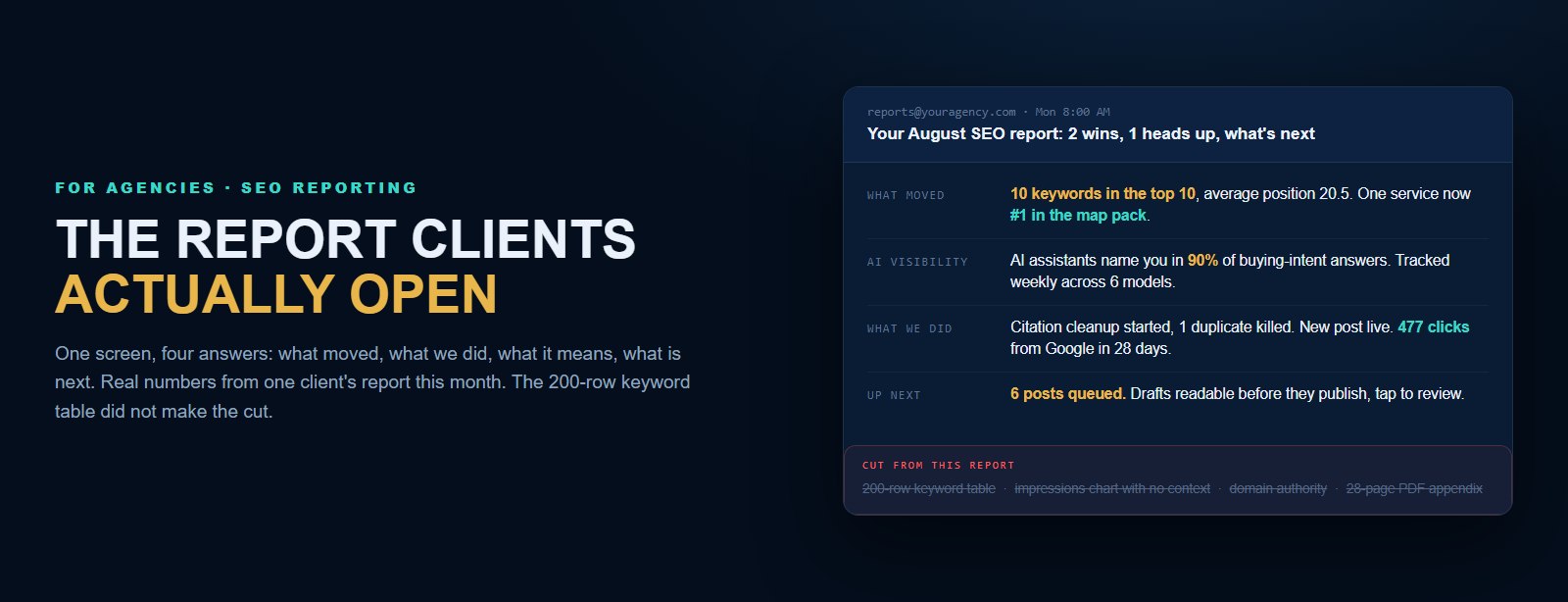
Every agency owner has lived this call. A client six months into a retainer asks what they are actually paying for, and you know for a fact that the answer went to their inbox on the first of every one of those months. Twenty-eight pages of it. The problem was never that you failed to report. The problem is that nobody on earth reads that report, and deep down you would not read it either.
We send white label SEO reports for the twenty or so businesses we manage, and we rebuilt ours this year around one blunt observation: clients do not want a report, they want four answers. What moved. What you did. What it means. What is next. Everything in the report that serves those four answers earns its place. Everything else is padding that costs you the read. This post is the include list, the cut list, the sending schedule, and the honest case for retiring the PDF, with real numbers from our own client reports this month.
- A white label SEO report needs exactly four sections: what moved, what we did, what it means, and what is next. If a client can read it in ninety seconds and repeat it to a business partner, it worked.
- Cut the 200-row keyword table, uncontexted impressions charts, and third-party scores like domain authority. Summarize rankings as counts and deltas: keywords in the top 10, what moved since last month, and on which surface.
- Report AI visibility. One client of ours gets named by AI assistants in 90 percent of buying-intent answers while its average Google position sits around 20. A rankings-only report hides its biggest asset.
- Send a short branded email monthly on a fixed day, backed by a live white label dashboard the client can open any day. The email is the summary, the dashboard is the proof, and the PDF is retired.
- Never let a favorable average hide the truth. One account's average position jumped 18 spots in a week with zero new top-10 rankings. Report the why or the number will eventually embarrass you.
Why does nobody read SEO reports?
Because most SEO reports answer the agency's question, "how do we prove we worked," instead of the client's question, "is my business doing better." Data dumps, jargon, and tool exports signal effort without communicating anything. A report a business owner cannot repeat to their partner in two sentences did not communicate.
The unread report is not a laziness problem. Business owners read plenty: their P&L, their job board, their reviews. They skip the SEO report because experience taught them it contains no decisions. It is a keyword table they cannot evaluate, a traffic chart with no verdict attached, and a glossary of somebody else's job.
There is also a trust tell hiding in the format. A report stuffed with every metric a tool can export reads like a report hiding something, because it usually is. When rankings are flat, the 28-pager suddenly leads with impressions. Clients may not know SEO, but they know spin when they smell it, and the defensive report is how retainers die politely.
The fix is not better charts. It is answering the four questions the client actually has, in their language, and having the discipline to stop there.
What should a white label SEO report include?
Four sections: what moved (ranking counts and deltas plus AI visibility, with the why), what we did (the work log in plain English), what it means (your verdict in one paragraph), and what is next (the upcoming work, including readable content drafts). Under your brand, with your logo and domain on it.
What moved. Summarize rankings as counts a human can hold: keywords in the top 10, the biggest individual moves, and which surface moved, because desktop, mobile, and the map pack are three different results. Then attach the why. This month one of our accounts, a carpet cleaner, posted an average position improvement of 18 spots in a single week while its top-10 count stayed at exactly zero. Both numbers are true. Reported alone, the first one invites a celebration nobody earned; the honest line says new long-tail keywords entered tracking and the money terms have not moved yet. Write that sentence. It costs you a little shine today and buys you credibility for the month something genuinely breaks your way.
AI visibility belongs here too. We track how often six AI models name each client in buying-intent answers, checked weekly, and it regularly tells a different story than Google does. One retail client gets named in 90 percent of AI answers in its market while its average Google position sits around 20. A rankings-only report would show that client a mediocre month and skip its single biggest marketing asset. In 2026 that is malpractice.
What we did. The work log, in plain English, from a system that logged it as it happened. Ours comes straight off the action queue each account runs all week: citations cleaned, a duplicate listing killed, a post published, a technical fix shipped. Specific beats voluminous. Three real completed items outsell ten vague ones like "ongoing optimization," which is agency Latin for nothing in particular.
What it means. One paragraph, written by a person, rendering a verdict: ahead, on track, or behind, and why. This is the paragraph the client actually pays for, and most reporting software cannot write it. If you write nothing else by hand, write this.
What is next. The upcoming work, with dates. For content, that means drafts the client can actually open and read before publish day. We shipped readable drafts after clients asked, reasonably, why approving a post required taking it on faith. "Two posts queued, tap to read them" turns the report from a rearview mirror into a steering wheel.
What should you cut from your SEO report?
The full keyword table, impressions charts without context, third-party scores like domain authority, screenshots of tool interfaces, and the glossary. The test for every element: does this change what the client believes or decides? If not, it is padding, and padding is what stops the next report getting opened.
The 200-row keyword table goes first. It exists so the agency can point at it, not so the client can read it. Keep the full table one click deep in the dashboard for the rare client who wants it, and summarize it in the email for everyone else.
Uncontexted charts go next. An impressions graph pointed up and to the right feels like progress and often means Google tested the site against queries it did not deserve yet. If a chart needs a caveat to not mislead, either write the caveat or cut the chart. There is no third option that keeps your credibility.
Third-party vanity scores like domain authority are a trap you set for yourself. The client cannot buy anything with them, and the first month the score dips you will be explaining a number you never controlled to a client who now watches it like a stock ticker.
And the raw numbers that need a story should either get the story or get cut. This month one of our construction clients shows an average position of 37, which reads like failure, next to 2,582 Google clicks in 28 days, which is the best traffic in its fleet cohort. Both facts in isolation mislead; together they say the site wins real customers on searches far beyond the tracked head terms. That is a sentence worth writing, and it only exists because a human looked at both numbers.
Reselling SEO under your own brand?
KillerSEOx runs the tracking, the AI visibility checks, the work log, and the branded client reports from one platform. See the white label SEO software program, or run a free audit on any client site in about 60 seconds.
Run a free auditHow often should SEO reports go out?
A short branded email monthly, on the same day every month, scheduled and automatic. Weekly reporting oversamples a channel that moves in weeks and months, trains clients to worry about noise, and quietly doubles your account management load. The live dashboard covers the client who wants to check in between.
Monthly is the right cadence because it matches the speed of the channel. SEO moves in weeks and months, and a weekly report of a monthly process is mostly noise with a logo on it. Worse, it invites the client to manage the noise: rankings wobble daily, and you do not want a Tuesday phone call about a Monday fluctuation that reversed itself by Thursday.
The day matters more than people think. A report that lands the first Monday of every month becomes a habit; a report that lands whenever someone remembered to export it becomes a surprise. Habits get opened. Schedule it in software and take your own memory out of the loop. Ours go out automatically under each agency's brand, and the send day is a setting, not a task on somebody's list.
One more honest rule for the early months, when the report is mostly inputs: say so. "Rankings have not moved yet, here is the work shipping anyway" is a sentence clients respect, because every owner knows what building looks like. The alternative, hiding a flat quarter behind an impressions chart, works precisely once.
Should the report be a PDF or a live dashboard?
Both, in a specific shape: a live white label dashboard as the source of truth, and a short scheduled email as the monthly summary that links into it. The standalone PDF is the worst of both worlds: stale the day it lands, unreadable on a phone, and invisible to you once sent.
The PDF survived this long because it feels like a deliverable. It has heft. But it is stale before it is opened, it reads terribly on the phone where your client actually is, and it gives you zero signal about whether anyone looked. Every client on our platform gets a live branded share link instead: current rankings, AI visibility, completed work, and upcoming content, readable any day of the month, not just reporting day. The monthly email becomes a summary with somewhere to point.
For an agency, the white label part is what makes this scale. The dashboard carries your logo and your domain, the emails send from your brand, and the client never sees the machinery underneath, which is exactly how it should work when your name is on the retainer. We priced that model out against running your own tool stack in the reselling math post, and reporting is where the hours difference shows up first: report day for ten clients is a settings page, not a weekend.
The uncomfortable question agencies ask about live dashboards is what happens in a bad month, when the client can see the dip without the spin. That transparency is the feature. A client who watches a real number wobble and recover with you stops treating every dip as an emergency, and the report stops being a defense document. If your reporting strategy depends on the client not looking, the reporting is not the problem.
If you run an agency, or you are the one person doing SEO for a business and reporting to yourself, the whole stack behind this post, rank tracking, AI visibility, the action queue, and the branded reports, ships on every KillerSEOx account, free tier included.
Quick answers
What is a white label SEO report?
Should SEO reports include keyword rankings?
What software do agencies use for client SEO reports?
How do you report SEO progress when rankings have not moved yet?