SEO Audit Checklist: The 21 Checks and Where Real Sites Fail
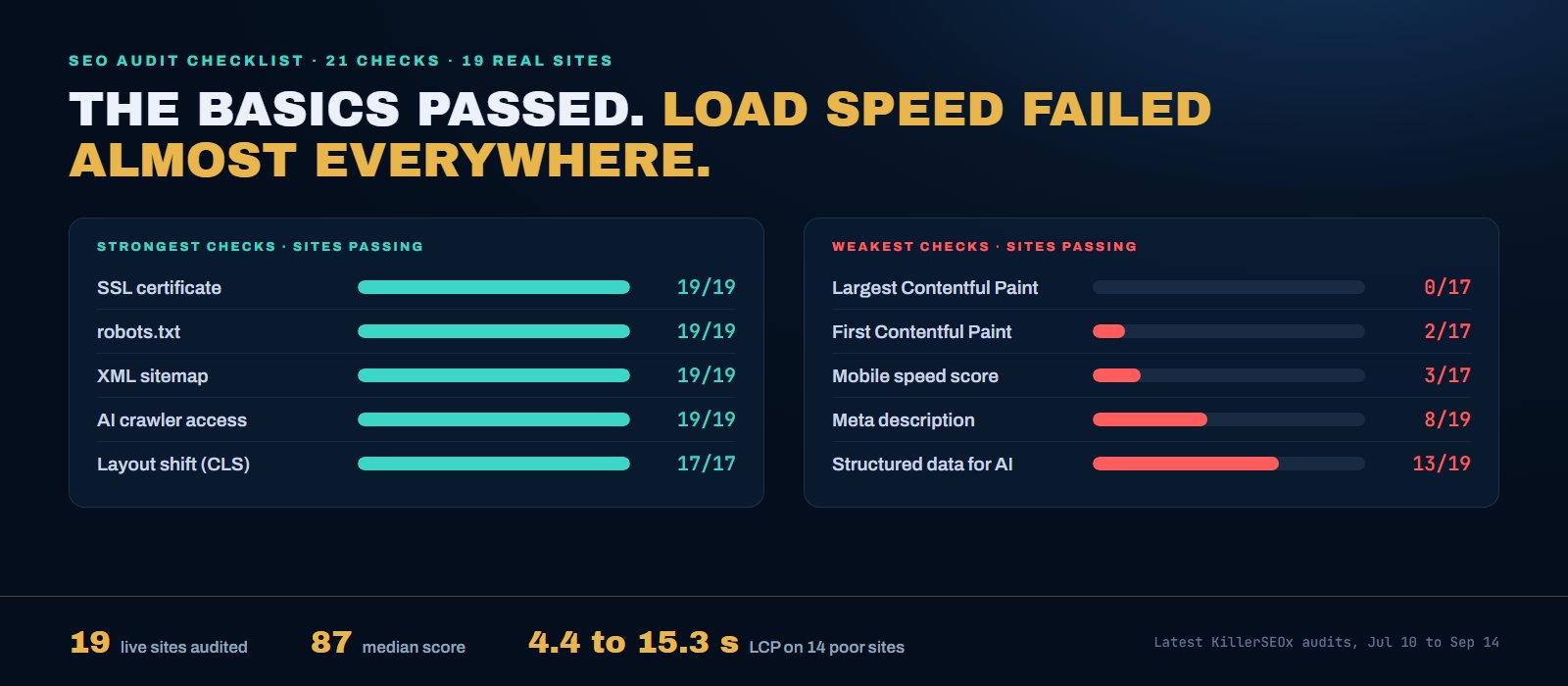
Every SEO audit tool hands you a score. Almost nobody explains what's underneath it, or which of the checks actually matter. So I pulled the most recent audit on 19 live sites we track and lined up all 21 checks side by side.
The results split in a way I didn't fully expect. The technical basics were close to perfect across the board. Page speed was a wreck on nearly every site. And the median overall score was 87, which tells you how little a score says on its own. Here's the whole checklist, what each check really tests, and where real sites fail it.
- An SEO audit is a snapshot of how one page loads, reads and signals to search engines and AI crawlers. Ours runs 21 checks across technical, on-page, speed and AI readiness.
- Across 19 real sites, the technical checks almost never fail. SSL, robots.txt, the XML sitemap and the mobile viewport passed on all 19.
- Page speed is where sites break. Not one of the 17 sites with a speed reading passed Largest Contentful Paint, and only 2 passed First Contentful Paint.
- The meta description was the most failed on-page check, passing on 8 of 19. Too long was the usual miss, but one site had 10 characters and one had none at all.
- A high score is not a clean site. The median was 87, and nearly every site at that score still had a red speed check.
What is an SEO audit, really?
An SEO audit is a structured check of how a page performs for search engines: whether it can be crawled and indexed, whether its titles and markup are right, how fast it loads, and now whether AI crawlers can read it. A good one tells you what failed, why it matters and what to fix first.
There are two kinds. A consultant's deep dive crawls every URL and reads the backlink profile by hand. An automated audit runs a fixed set of measured tests on one URL in about a minute. They answer different questions.
Ours is the second kind. It checks one URL, usually the homepage, against 21 checks and rolls them into category scores and one overall number. If you want a tool roundup, see which free SEO tools are actually free. This post takes a real report apart line by line.
One honest limit before we start. An audit measures hygiene. It doesn't tell you where you rank, who outranks you, or whether anyone links to you. Rankings take a local rank tracker. Keep that in mind any time a score looks good.
Which SEO audit checks do real sites fail most?
Speed checks, by a wide margin. Across the latest audits on 19 live sites, zero of 17 measured sites passed Largest Contentful Paint, 2 passed First Contentful Paint and 3 passed the mobile performance score. The meta description came next at 8 of 19. Nearly every technical check passed everywhere.
Here's the whole board. These are the most recent audits on 19 sites: 15 client sites across home services, the trades and retail, plus four of our own properties. They ran between July 10 and September 14. Two of the sites wouldn't complete Google's PageSpeed test, so the five speed checks cover 17 sites, not 19.
| Check | Group | Passed |
|---|---|---|
| SSL certificate | Technical | 19 of 19 |
| robots.txt | Technical | 19 of 19 |
| XML sitemap | Technical | 19 of 19 |
| Mobile responsive | Technical | 19 of 19 |
| Canonical tag | Technical | 18 of 19 |
| Server response time | Technical | 16 of 19 |
| Title tag | On-page | 15 of 19 |
| Meta description | On-page | 8 of 19 |
| Heading structure | On-page | 18 of 19 |
| Image alt text | On-page | 18 of 19 |
| Schema markup | On-page | 18 of 19 |
| Social meta tags | On-page | 18 of 19 |
| Largest Contentful Paint | Speed | 0 of 17 |
| First Contentful Paint | Speed | 2 of 17 |
| Mobile performance score | Speed | 3 of 17 |
| Total Blocking Time | Speed | 11 of 17 |
| Cumulative Layout Shift | Speed | 17 of 17 |
| AI crawler access | AI | 19 of 19 |
| Structured data for AI | AI | 13 of 19 |
| Content depth | AI | 16 of 19 |
| llms.txt | AI | 16 of 19 |
Overall scores ran from 65 to 94. The median was 87, and 18 of the 19 sites scored 83 or higher.
Now read that next to the speed rows. A site can score in the high 80s and still take 15 seconds to show its main content on a phone. The score averages the good news with the bad, and the bad is what costs you visitors.
What do the technical SEO checks test?
The six technical checks confirm a search engine can reach and trust the page: a valid SSL certificate, an accessible robots.txt, an XML sitemap, a mobile viewport tag, a canonical tag and a quick server response. They are the foundation. If one of them fails, fix it before anything else on the list.
- SSL certificate. HTTPS with a valid certificate. Browsers warn people away from sites without one.
- robots.txt. The file that tells crawlers what they're allowed to fetch. We check that it loads and doesn't shut the site out.
- XML sitemap. The list of URLs you want found. We check that it exists and count what's in it.
- Mobile responsive. A viewport meta tag, the minimum sign that the page was built with phones in mind.
- Canonical tag. The page's preferred address, so the same content on two URLs doesn't split its signals.
- Server response time. How quickly the server starts answering. Our slowest was 1,072 ms, which failed. Two others at 615 and 655 ms got a warning.
Why does almost everybody pass? Modern hosting and site builders ship most of this by default. That's good news. It's also why a technical score of 100 shouldn't make anyone feel finished.
The check that can still fool you here is the sitemap, and not because it's missing. Our own audit in July said our sitemap passed, with 1 URL in it. The file existed, so it passed. It was also close to useless. Today it lists 28 URLs, because we add every new page to it by hand, and in September we caught a post that had been left out. I told that story in the Bing IndexNow post. A pass means the file is there. Open it and read it.
What does an on-page SEO audit catch?
The on-page checks read what a page tells search engines about itself: the title tag, meta description, heading structure, image alt text, schema markup and the Open Graph tags used for social sharing. On real sites these fail on length far more often than on absence. The meta description is the most common miss.
The meta description passed on only 8 of 19 sites, and the failures came in three shapes.
- Too long. Seven sites ran from 163 to 352 characters. Google trims long descriptions, so the end of your pitch never shows up.
- Too short. Three sites had 10, 22 and 87 characters. Ten characters isn't a description. It's a placeholder somebody forgot to replace.
- Missing. One site had none, which leaves Google to write your snippet from whatever text it finds on the page.
Title tags did better, passing on 15 of 19. Three ran long at 68 to 72 characters, and one page had no title tag at all. In my experience a long title is often the template's fault, not the owner's. Plenty of themes and SEO plugins tack the business name onto the end of every title, so a sensible 50 character headline ships at 70. Fix the template, not the headline.
Everything else in this group passed on 18 of 19. One site had two H1 headings. One had 2 of its 20 images without alt text. The missing schema and the missing social tags both came from the same site, the one that scored 65, which also had no title tag, no meta description and no canonical. When a site misses the basics, it tends to miss them all at once.
See your own 21 checks
Run the free KillerSEOx audit on your homepage. It takes about 60 seconds, needs no card, and shows you exactly which of these rows your site passes.
Run my free auditWhy do so many sites fail the page speed checks?
Because the main content is heavy. Largest Contentful Paint measures when the biggest visible element, usually a hero image or slider, finishes loading in Google's PageSpeed test. Google's good threshold is 2.5 seconds. Across 17 real sites the fastest was 2.6 seconds and the slowest was 15.3. Oversized images and render-blocking scripts are the usual suspects.
This is the ugliest row on the board. Fourteen of the 17 sites were rated poor on LCP, somewhere between 4.4 and 15.3 seconds. The other three were close but still over the line at 2.6, 2.7 and 2.9 seconds. Not one passed.
First Contentful Paint, the moment anything at all shows up on screen, passed on 2 of 17. The mobile performance score passed on 3.
Two rows tell you where the problem isn't. Cumulative Layout Shift passed on all 17, so these pages aren't jumping around while they load. Total Blocking Time passed on 11, so most of them respond fine once they arrive. The pages are stable. They're just heavy. That usually comes down to pictures: a full size photo straight off a camera or a stock site, dropped into a hero section and served to a phone on a cell connection.
Most of these are good looking sites built by people who cared. The big beautiful image that sells the business is the same image that makes the page slow.
Our own site isn't exempt. KillerSEOx came in at 5.7 seconds on LCP in July, and that was the one red row on our report.
What does an AI readiness audit check?
Four things: whether robots.txt lets AI retrieval crawlers like OAI-SearchBot and PerplexityBot in, whether the site publishes an llms.txt file, whether its structured data includes the business and FAQ schema types our audit looks for, and whether the page has enough real content to quote. These are the newest checks on the list.
AI crawler access passed on all 19. A site generally only fails this one if somebody went out of their way to block those bots, so a pass is the normal state.
llms.txt was on 16 of 19, and that number is high for a reason. Adding one is part of how we set up the sites we manage, so this row reflects our process more than the wider web, where the file is still rare. If you want the full walkthrough, the AIO on-page checklist covers llms.txt and entity schema step by step.
Structured data for AI passed on 13, and the misses were specific. Two sites had LocalBusiness schema and no FAQ schema. One had FAQ schema and no LocalBusiness. Two had other schema but neither type, and one had none at all.
Content depth passed on 16. Three homepages came in between 696 and 746 words, just under the 800 word line our audit uses. Treat that line as a nudge, not a law. A homepage that says clearly who you are, what you do and where you do it beats a padded one. For the bigger picture on why any of this matters, start with what AIO is and how AI visibility tracking works.
What did our own SEO audit find, and what did we fix?
Our July audit scored killerseox.com an 87, with 15 passes, 5 warnings and 1 fail. Since then the meta description went from 189 characters to 160, FAQ schema went onto the homepage, and the sitemap grew from 1 URL to 28. The slow LCP is still open, and we chose to ignore one warning on purpose.
I'd rather show you ours than only talk about everyone else's. On July 13 the audit gave killerseox.com an 87: technical 100, on-page 92, speed 74, security 100 and AI 73. Here's what happened to each red and yellow row, checked against the live site this morning.
- Meta description, 189 characters. Fixed. It's 160 today.
- Structured data for AI, no LocalBusiness or FAQ schema. Half fixed, on purpose. The homepage carries FAQ schema now. We didn't add LocalBusiness, because we're a software product sold nationwide, not a storefront. Adding a business type that doesn't describe us just to quiet a warning would be the wrong fix.
- Content depth, 746 words. The homepage has changed a lot since July. The next audit will tell us where it landed.
- First Contentful Paint at 2.1 seconds and a mobile score of 74. Warnings, and both tie back to the next row.
- Largest Contentful Paint, 5.7 seconds. The fail. Still open, and it's the one I care about most.
That list is the real lesson of any audit. Not every warning deserves a fix. The ones that matter change what a visitor actually experiences, and on almost every site we looked at, that's speed.
An audit is a list, though, and a list doesn't prioritize itself. Turning findings like these into ranked, weekly work is what our SEO action engine does. If you run audits for clients, I wrote up how we use one to open sales conversations in the 60-second close, and our white label SEO software puts your name on the report instead of ours.
Want to see which of these 21 rows your site passes? Run the free audit on your homepage, or start on the free tier and keep watching the numbers week to week. Then go open your sitemap and look at your hero image. Those two alone will tell you a lot.
Quick answers
How long does an SEO audit take?
How much does an SEO audit cost?
Can ChatGPT do an SEO audit?
How often should you run an SEO audit?
Does a high SEO audit score mean my site will rank?