Past 10 Clients: When the Math Says Automate, Hire, or Raise Prices
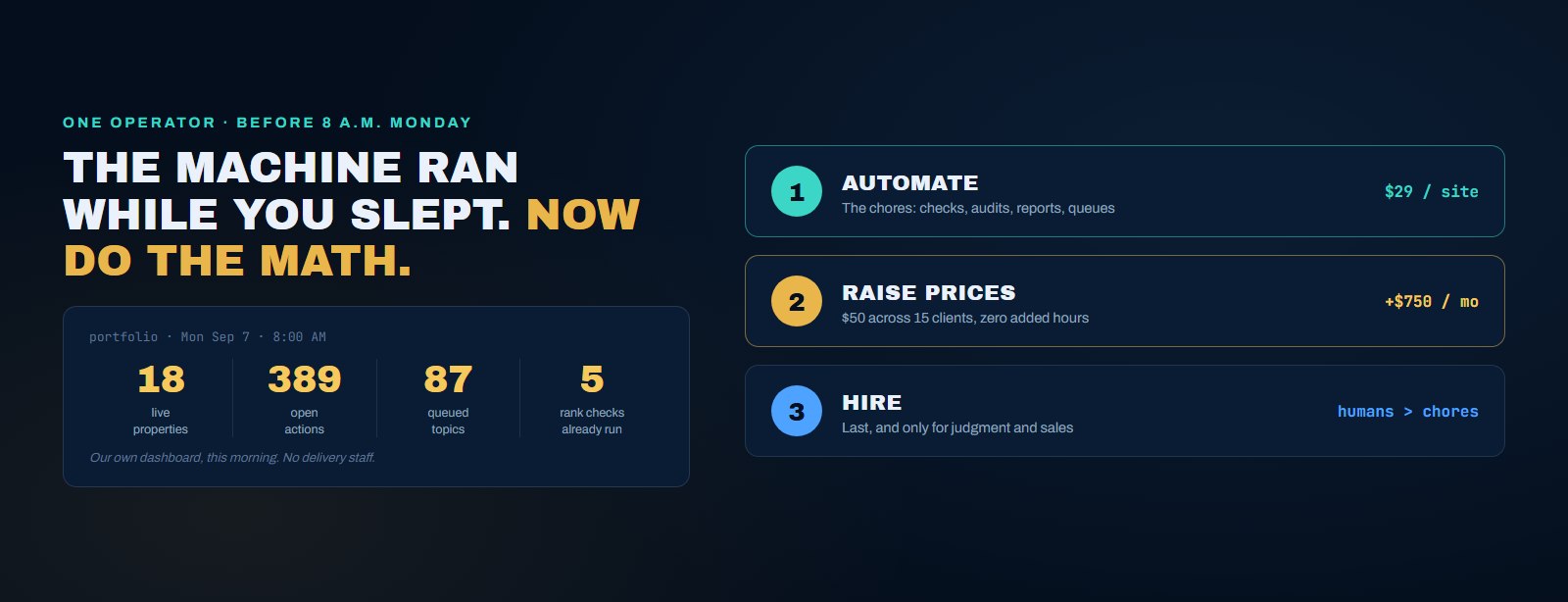
There is a wall in this business, and it shows up somewhere between client number 10 and client number 15. Not because the work gets harder. Because the same fixed chores you happily did for five clients now run twelve to fifteen times a week, and the calendar simply runs out. Every operator who hits it reaches for one of three levers: automate the delivery, hire someone, or raise prices. Most pick the wrong one first.
I can write about this with real numbers because we run the machine ourselves. This Monday morning, before 8 a.m., our own dashboard was already holding 18 live properties, 389 open action items, and 87 queued blog topics, with fresh rank checks completed on 5 of those properties while I was pouring coffee. No employee did that. Here is the math behind each lever, and the order that actually works.
- SEO delivery breaks past 10 clients because the chores scale linearly: every signing adds the same rank checks, audits, reports, and monitoring, and those hours come out of the same workweek.
- Automation is the cheapest lever by an order of magnitude. At our published $29 per site white label price, software for 100 clients costs less per month than any full-time hire you could make.
- Hire for judgment, relationships, and sales. Never hire to do chores a machine does better, because that converts your cheapest problem into your most expensive one.
- Raise prices when you are at capacity and demand keeps coming. A $50 bump across 15 retained clients is $750 a month for zero added hours, and the clients who leave over it were your least profitable ones.
- The order that works: automate first, raise prices second, hire last, and only when the human work, not the chore work, is the bottleneck.
Why does everything break after 10 clients?
Because SEO delivery is mostly fixed, repeating chores, and chores scale linearly. Every new client adds the same weekly rank checks, monthly audits, report assembly, and monitoring. At 5 clients those hours fit around the real work. At 12, the chores are the workweek, and growth stalls exactly when sales are going well.
Walk through one client's month honestly. Check their rankings, ideally weekly, across desktop, mobile, and Maps. Re-run their technical audit. Check what the AI models are saying about them, because that is a ranking surface now too. Assemble a report a human will actually open. Read their Search Console for anything on fire. Keep their content pipeline moving. None of it is hard. All of it is non-negotiable, and every line of it repeats for every client, every cycle, forever.
That is the trap nobody warns you about when the first ten signings come easy. Revenue scales with client count, but so does every chore, at exactly the same rate. There is no efficiency of scale in manual delivery. The fifteenth client's Tuesday rank check takes just as long as the first client's did, and it lands on the same Tuesday.
I watched the numbers on our own board while writing this. One construction contractor is sitting on 72 open action items right now. One roofing client has 17 approved topics queued out for months. Multiply that texture across 18 properties and you have the honest picture of what "just handle delivery manually" means. Nobody reads 18 Search Console accounts before lunch. So the question is not whether something has to give. It is which lever you pull, and in what order.
What does SEO automation actually replace?
The repeating, judgment-free work: rank tracking on a schedule, technical audits, AI visibility checks across models, report assembly, and turning all of that data into a prioritized action queue. It does not replace strategy, client conversations, or the decisions about what a business should say. It buys those hours back.
The word automation scares owners who picture robo-content and spam. That is not what wins here. What wins is automating the monitoring and the paperwork, the layer of delivery that has one right answer and no judgment in it. A rank check is a rank check. There is no artisanal way to fetch position data on 30 keywords, and doing it by hand adds nothing but hours.
Here is what that layer looked like on our own stack this morning, one operator, no delivery staff:
Every one of those numbers used to be a human task at some agency. The rank checks ran on schedule overnight. The action engine read the audits, the rankings, and Search Console, and queued the 389 items in priority order, so the human work starts at "which of these matter most," not "go find out what is wrong." The weekly AI visibility checks ran across six models without anyone typing a prompt. And when a client asks how things are going, the report is already assembled under the agency's own brand, which is the part clients actually open.
The cost side is what makes this the first lever. Our white label SEO software runs $29 per site per month, published right on the pricing page. One hundred clients on that plan is $2,900 a month. There is no full-time hire anywhere in this country that costs less than that, and the software does not call in sick, quit for a competitor, or need six weeks of training on your reporting format.
When is hiring the right answer?
Hire when the human work is the bottleneck: strategy calls you cannot fit, sales conversations you are turning away, relationships going cold from neglect. A hire multiplies judgment and trust. A hire doing chores a $29 tool handles is the most expensive way to solve your cheapest problem.
Hiring is the lever operators reach for first, because it feels like what real businesses do. Sometimes it is exactly right. If you are turning away discovery calls, if retained clients have not heard your voice in a month, if proposals sit unwritten while you assemble reports, then the constraint is human hours doing human work, and only a human fixes that.
But run the test honestly: write down what the new hire would actually do all week. If the list reads "check rankings, update reports, monitor Search Console, keep the content calendar moving," you are about to pay a salary for chore work, then spend your own hours managing the person doing it. The math never recovers. A delivery hire has to clear their fully loaded cost every month before they add a dollar, and the work they are doing is the exact work software does for $29 a client.
The hires that pay are the ones automation cannot touch. Someone who runs client calls well. Someone who closes. Someone whose judgment you trust on what a roofing company should say to a nervous homeowner. When you do make that hire, the automated layer is what makes the seat productive on day one, because the new person inherits dashboards, queues, and reports instead of a pile of tribal knowledge in your head.
When should you raise prices instead?
Raise prices when you are at capacity, demand keeps coming, and your delivery already justifies more than you charge. A $50 increase across 15 retained clients adds $750 a month with zero added hours. If a client leaves over $50, they were priced at the edge of leaving anyway.
This is the forgotten lever, and it is pure margin. Most operators price their SEO retainers when they are hungry, in year one, and never touch the number again. Three years later they are delivering three times the value, with weekly data and AI visibility tracking their competitors do not offer, at the hungry price. We wrote up the full per-client pricing math separately, but the short version: if your pipeline is full and your churn is low, your prices are telling you they are too low.
The reason raising prices belongs ahead of hiring in the order is risk. A price increase on existing clients costs you nothing to try and takes effect next invoice. A hire is a five-figure annual commitment that has to be right. And the two levers compound: automated delivery gives you the report quality and the week-by-week receipts that make the increase defensible in one email. You are not asking for more money for the same thing. You are pointing at a delivery stack the client can see.
There is a second-order effect worth naming. The clients most likely to walk over a small increase are usually the loudest, lowest-margin accounts. A modest raise quietly re-sorts your roster toward the clients worth keeping, which is a capacity gain all by itself.
See the delivery stack before you price it
The free KillerSEOx audit shows you exactly what the automated layer catches on a real site, yours or a prospect's. About 60 seconds, no card.
Run my free auditWhat does the per-client math look like at 25 clients?
At our published prices: 25 clients on white label software costs $725 a month. Billing those clients a typical $299 each brings in $7,475, leaving $6,750 of gross margin before your labor. The software line grows $29 at a time, so the margin per client holds at scale instead of eroding.
Numbers, since this is a math post. These are our published prices, not a hypothetical: $29 per site white label, and $99, $198, and $349 direct tiers, with done-for-you at $997. The reselling math we published earlier works one client at a time: $29 in software, billed at $299, is $270 gross before your hours.
Now push it past the wall. At 10 clients that is $2,700 a month gross, and at 25 clients it is $725 in software against $7,475 billed, or $6,750 gross. Here is the part that matters for the scaling decision: the software line is the only delivery cost that grew, and it grew linearly at $29 a step. Manual delivery grows at the same linear rate but in your hours, which are capped and already spent. Payroll grows in five-figure annual steps. Automated delivery is the only one of the three whose growth curve you can actually afford to ride from 10 to 25 without changing anything else about the business.
That is also why the margin question and the capacity question are the same question. The operator doing manual delivery at 25 clients does not exist, or exists briefly and burns out. The operator with a delivery hire at 25 clients is fine but gave up a large slice of that $6,750 to payroll. The operator on automated delivery keeps the margin and spends it deliberately, on the sales hire, on the price hold for a strategic account, on profit.
What order should you pull the levers in?
Automate first, because it is the cheapest and reversible. Raise prices second, once automated delivery gives you the receipts to justify it. Hire last, and only for human work: strategy, relationships, and sales. Each lever makes the next one work better, and running them in reverse order is how agencies stall.
The sequence matters more than any single lever. Automate first because $29 a client is the cheapest capacity you will ever buy, and because it is reversible: if a tool disappoints you, you cancel it, which is not a conversation you get to have with an employee. Automating first also generates the artifact you need for lever two, a delivery stack with visible, weekly output.
Raise prices second, armed with those receipts. Then, when the freed hours fill up again, notice what they filled up with. If it is strategy calls and sales conversations, congratulations, that is the good bottleneck, and now a hire multiplies a working machine instead of propping up a broken one.
We built KillerSEOx as the first lever, and we run our own agency on it, which is where every number in this post came from. If you are staring at the wall right now, start where the math starts: put one client on the free tier and watch what the automated layer catches this week, or look at the agency plan next to whatever your delivery hours currently cost you. The wall does not move on its own.
Quick answers
Can SEO be fully automated?
How much does SEO automation cost?
How many SEO clients can one person handle?
Will clients notice the work is automated?