AI Reputation Management: Do Reviews Actually Move AI Answers?
Every agency selling AI visibility right now is telling clients the same thing about reviews. Get more of them, keep the rating up, and the assistants will start recommending you. It sounds obvious. We went and measured it on our own book of business, and it is not what the data says.
We check six models every week for every client we manage: ChatGPT, Claude, Gemini, Perplexity, Grok and Meta Llama. Each one gets a set of real customer questions, the kind a person actually types, and we record whether the client's business gets named in the answer. That store now holds 11,580 checks across 544 prompts going back to March. This post uses the most recent four weeks, Aug 24 to Sep 21, 2026, which is 3,646 answers.
Then I pulled every one of those businesses' live Google review counts and ratings and lined the two up. Nobody is named below. Trades and regions only.
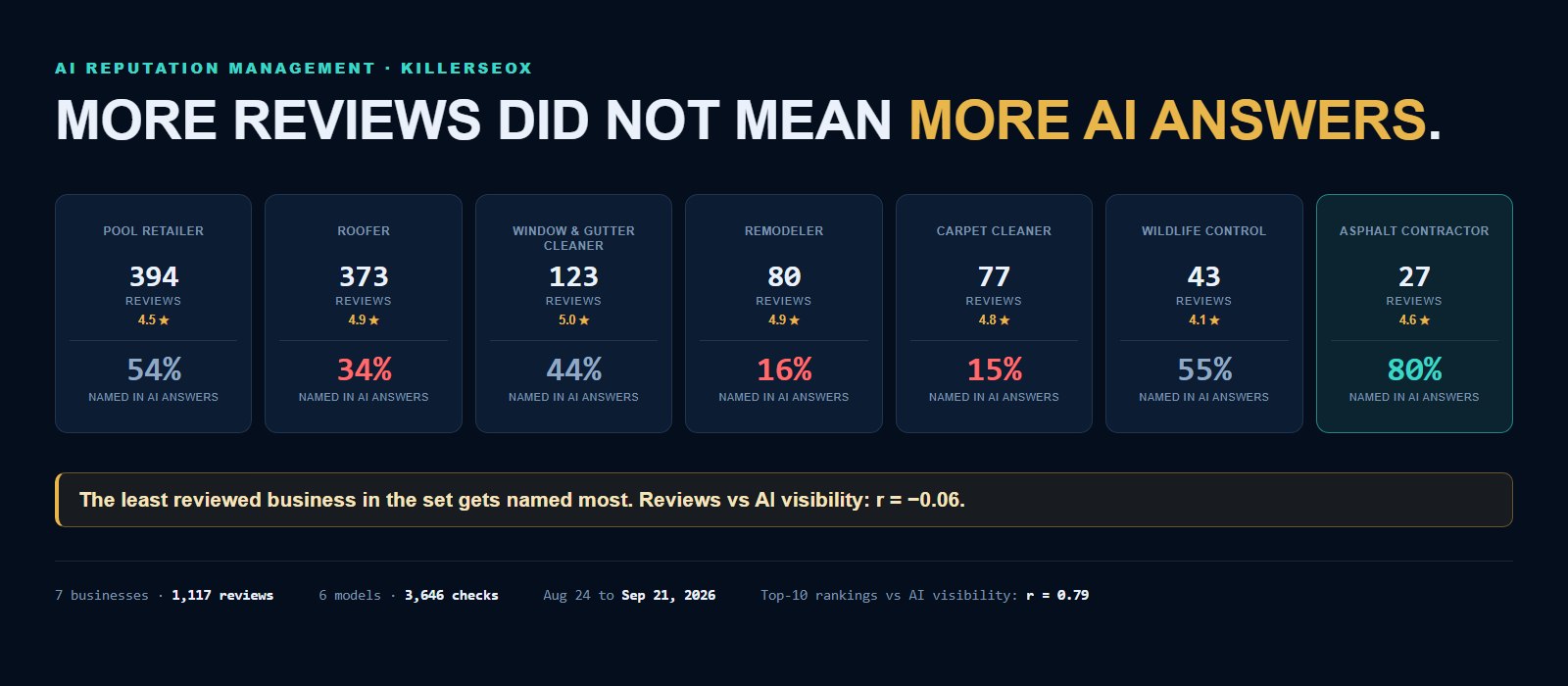
- Across seven businesses holding 1,117 Google reviews between them, review count and AI visibility correlate at r = −0.06. That is nothing.
- The most reviewed business in the set, 394 reviews at 4.5 stars, gets named in 54% of answers. The least reviewed, 27 at 4.6, gets named in 80%.
- What does predict it: organic rankings. Across 16 businesses, top ten keyword count correlates with AI visibility at r = 0.79.
- In 4,458 stored answer excerpts, a review platform gets named 1.7% of the time. The Better Business Bureau came up more often than Yelp, Angi, Facebook and Thumbtack combined.
- Model spread matters more than most agencies report. Perplexity named clients in 30.8% of answers, Grok in 43.1%, on the same questions in the same week.
What is AI reputation management?
Managing what AI assistants say about a business when a customer asks them for a recommendation. It overlaps with review management but it is a different job. Review management works on ratings and replies. AI reputation management works on whether the assistant names the business at all, which in our data is driven far more by search visibility than by review volume.
The category got named before anybody measured it, which is how we ended up with a whole industry assuming it is review management with a new label. The assumption is reasonable. Reviews are what "reputation" has meant online for fifteen years, and a language model trained on the web has certainly read a lot of them.
But there are two separate questions hiding inside one phrase. The first is what the assistant says about a business once it decides to mention them. The second, and the one that actually pays, is whether it mentions them at all. A five star reputation that never surfaces in an answer is worth nothing to the client, and that first question is the one everybody is selling.
Do AI assistants use your client's Google reviews?
Not in any way we can measure. Across seven client businesses holding 1,117 Google reviews between them, review count and AI visibility correlated at r = −0.06 over four weeks and 3,646 model answers. Star rating did not help either. Reviews still matter for the humans who click and for the Maps pack. They are not what gets a business into an AI answer.
Here is the whole set, sorted by review count, highest first. The percentage is how often the six models named that business when asked a real customer question in their category and area.
Read it left to right and the line goes nowhere. A pool retailer with 394 reviews lands at 54%. A roofing contractor with 373 reviews and a near perfect 4.9 lands at 34%. A window and gutter cleaning company with a clean 5.0 across 123 reviews lands at 44%. And the asphalt contractor at the end of the row, with 27 reviews, gets named in four answers out of five.
The two businesses at the bottom are the ones worth sitting with. A remodeler with 80 reviews at 4.9 and a carpet cleaner with 77 at 4.8 are both in the mid teens. By every reputation metric an agency would put on a slide, those two are in good shape. The assistants do not care.
I want to be straight about the size of this. Seven businesses is a small sample and I am not going to pretend otherwise. What seven businesses can do is kill a strong claim, and "more reviews means more AI visibility" is a strong claim. If the effect were anywhere near as large as the pitch decks imply, seven businesses spanning 27 to 394 reviews would show it. The rank order would at least lean the right way. It leans very slightly the wrong way.
Rating was the same story. Across the same seven, star rating ran negative against AI visibility, which with a sample this size means nothing except that it is certainly not a lever. The 4.1 star wildlife control company outscored the 4.9 star roofer by 21 points.
What do the models actually cite?
Mostly not review platforms. In 4,458 stored answer excerpts, the word "review" appears 76 times, about 1.7%. The Better Business Bureau shows up 86 times, Google reviews and ratings 21, Angi 17, Yelp 7, Facebook 6, HomeAdvisor 4, Reddit once. Thumbtack, Nextdoor and Trustpilot never appear at all.
One honest limit before the numbers get quoted anywhere: we store a 240 character excerpt around the mention, not the full answer. So this counts what the model said in the same breath as naming the business, not everything it said. That is still the part that matters, because that is where a model justifies a recommendation if it is going to justify one.
And in that window, it mostly does not talk about reviews. It talks about what the business does, where it works, and how long it has been doing it. When a third party name does appear, the most common one by a wide margin is the Better Business Bureau, which almost nobody is actively managing and which shows up more often than Yelp, Angi, Facebook and Thumbtack put together.
That is a strange finding and I would not build a strategy on it. What I would take from it is that the sources shaping these answers are not the ones on the reputation management invoice. If you want the fuller picture of how citation surfaces behave, we mapped the cited domains across our AI Overview pulls in how to rank in AI Overviews, and the short version there was the same: the cited set is wider and weirder than anyone expects.
So what does predict getting named?
Classic search visibility. Across 16 businesses we track, the number of keywords ranking in the organic top ten correlates with AI visibility at r = 0.79. Average organic position correlates at r = −0.65. The assistants are reading the same web the crawlers read.
This is the number that changed how I talk to clients about it. Run the same correlation against rankings instead of reviews and it stops being noise and starts being a straight line. Businesses with a dozen or more keywords in the top ten sit in the 50s and 70s for AI visibility. Businesses with zero or one sit in the teens or at flat zero.
It also explains the asphalt contractor at the top of that first row. They have 27 reviews and an average organic position around 9. They are not winning on reputation. They are winning because when a model goes looking for an answer, they are what it finds.
I checked the obvious third explanation too, and it is not citations. Directory coverage across our roster is close to empty: most clients match on one or two of 25 checked directories, which is a real problem we work on separately and which you can read about in the local citation audit post. But it is so uniformly bad across the roster that it cannot be what separates the 80% client from the 15% client. Rankings can, and do.
None of which means reviews are wasted. We published a separate piece on whether Google reviews move local rankings using live Maps pulls, and the answer there was also more complicated than the pitch. Reviews close the customer who is already looking at you. They are a conversion asset. Selling them as an AI visibility lever is where it goes wrong.
Which model is hardest to get into?
Perplexity, in our four weeks of data, at 30.8%. ChatGPT came next at 34.9%. The most generous were Grok at 43.1% and Meta Llama at 42.1%, with Claude at 41.0% and Gemini at 40.5%. Same clients, same questions, same weeks.
There is a 12 point spread between the strictest model and the loosest on identical questions. That matters for two practical reasons.
The first is reporting. If you check one model and call the result "AI visibility," you have handed the client a number that could swing a dozen points depending on which model you happened to pick. Check ChatGPT alone and a client looks worse than they are. Check Grok alone and better.
The second is diagnosis. A client sitting at 40% on five models and 5% on one has a specific, findable problem on that one surface. A client sitting near zero everywhere has a ranking problem, and no amount of review work will touch it. You cannot tell those two apart from a single score, and they need completely different months of work. We walked through what that weekly spread looks like on one account in the weekly AI visibility report, and the six model comparison in more depth in what six AI models recommend.
See it on a site you manage
Run the free audit on any client site and it checks AI readiness alongside the technical and on page scores. No card, no call.
Run the free auditWhat should you actually sell as AI reputation management?
Sell it as a measured outcome inside the SEO retainer, not a separate product. The work that moves it is work you already do: rank the pages, fix crawlability, keep the entity consistent across the web. What is genuinely new is the measurement, and the measurement is the part a client will care about, because they can check it themselves in thirty seconds.
I understand the pull toward packaging this as a new line item. It is new, clients are asking about it, and new things carry a price. The problem is that a separate AI reputation product has to have separate deliverables, and once you start inventing deliverables to fill it you end up selling review solicitation and calling it AI work. That is the thing I would avoid, because in twelve months a client will ask what it bought them and the honest answer will be nothing.
What holds up is different. Tell the client this is measured now. Show the six model score every week alongside the rankings. When the number moves, connect it to the page that started ranking, not to the reviews that came in. That framing survives the client checking your work, which is the only test that counts.
For an agency reselling under its own brand, it also solves a positioning problem. You are not selling a second retainer. You are selling a retainer that reports on a surface the last agency could not see. That is an easier conversation and a more defensible one, and it is why we build the AI check into the same dashboard rather than a separate product. The mechanics of that side of it are in white label SEO software.
How to measure it for a client
Write 20 to 30 real customer questions per client, check them against all six models on a fixed weekly schedule, and store the result with a date. Score the client on the percentage of answers that name them. Do not accept a single blended number from a single model, and do not check daily.
The questions are the part people get wrong. They write prompts a marketer would type, like "best SEO friendly roofing companies," rather than what a homeowner types at nine at night with a leak. The prompt set is the measurement instrument. If it is wrong, every number after it is wrong, and it is also the one part of this you cannot automate away.
Weekly is the right cadence, for the same reason weekly is right for rank checking. These answers move on their own. Check daily and you will spend your Tuesdays explaining normal variance to a client who thinks something broke. Check monthly and you cannot tell whether last month's work did anything. We made that case with the ranking data in how often you should check keyword rankings.
Then pair it with the ranking data on the same screen, because our numbers say those two move together and you want the client seeing that relationship rather than guessing at it. That is the whole argument for tracking both in one place, which is what the local rank tracker does, and the reason we never shipped AI visibility as a standalone tool.
The short version
If a client asks you this week whether reviews will get them into ChatGPT, here is the honest answer, and it is a better sales conversation than the easy one.
- Reviews are not the lever for AI visibility. In our data, seven businesses, 1,117 reviews, correlation of r = −0.06.
- Rankings are. Top ten keyword count correlates at r = 0.79 across 16 businesses. Rank the pages and the mentions follow.
- Reviews still matter, for the human deciding between two listings and for the Maps pack. Sell them as what they are.
- Check all six models, because there is a 12 point spread between them on identical questions in the same week.
- Measure weekly with real customer questions and store the history. The history is what proves the work when the client asks.
The reason I like this answer is that it is checkable. A client can open ChatGPT, type their own question, and see for themselves. Any story you tell them has to survive that, and "we got you more reviews so the AI likes you now" does not. If you want the ground floor version of how these answers get assembled in the first place, start with AI visibility tracking and what AIO actually means. If you want to see the measurement running on a real site, put one client through the free audit or onto the free tier and compare a week of it against whatever you are reporting now.
Quick answers
What is AI reputation management?
Do AI assistants use Google reviews to pick businesses?
What actually predicts whether an AI assistant names a business?
Which AI model is hardest for a local business to get named in?
Should an agency sell AI reputation management as a separate service?