How Often Should You Check Your Keyword Rankings?
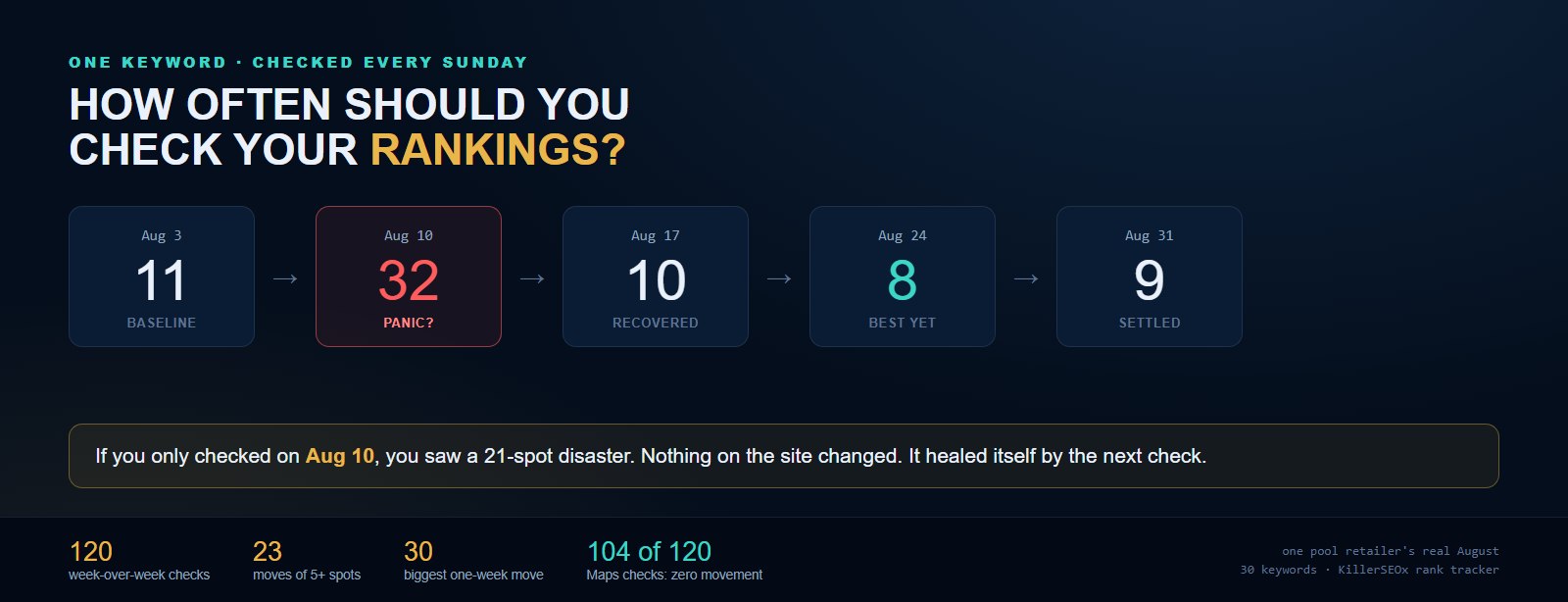
A client once emailed me three screenshots of the same keyword taken on three different days. Position 11, then 32, then 10. He wanted to know which one was real and what we broke. The honest answer: all three were real, we broke nothing, and the only mistake in the story was checking a moving target like it owed him a straight line. Rankings wobble. The question that actually matters is how often you should look, and what you should be looking at when you do.
We run rank tracking for a fleet of local businesses, checked on a fixed weekly schedule, so I can answer this with data instead of opinion. This post uses one real account, a pool retailer we manage, with 30 keywords checked every Sunday through August. Five checks, 120 week-over-week movements, and a couple of heart attacks that healed themselves. Here is what a month of honest measurement looks like, and the cadence I would run if I owned your business.
- Googling yourself is the worst way to check a ranking: personalization, your location, and your own click history all bend the result. Use Search Console for the crowd view and a rank tracker checking from a neutral, pinned location for the controlled one.
- Rankings move constantly. Across 120 week-over-week checks on one real account in August, 29 stayed put, 68 moved 1 to 4 spots, 23 moved 5 or more, and the single biggest one-week move was 30 spots.
- Most scary moves undo themselves. One keyword went 11 to 32 in a week, then back to 10 by the next check, and ended the month better than it started. A daily checker would have panicked on day two and "fixed" something that was not broken.
- Weekly is the right cadence for managing SEO. It is frequent enough to catch every real trend within days, and slow enough that one bad crawl day does not read as a crisis. Reserve daily checks for migrations and recoveries.
- Maps rankings barely move: 104 of 120 weekly Maps checks on the same account showed zero change, and nothing moved more than 2 spots. Different channels earn different cadences.
How do you check your keyword rankings the right way?
Use two instruments: Google Search Console for the queries real searchers found you with, and a rank tracker that checks your chosen keywords from a neutral, pinned location on a schedule, split by desktop, mobile, and Maps. Never trust a search you ran yourself, because Google personalizes what you see.
Start with what not to do. Opening an incognito tab and Googling your own keyword feels like checking, but it is not measurement. Google adjusts results by your location down to the neighborhood, by device, and by history, and incognito only strips some of that. Worse, you have been clicking your own site for years, which is exactly the signal that trains Google to show it to you higher than anyone else sees it. The number you get is a mirror, not a scoreboard.
Real checking uses two tools that answer two different questions. Search Console tells you what actually happened: which queries you appeared for, how many people saw you, how many clicked. It is free and it is the ground truth for demand. But its position number is a blended average across every searcher, device, and SERP feature, which is why it rarely matches anything else. I unpacked that whole fight in what average position actually means.
The second tool is a local rank tracker: it asks Google the same question from the same neutral place on a schedule and records the answer for desktop, mobile, and the Maps pack separately. Fixed variables are the entire point. When that number moves, the movement is real, and you can hang a decision on it. Everything below comes from ours.
How often do Google rankings actually change?
Constantly. On one real account, 30 keywords checked every Sunday in August produced 120 week-over-week movements: 29 held still, 68 drifted 1 to 4 spots, 23 jumped 5 or more, and the biggest single-week move was 30 spots. Position is a wave, and any single check is one photo of it.
Here is the keyword that tells the whole story. A hot tub term this retailer cares about, checked five Sundays in a row:
That middle number is a 21-spot crash. If you checked on August 10 and only August 10, you saw a disaster and probably started rewriting pages. If you checked on the 8th and the 12th, you likely never saw it at all. By the next scheduled check it was gone, and the keyword finished the month two spots better than it started. Nothing on the site changed during any of this. The SERP was just breathing: Google tests result orders, competitors flicker in and out, features reshuffle the page. I covered the mechanics of why this happens in why your rankings moved when nothing changed.
The same month, a pool maintenance keyword went 40, 40, 68, 38, 35. That is a 28-spot fall and a 30-spot recovery inside three weeks, ending better than it began. Meanwhile the boring keywords stayed boring: an above ground pool term logged 5, 5, 5, 5, 5 and the brand-adjacent term sat at 3 all five checks. Across the whole account, 19 of 30 keywords swung 5 or more spots at some point in August, yet 14 of 30 ended the month within 2 spots of where they started. Most of the drama canceled itself out.
Should you check your rankings every day?
Not for managing SEO. Daily checks mostly show you noise that reverses on its own, and they push you to react to phantom problems. Save daily monitoring for the few weeks after a site migration, a redesign, a penalty recovery, or a Google core update, when fast feedback actually changes what you do next.
Think about what a daily habit would have done with that 11 to 32 crash. Day one: panic. Day two: emergency changes to a page that was fine. Day three: the ranking recovers on its own, the changes get the credit, and now you believe something false about what works. Checking too often does not just waste time. It manufactures fake lessons, and fake lessons compound.
There is a second cost nobody mentions: reaction time is not the bottleneck in SEO. Content takes weeks to earn its position. Authority builds over months. Knowing about a wobble six days sooner changes nothing you would actually do, because the right response to a wobble is to wait for the next check anyway. The only situations where daily data changes decisions are the exceptional ones: you migrated the site and need to know indexing survived, you got hit and are watching a recovery, or a confirmed core update is rolling out and you want to know where you landed. Those weeks, watch closely. The other 48 weeks a year, the daily graph is a slot machine.
Why weekly checks catch everything that matters
Weekly hits the sweet spot for one reason: it matches the speed of real ranking change. Genuine trends, the kind you act on, take weeks to form. A weekly check catches the start of every one of them within seven days, which is faster than any content or authority response you could mount anyway. What it filters out is precisely the one-day noise that daily checking amplifies.
The filter is simple, and it is the rule we run every account on: one check is a photo, two consecutive checks are a signal. When a move shows up on two Sundays in a row, it is real and worth a response. When it shows up once, wait. In the August data, the noise never survived that rule and the real moves always did. A pool supplies keyword went 20, 11, 11, 9, 10: the jump held on the next check, so it was a real climb, and it stuck. A showroom keyword that had idled at 12 and 13 all month hit 4 on August 31; the next check either confirms a breakout or files it under noise. Compare that with the maintenance keyword's one-week visit to 68, which the very next photo erased.
Weekly also produces enough data to be honest with clients. Five checks a month means a trend line, not two dots and a story. It is the same reason our AI visibility reports run weekly: fast enough to catch everything, slow enough to mean something.
See a month of your own rankings, checked properly
KillerSEOx tracks your keywords weekly across desktop, mobile, and Maps from neutral locations, and flags the moves that survive two checks. Start with a free audit, about 60 seconds, no card.
Run a free auditHow often does Google update search results?
Continuously. Google crawls and re-scores pages around the clock, so there is no update day to wait for. On top of that constant churn, Google ships several confirmed core updates a year that can move rankings broadly over a rollout of days to weeks. Both kinds of change are why single checks mislead.
People imagine Google updates results the way an app updates, in versions. It does not. The index refreshes continuously as pages get recrawled, which for an active site can be daily. Small ranking adjustments ship all the time without announcement, and the SERP itself gets re-tested constantly: Google routinely reorders results to measure how searchers respond. That ambient churn is most of what you saw in the August numbers above.
Core updates are the second layer. A few times a year Google announces one, the rollout runs one to three weeks, and sites can move meaningfully in either direction. Those are the moments to tighten your checking cadence and, more importantly, to resist judging anything until the rollout finishes. A position captured mid-rollout is a photo of a wave during an earthquake.
Do Maps rankings move as much as organic?
Not even close. On the same account and the same five Sundays, 104 of 120 weekly Maps checks showed zero movement, and no Maps position moved more than 2 spots all month, while organic averaged a 3-spot weekly wobble with swings up to 30. Maps is stable week to week; what varies is location.
The Maps pack runs on different physics. Proximity, reviews, and profile strength move slowly, so pack positions barely drift: this retailer held the number 1 Maps spot on 17 of 30 keywords for the entire month without a single interruption. When a Maps position does move on a weekly check, take it seriously, because it is far more likely to be a real change than organic's daily jitter.
The catch is that a Maps ranking checked from one point hides the dimension that actually varies: geography. Your pack position changes street by street across your service area, which is why we run grid scans instead of single Maps positions for the map side. The cadence that works in practice: weekly single-point Maps checks to catch changes, a monthly grid scan to see the territory.
What should a ranking check actually look at?
Not individual positions. Read the movers list filtered to moves that held for two consecutive checks, the striking-distance band between 8 and 20, and the desktop, mobile, and Maps split per keyword. Five minutes a week on those three views beats an hour a day of watching single numbers twitch.
The habit that makes weekly checking work is knowing what to read in those five minutes:
- Confirmed movers first. Anything that moved 5 or more spots and held it across two checks. That August list was short: the pool supplies climb, the contractor terms sliding from the low 30s to around 40. Short lists get acted on.
- The 8 to 20 band. Striking distance. These keywords are one content improvement away from the clicks, and this band is where our action engine mines most of its quick wins.
- The channel split. A keyword at 42 organic and 1 in Maps needs completely different work than 42 organic with no Maps presence. One number per keyword hides exactly this.
- Trend over position. Where has it been for four checks, not where is it today. The line matters; the dot does not.
That is the whole discipline. Check weekly, believe things that happen twice, live in the striking-distance band, and split by channel. If you want the entire routine handled for you, tracking, weekly checks, and the movers already filtered from the noise, the free tier does it for real, no card and no trial clock.
Quick answers
How can I check my keyword rankings for free?
Why do I see a different ranking when I Google myself?
How long does it take for rankings to change after SEO work?
Should I track desktop, mobile, or Maps rankings?