Do Google Reviews Actually Move Local Rankings?
Every local business owner has heard the same advice. Get more Google reviews and you will climb the map. It is the most repeated tip in local SEO, and it is half right, which is exactly what makes it expensive.
Half right means an owner spends a year chasing a number, passes the competitor on review count, and then sits there wondering why that competitor still owns the pack. So this morning I pulled 100 real Google Maps results across five local searches, three of them in markets where we run clients, and looked at where the review counts actually landed. Here is what the data says and what I would do about it.
- Reviews do help. Google says review count and review score factor into local ranking, and in four of our five searches the top three carried more reviews than the typical listing below them.
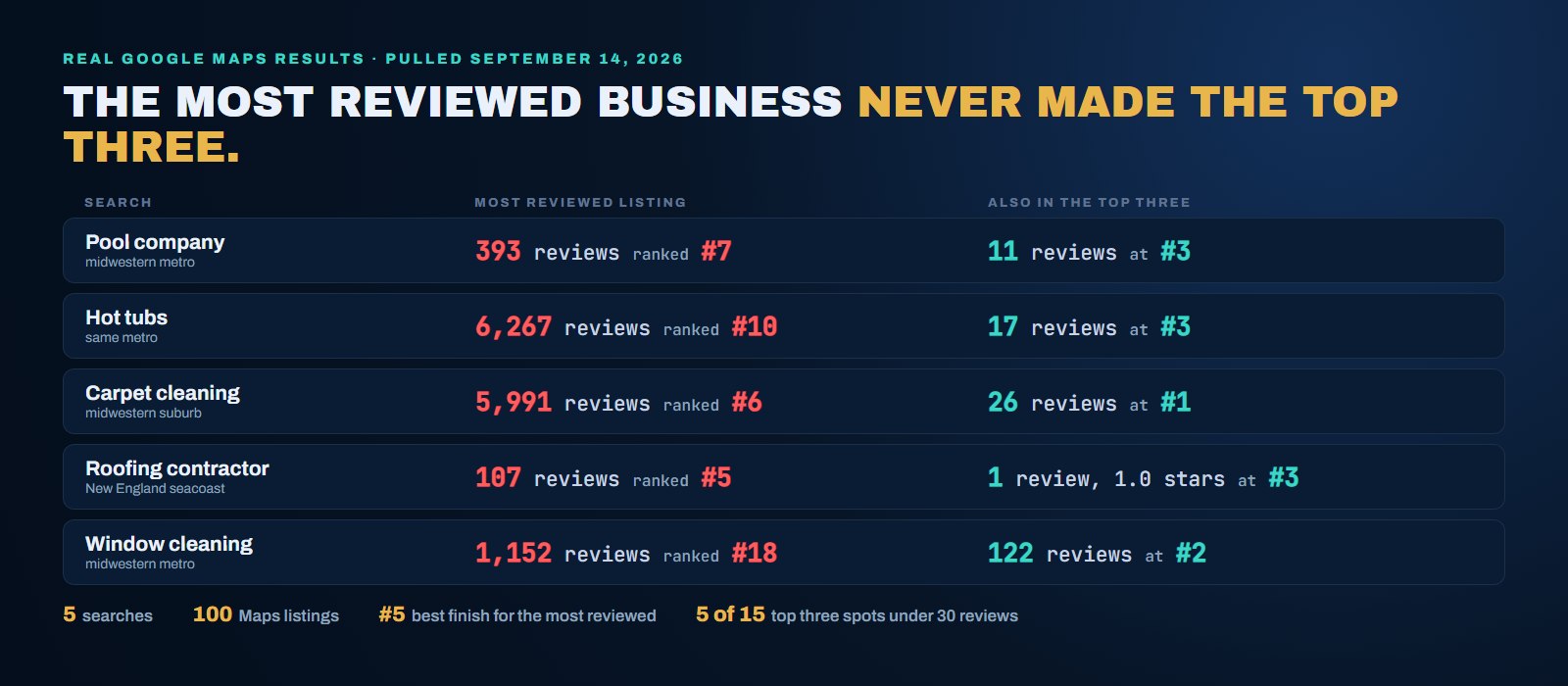
- They do not overpower distance. The most reviewed business in each of the five searches finished 5th, 6th, 7th, 10th and 18th. It never made the top three once.
- The same 393 reviews rank one pool retailer #1 from its own neighborhood and #7 from downtown. The reviews did not change. The searcher's location did.
- Five of the fifteen top three spots went to businesses with fewer than 30 reviews, including a roofer with one review and a 1.0 rating.
- Chase reviews for the call, not only the rank. A pack spot gets you seen. Your count and your rating decide who gets picked.
Do Google reviews actually help local SEO?
Yes, but less than you have been told. Google lists review count and review score as part of prominence, one of three things it weighs next to relevance and distance. Reviews can break a tie between nearby businesses that are equally relevant. They rarely beat a competitor who is simply closer to the person searching.
Google is unusually open about how local ranking works. Its own help page for Business Profiles names three factors: relevance, meaning how well your profile matches the search; distance, meaning how far you are from the searcher or the location in the query; and prominence, meaning how well known your business is. Reviews live inside prominence, next to links, articles and directory mentions. Google says plainly that more reviews and better ratings can improve your local ranking. That is a confirmed signal, not folklore.
What the advice leaves out is the other two factors. Prominence is one of three, and distance is not something you can buy. Your review count is a lever you control. Where your customer happens to be standing when they search is not. So the real question was never whether reviews help. They do. The question is how much they help against the factors you cannot move, and that is a question for data rather than opinion.
What did 100 real Maps results show about review counts?
The most reviewed business in each of five searches finished 5th, 6th, 7th, 10th and 18th. Five of the fifteen top three spots went to businesses with under 30 reviews. Reviews still leaned toward the top, though: in four of the five searches, the top three carried more reviews than the median listing below them.
Here is how I pulled it. On September 14 I ran five Google Maps searches through the same live search data our platform uses for Maps tracking, and recorded the top 20 listings for each one with their rating and review count. The five searches were a pool company and hot tubs in a midwestern metro, carpet cleaning in a midwestern suburb, a roofing contractor in a New England seacoast city, and window cleaning in the same midwestern metro. Three of those markets have a client of ours somewhere in the twenty. I have left out every business name, ours included.
Read those slowly. The carpet cleaning listing with 5,991 reviews is a franchise location carrying a count no independent operator will ever catch, and it lost to a local shop with 26. In window cleaning, a business with 1,152 reviews sat at #18, fourteen spots below a listing with exactly one.
Before anyone concludes that reviews do not matter, look at the medians, because they tell the other half. In the pool search the top three had a median of 53 reviews against 36 for positions 4 through 20. Hot tubs was 141 against 80. Roofing was 25 against 12. Window cleaning was 169 against 49. Only carpet cleaning flipped, at 77 against 150. So reviews do lean toward the top of the pack. They just do not decide it. A signal that correlates with ranking but loses to a closer competitor is exactly what Google's three factor model predicts.
One honest caveat. A hundred listings from five searches on one morning is a snapshot, not a study of every market in America. I trust it because it matches what we watch in client tracking every week, and the next section is the cleanest example of that I have.
Why does a business with 393 reviews rank #1 and #7 at the same time?
Because Maps rankings are calculated from where the searcher is. A pool retailer we work with has more reviews than anyone in its market. Checked from its own location it holds #1. Searched from the center of the metro it drops to #7, behind a business with 53 reviews. Same profile, same reviews, different distance.
This is my favorite example because it isolates the variable. The pool retailer has 393 reviews at 4.5 stars. That is the highest count of all twenty businesses in the metro search, and about 50 percent more than the next one down at 257. On pure review strength, nobody in that market is close.
Our tracker checks this client's keywords from the business's own location every week. The reading from this same Monday: Maps #1 for "pool company" plus the city, 18 of its 30 tracked keywords at #1, 27 of 30 inside the top three, and an average Maps position of 1.7. The metro center search, run the same morning, put it at #7.
Nothing about the reviews changed between those two readings. The only thing that moved was the point on the map the search came from. The business sitting at #1 from the metro center has 53 reviews and is simply nearer to that point.
The hot tub search makes the same case even harder to argue with. Three locations of the same hot tub chain showed up in that search. The store with 1,168 reviews held #1. The store with 6,267 reviews, more than five times as many under the identical brand name, landed at #10. Same brand, same reputation. Distance and relevance to that particular search picked the winner.
You might be losing a distance fight, and no review count wins those. It is the same visibility gradient we laid out for businesses that work across many towns in service area business SEO, and the reason a single Maps position lies to you, which we covered with real grid scans in grid heatmaps vs a single Maps position.
Which part of your reviews does Google actually weigh?
Google confirms review count and review score, and it tells businesses to respond to reviews. Everything else, like how recent your reviews are or which keywords customers use in them, is widely believed but not confirmed. Build your plan on the confirmed signals and treat the rest as a bonus, never as the strategy.
A lot of review advice blends what Google has said with what SEO people suspect. Split them apart before you spend money.
Confirmed. Count and score. Google's local ranking guidance names both. It also recommends replying to reviews, and frames that as showing customers you value their feedback.
Believed, not confirmed. Recency, meaning a steady trickle of new reviews beats a pile that stopped arriving in 2023. Keywords inside the review text. Keywords in your replies. All three are plausible, and industry surveys keep ranking them highly, but Google has not confirmed any of them as a ranking input. I would never coach a customer to type "best roofer in town" into a review. It reads fake to the next customer, and scripted reviews are how profiles get filtered.
The roofing search also shows the limit of rating as a ranking signal. The #3 listing had one review, and that one review was a single star. Google is obviously not sorting the pack by stars. But ask yourself whether you would phone a roofer with a 1.0 rating. That is the part of the review question that owners skip, and it is where the money actually is.
How many Google reviews do you need to rank?
There is no magic number. In our five searches, top three spots went to businesses with 1, 11, 17, 25 and 26 reviews, while several listings with over 1,000 reviews sat outside the top five. The useful target is relative: stay in range of the businesses close to your customers, then keep reviews arriving every month.
Owners want a number, and plenty of agencies will hand them one. Get to 100. Get to 250. Those numbers are invented. The only honest benchmark is local, and it is the businesses that show up near your customers, not the franchise across the metro with thousands.
So look at who holds the pack where your customers actually are. If they carry 40 reviews and you carry 8, close that gap, because it is a real disadvantage in the prominence part of the formula. If you carry 120 and they carry 60, your next 50 reviews are good for conversion and nearly useless as a ranking fix. Your problem is somewhere else.
Two of our own clients show both sides. The carpet cleaner has 77 reviews and sits #2 in its suburb, behind a shop with 26 and four spots ahead of the franchise with 5,991. It did not win by having the most. It won by being close, being relevant, and being in range. The window cleaner has 123 reviews at a perfect 5.0, more than six of the eleven businesses ranked above it in the metro search, and it landed at #12. Reviews are not what is holding it back in that search, and another hundred of them would not change the result.
If reviews do not win the pack, why chase them at all?
Because a pack spot gets you seen and your reviews get you picked. The roofing search had a business with one review and a 1.0 rating at #3. It earned the visibility. It will not earn many calls. Reviews do their heaviest lifting after the ranking, when a customer is deciding who to phone.
The most expensive mistake in this whole topic is judging reviews only by what they do for rank. Rank is the gate. The phone call is the point. When three businesses sit in the pack, the searcher sees the stars, the count, and maybe the last review, and makes the choice in the time it takes to scroll. Your count, your rating, how recent the reviews are and whether you answered the angry one are all visible in that moment.
Getting more of them is mostly a habit problem, not a marketing problem. Ask at the moment the job goes well, in person or by text, and send the direct review link so nobody has to hunt for your profile. We keep every client's direct Google review link on file for exactly that reason, because a customer who has to search for you to leave a review usually does not bother.
Then stay inside the rules. Google's review policy prohibits offering anything in exchange for a review and prohibits asking only the customers you expect to be happy. The Federal Trade Commission's rule against fake and bought reviews has been in force since October 2024. Ask everyone, pay no one, script nothing.
See what is really holding your site back
Run the free KillerSEOx audit on your own domain. About 60 seconds, no card, no trial clock.
Run my free auditHow do you tell whether reviews are what is holding you back?
Track your Maps position from more than one spot, then compare your reviews to whoever beats you at each spot. If you lose only where competitors are closer, it is distance. If you lose next door to businesses with far more reviews, reviews are the gap. If you lose next door to weaker profiles, it is relevance.
A single Maps position checked from your office tells the flattering version of the story. The pool retailer's own tracking says #1 on 18 keywords, which is true, and it is the view from home. The metro search says #7, which is also true. The work lives in the gap between those two numbers.
Here is the sequence I would run before spending a dollar on a review push.
- Track Maps separately from organic. They are different rankings with different winners. A local rank tracker should show desktop, mobile and Maps side by side, checked every week from the business location.
- Check from more than one point. Run a grid or multi point scan across the towns you serve, so you see where you win and where you vanish.
- Write down who beats you at each losing point. Their distance from that point, their review count, their rating, and their primary category.
- Read the pattern. Losing only far from your location is distance, and the fix is service area content and signals. Losing to nearby businesses with far more reviews is a genuine review gap. Losing to nearby businesses with fewer reviews is relevance: categories, profile completeness, your website and your local citations.
That last case surprises owners every time, and our data had it. In the window cleaning search a business with 1,152 reviews landed #18, below a listing with one. When a heavily reviewed business loses to an almost empty profile close by, the problem is almost never reputation. It is usually category and relevance. Check those before you chase review number 1,153.
It is also worth remembering that Maps is not the only surface anymore. On informational searches an AI Overview often sits above everything, and we broke down where customers click between the two in AI Overviews vs the local pack. If you want to see where you rank on Maps from where your customers actually search, that is what our Google Maps rank tracker is built to do.
Reviews are worth every ask. Just know which problem you are solving before you decide they are the answer. Run the free audit on your site, or put your business on the free tier and look at your Maps positions this week. If the businesses beating you are closer, no review campaign will fix it. If they are next door and better reviewed, you just found your easiest win.
Quick answers
Does responding to Google reviews help SEO?
Do Yelp and Facebook reviews help Google rankings?
Can you offer customers something in exchange for a Google review?
Do keywords in Google reviews help rankings?
Does review rating matter more than review count?