Service Area Businesses: How to Rank Where You Work, Not Where You Sleep
A plumber, a mobile groomer, a wildlife trapper, a pressure washer. None of them want you driving to their house, and most of them work out of one. That makes them service area businesses in Google's eyes: real companies with no storefront, no walk-ins, and no address on the map. Google treats them differently, and most of the advice they get was written for businesses with a front door.
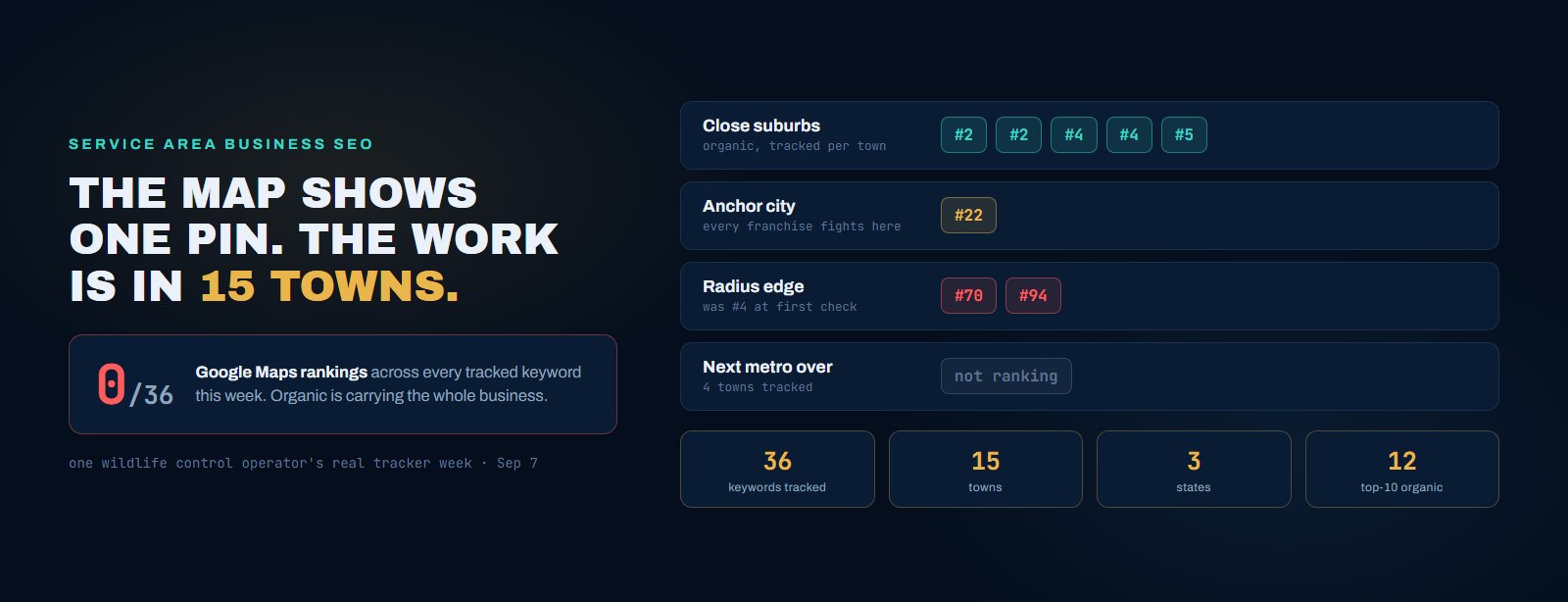
We track rankings for a fleet of local companies, and most of them are exactly this kind of business. One of them, a wildlife control operator, is the cleanest picture of the problem I have seen. We track 36 keywords for them across 15 towns in three states, checked every week. This week's check tells the whole service-area story in one screen: top 5 organic positions in the close suburbs, position 22 in their own home city, position 94 at the edge of their radius, and zero Maps rankings. All 36 keywords, not one Maps position. Here is what that data says about how ranking without an address actually works.
- A service area business is one that travels to customers instead of hosting them. Google lets it hide its address and list service areas, but ranking still anchors to where the business really sits.
- The service area you draw in your Google Business Profile is a statement of where you work, not a ranking lever. Drawing a bigger circle does not make you show up in more of it.
- Maps visibility fades with distance from home base no matter what your profile says. Our tracked operator holds zero Maps rankings across 36 keywords while ranking top 5 organically in five suburbs.
- Organic town pages are how a service area business wins the towns its pin cannot reach: position 2 to 5 in close towns, in the same week the map showed nothing.
- Track every town you sell in separately, on desktop, mobile, and Maps. One citywide rank number hides exactly the decay pattern that decides where your calls come from.
What counts as a service area business?
A service area business serves customers at their location instead of its own: plumbers, landscapers, mobile detailers, wildlife control, most home services. Google's rules for them are specific: if customers do not visit your address, you clear it from your Business Profile and list the areas you serve instead.
The distinction sounds bureaucratic until you see what it does to your marketing. A storefront business gets a pin, and that pin earns proximity: people standing near it see it rank. A service area business gets a hidden location and a polygon of towns. The polygon is what customers see on your profile. The hidden location is what Google actually ranks you from. Those are two very different things, and almost every frustrated service business owner I talk to has confused one for the other.
It matters because the whole local stack treats you differently. Your Maps presence behaves differently, your citations need different handling (a home address leaking onto directory sites is the classic service-area citation audit finding), and your website has to do work that a storefront's pin does for free.
Why don't you show up in Maps outside your neighborhood?
Because Maps ranks on proximity to the searcher, and a service area business still anchors to one real location even with the address hidden. Listing 15 towns in your profile does not project your pin into them. Visibility decays block by block as searchers get farther from your base.
Here is the number that surprises owners most. Our wildlife control operator, an established company with reviews, real town pages, and top 5 organic rankings around the metro, holds this Maps line in the tracker this week:
Zero out of thirty six. Not because the profile is broken and not because Google is punishing anyone. Their one anchored location sits where they actually operate, and the tracker checks each keyword from the town the customer would search from. From fifteen towns away, proximity math buries any single pin. When we ran a 121 point grid scan on this same operator in August, their name surfaced at exactly one grid point, ranked number one there, and nowhere else. That is what a service area business looks like on a map: a lighthouse, bright at home, dark at distance.
Once you accept that, the strategy stops being "fix the map" and becomes "win the surfaces that travel." Which the same company is quietly doing, and that is the interesting half of the data.
How should you set up your Google Business Profile service area?
Clear the address if customers never visit it, then add the towns and counties you genuinely serve, up to Google's limit of 20 areas, keeping the footprint within roughly a two hour drive. Set it honestly and move on. The service area describes your business to customers; it does not decide your rankings.
The setup itself is twenty minutes of work. Where owners burn months is expecting the polygon to perform. I have watched businesses redraw their service area over and over, adding counties, swapping zip codes for city names, hunting for the combination that unlocks the neighboring metro. There is no combination. Google's own documentation is plain that the service area you list does not affect where you rank, and our grid data backs it up: the operator above lists towns across three states and lights up one point on the grid.
What the profile does deserve is the boring fundamentals done properly: correct categories, real photos of crews and jobs, reviews that mention the towns customers are in, and services filled out. And one thing specific to service area businesses: keep your home address off the rest of the internet too. Directory sites love to resurrect an old registered address, which hands Google a conflicting story and hands your home address to anyone who looks. That cleanup is half of what a citation audit exists to catch for this kind of business.
See where your visibility actually dies
The free KillerSEOx audit reads your site the way Google and the AI engines do, storefront or not. About 60 seconds, no card.
Run my free auditHow far does organic visibility actually travel?
Much farther than Maps, and it decays in a gradient you can measure. Our tracked operator ranks position 2 to 5 organically in five suburbs in the close ring around base, position 22 in the big anchor city, position 70 to 94 out at the edge of the radius, and unranked in the next metro over.
This is the part of the week's data worth studying, because it is the map nobody draws for you. Same company, same week, organic positions by distance from home base:
Three things jump out of that line. First, the close suburbs are winnable and won: five towns, all top 5, including two towns across a state line. Those positions belong to dedicated town pages, the pattern we broke down in the town pages post, and they are exactly the towns where the map shows nothing. Organic is carrying one hundred percent of this company's search visibility outside its home neighborhood.
Second, the anchor city is the hardest fight on the board. Position 22 in the big city, against every franchise and aggregator that targets it, while smaller towns hand over top 5 spots. For a service area business the honest play is often to win the ring of suburbs first and treat the city head term as the long campaign, not the starting point.
Third, the edge is volatile. That position 94 town sat at position 4 when we started tracking it. It slid to the nineties across a few weekly checks, the kind of collapse that nobody can explain after the fact if nobody was measuring. At the edge of your radius you are the marginal result, first trimmed when Google reshuffles. Distance does not just lower your rank; it makes your rank fragile.
What should a service area business track every week?
Every money keyword in every town you actually sell in, checked separately for desktop, mobile, and Maps. A single citywide position hides the gradient. Fifteen towns means fifteen different answers to "where do we rank," and the towns going dark are the ones you find out about from the phone not ringing.
The tracking mistake service area businesses make is inherited from storefront thinking: pick five keywords, check them "in Cincinnati" or "in Dallas," and call that the rankings. Every number in this post exists because this operator's keywords are tracked per town, from the searcher's location, across all three channels. Checked citywide, this week's story reads "average position 18, no Maps." Checked per town, it reads "dominant in the northern suburbs, invisible past the state line, town page at the edge collapsing." Only one of those tells you what to fix.
That per-town setup is exactly what a local rank tracker is for. Ours checks each keyword from its own town weekly on desktop, mobile, and Maps, which is how a 4 to 94 slide gets caught in weeks instead of quarters. For the towns that matter most, a grid scan adds the block by block picture around them. The weekly cadence question has its own post, but the short version for service area businesses: the edge of your radius moves more in a month than a storefront's rankings move in a year. Weekly is not paranoia, it is matched to the volatility.
Does AI search care where your address is?
Far less than Maps does. AI assistants recommend businesses from what the open web says: reviews, town pages, service descriptions, and consistent citations. They do not run proximity math on a hidden pin. For a service area business, that makes AI answers a surface where the storefront disadvantage mostly disappears.
When someone asks ChatGPT or Gemini for a wildlife trapper or a pressure washer in their town, the model is not measuring meters to a pin. It is synthesizing what it can read: which companies are described as serving that town, what their reviews say, how clearly their site answers the question. Every asset that wins the organic gradient above, real town pages, service pages that read like a human wrote them, clean citations, feeds the same machine. We watch this weekly across six AI models for every client, and the businesses that get named are the ones the open web describes clearly, not the ones with the best pin placement.
So the priority list for a service area business in 2026 is almost pleasant: the work is layered, not scattered. Honest profile setup once. Town pages for the ring you actually serve. Citations that agree with each other and keep your home address out of it. Weekly per-town tracking so the edge cannot rot silently. Then let the same assets compound across organic, Maps where proximity allows, and the AI answers that are eating both. If you want to see the whole gradient for your own service area, the free tier will start drawing it this week.
Quick answers
Can a service area business rank in Google Maps?
Should I hide my address on my Google Business Profile?
How big should my Google Business Profile service area be?
Do service area businesses need location pages?