How to Get More Google Reviews Without Breaking the Rules
Every agency has a client who wants more Google reviews, and most of the advice on how to get them will get the client's profile stripped or, since October 2024, get somebody fined. The line between a good review program and a policy violation is narrower than it looks, and it is not where most people think it is.
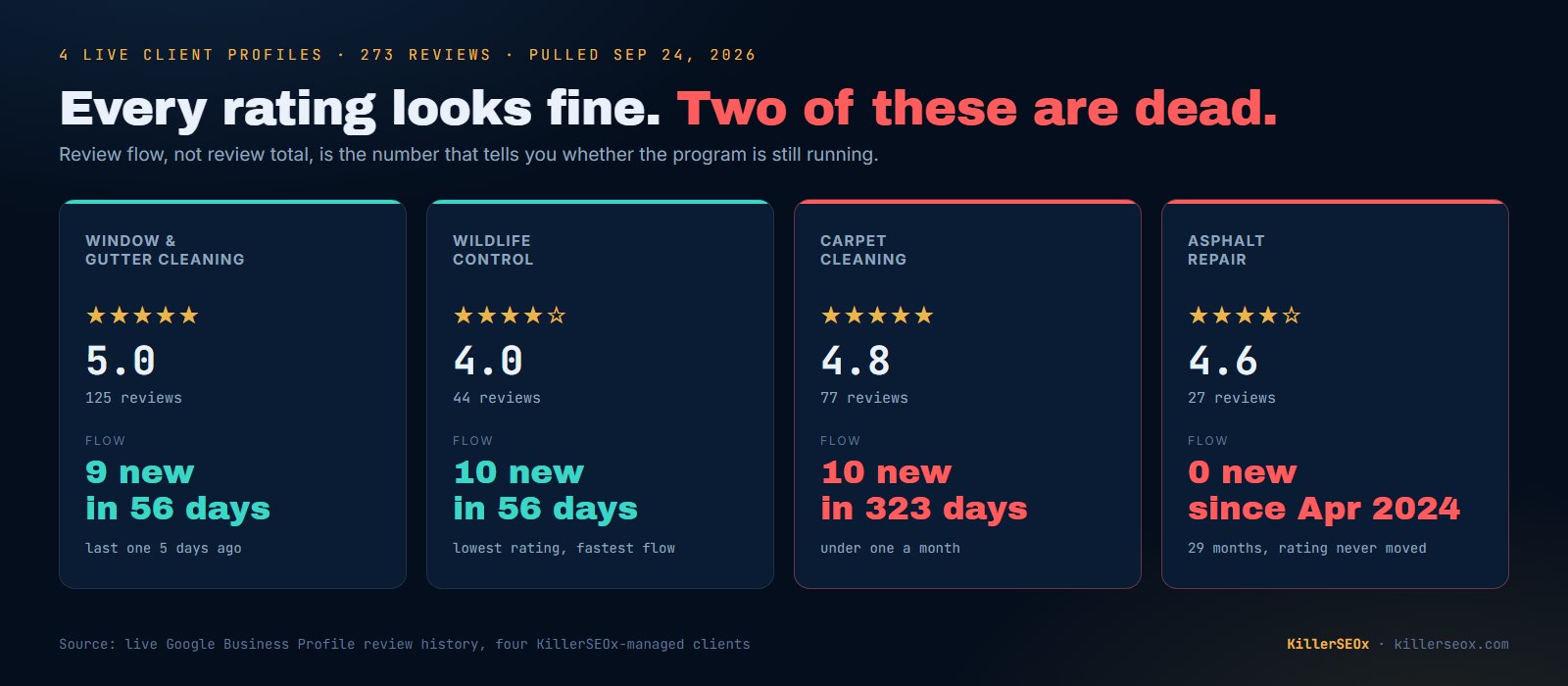
So I went and pulled the live review history off four Google Business Profiles we manage. Different trades, different states, 273 reviews between them, all four with ratings any owner would be happy with. What they do not have in common is flow. One of them took nine reviews in the last eight weeks. Another has not received a single new review since April 2024 and is sitting on a 4.6.
Nobody is named below. Trades only. If you manage local clients, you already have one of each of these on your book.
- Rating tells you almost nothing. Across four profiles rated 4.0 to 5.0, the review flow ranged from ten in 56 days down to zero in 29 months.
- Google's fake engagement policy prohibits incentivized reviews outright, and its prohibited content policy bars selectively soliciting positive reviews. Review gating is not a grey area.
- The FTC's consumer review rule took effect October 21, 2024. It reaches whoever buys, sells or procures fake reviews, which includes an agency doing it for a client, and it carries civil penalties per violation.
- Of the last 30 reviews across three of these profiles, 14 name the technician who did the work by first name. That is what an ask made in the field produces.
- On the fastest growing profile in the set, nine reviews landed in 56 days and not one of them has an owner reply. Flow and response are separate jobs and most clients are failing a different one than they think.
How do you get more Google reviews?
Ask every customer at the moment the job finishes, by the person who did the work, using the profile's own short review link sent as a text. Ask once, follow up once, then stop. Everything else in review acquisition is a variation on that, and every method that skips it is either slower or against Google's rules.
There is no clever version of this. The review comes from a person who is standing in their own driveway feeling good about a job that just got done, and it comes in the next few hours or it does not come at all. By Thursday they are not thinking about the carpet.
Three things decide whether that ask lands. The first is who makes it. A text from the office is a marketing message. A technician saying "if that looked right to you, I'm going to send you a link, it takes thirty seconds" is a favour between two people who just spent an hour together. You can see the difference in the reviews themselves. Across the last ten reviews on three of these profiles, 14 of 30 name the technician by his first name. Those reviews read as real because they are, and they are the ones that do the work when a stranger is choosing between two listings.
The second is the link. Every Google Business Profile has a short review link, the g.page/r/ form, that drops the customer straight onto the review box with the stars already up. We store it as a field on every client we onboard. Asking somebody to "search for us on Google and leave a review" instead loses most of them.
The third is the timing of the follow up. One reminder, the next day, and then leave it alone. Agencies build four step sequences because sequences are what the software does. A customer who ignored two asks is not going to write you a paragraph on the third.
What does healthy review flow actually look like?
Somewhere between four and six new reviews a month for an active residential service business, with the most recent one inside the last two weeks. Total count and star rating both look fine long after the program has stopped working, so the two numbers worth watching are reviews per month and days since the last review.
Here are the four profiles, current as of this morning, sorted by how fast they are actually moving rather than by how many reviews they have.
The window and gutter cleaning company took nine reviews between July 25 and September 19, and the most recent one is five days old. That is a business whose crews are asking. The wildlife control company took ten between July 2 and August 27, which is the same rate, off a profile with a third as many reviews and a 4.0 rating that would make most owners nervous.
The carpet cleaner is the one that fools people. Ten reviews, every one of them five stars, 4.8 overall, a profile that looks excellent on a slide. Those ten reviews are spread across 323 days. That is under one a month, and it is a one man operation where the same person doing the cleaning is the one who would have to ask.
The asphalt repair contractor is the honest failure. Twenty seven reviews at 4.6, and the newest one was written in April 2024. The company is busy and the work is good. The review program stopped existing at some point and nobody noticed, because the rating never moved.
This is why total review count belongs nowhere near a client report. It only goes up, and it keeps looking healthy for years after the last customer was asked for anything. If you want the argument for why the total is not the ranking lever either, we took 100 real Maps results apart in do Google reviews actually help local SEO.
What is review gating, and why does it get profiles stripped?
Gating is asking customers privately how it went and only routing the happy ones to Google. Google's prohibited content policy explicitly bars selectively soliciting positive reviews or discouraging negative ones, and since October 2024 the FTC's consumer review rule treats review suppression as an unfair practice with civil penalties attached. Send one link to everybody.
Gating is still sold as a feature. The pitch is a survey step in front of the review link: five stars goes to Google, anything less goes to a private feedback form where the owner can "make it right first." It sounds responsible. It is banned twice over.
Google's side is the prohibited and restricted content policy for Maps contributions, which covers discouraging negative reviews and selectively soliciting positive ones. The FTC's side is the Rule on the Use of Consumer Reviews and Testimonials, effective October 21, 2024, which covers fake and AI written reviews, buying positive or negative ones, undisclosed insider reviews, company run review sites dressed up as independent, and suppression of negative reviews. It carries civil penalties, and the per violation figure runs into five figures.
Read who the rule applies to, because this is the part agencies skip. It reaches whoever buys, sells or procures the reviews. If you are the one who set up the gating funnel or bought the review package on the client's behalf, you are not a bystander in that sentence.
The practical version is simple enough to put in a scope of work. One link. Everyone who paid gets it. Whatever they write is what goes up. If a client cannot live with that, the review program is not the problem and more reviews will not fix it.
Can a client offer a discount for a review?
No. Google's fake engagement policy prohibits offering money, discounts, gift cards, free product or any other incentive in exchange for reviews, and it does not matter whether the business or its agency is the one offering. Incentivized content can be removed, and profiles that keep doing it can be suspended.
This is where Google is stricter than the law, and the gap trips people up. The FTC rule mainly attacks incentives that are conditioned on the review being positive. Google bans the incentive full stop, positive or not, including the ones that feel harmless. A drawing for a gift card among everybody who leaves a review is an incentive. Ten dollars off the next service is an incentive. A free filter is an incentive.
Employee and family reviews are the other reliable way to lose content. Reviews from people with a conflict of interest are prohibited, and a small profile where four of the first ten came from the owner's relatives is not a subtle pattern.
None of the above is why I tell clients to skip incentives, though. The real reason is that an incentivized review reads like one. "Great service, thanks!" from somebody who wanted the gift card is worth nothing to the next customer, and it is worth nothing to an AI assistant summarizing what people say about the business. We tested whether reviews move AI answers at all and came up close to empty, which is what AI reputation management actually is and is not.
See where a client's profile actually stands
Run the free audit on any site you manage and it checks the profile alongside the site. No card, no trial clock, no call.
Run my free auditWhy does a client stall at a good rating and no new reviews?
Because the ask lived in one person's head instead of in the job workflow. Review programs almost never get switched off on purpose. A tech leaves, a scheduling system changes, a busy season hits, and the step that was never written down anywhere quietly stops happening while the rating on the profile stays exactly where it was.
The asphalt contractor did have a program once. The reviews it does have are detailed and specific, the kind property managers write when somebody asks at the right moment. Then they stop dead, and the rating gives no signal that anything changed.
What makes it an agency problem is that you are the only one looking weekly. The owner sees 4.6 and 27 reviews and concludes things are fine. You are the one who can see the date on top.
So the fix is not a tool. It is putting the ask into the step of the job that cannot be skipped, which is usually the invoice or the completion text, and then checking the date of the most recent review the same way you check rankings. If you do not have a weekly rhythm for the profile already, the weekly Google Business Profile post piece covers what that rhythm should and should not include.
Should you reply to every review?
Yes, and keep them short. A reply is for the stranger reading the profile next month, not for the customer who already wrote it. Reply within a day to the good ones and within the hour to the bad ones, because a one star review with no answer under it is the first thing a prospect reads.
The response data across these four profiles is the part that surprised me. The fastest growing profile in the set, the window and gutter cleaner with the perfect 5.0, has taken nine reviews in eight weeks and not one of them has an owner reply. Three of those nine are bare star ratings with no text at all. That is a business winning the hard half of this and losing the easy half.
The carpet cleaner replies to every single one, all ten, every time, usually within an hour. The replies are eight words long. "Thank you for the business and nice review." Nobody will ever call that copywriting and it does not matter, because it gets sent.
Compare that to the asphalt contractor, whose replies run 150 to 250 words and read exactly like what they are. Seven of the last ten got one. The three that did not are the short reviews, which is the giveaway: when a reply takes twenty minutes to write, it stops getting written.
The best thing in the whole pull was the wildlife control company, which took two one star reviews inside ten days in August. One was from somebody not in their customer database, complaining about a yard sign. The owner answered in 18 minutes, publicly, by name, asking what he could do. The other was a real service complaint and got a detailed reply the same afternoon plus a crew sent back out. That profile sits at 4.0, the lowest rating in the set, and it is the one I would bet on.
How do you package this for a client?
Sell the system and the measurement, not the outcome. You can own the link, the message, the reply drafting and the weekly reporting. You cannot own whether a technician asks, so do not price it as if you can, and never sell review volume as a ranking guarantee.
The honest scope is narrow, which is fine, because narrow is what you can deliver. Set up the short link and get it into the field workflow. Write the ask text and the one follow up. Draft replies daily, or hand the client a two line template per rating. Report flow, response rate and days since the last review. Refuse the rest.
The refusals are worth writing into the proposal, because they are a selling point against whoever else is pitching the client. No gating funnels. No incentive campaigns. No review purchasing, ever, from any vendor, however they describe it. No promise to remove a bad review, because you cannot.
What you can promise is that they will know. Most owners have no idea their review flow died eighteen months ago, and being the person who catches that in month one is worth more than any number of reviews you could have bought. It is the same case we make for tracking rankings weekly instead of monthly in how often you should check keyword rankings, and it is why review flow sits next to the ranking data in the local rank tracker rather than in a separate reputation product.
Do not price it as a standalone line item. It belongs inside the local retainer at about an hour a week, and the tooling under it should cost you a few dollars a site, not a few hundred. That is the whole reason we built white label SEO software the way we did.
The short version
If a client asks you this week how to get more Google reviews, here is the answer in full.
- The technician asks, at the job, by text, with the short link. Everything else is a slower copy of that.
- One link to everybody. Gating is banned by Google and reachable by the FTC, and the FTC rule names whoever procures it, which is you.
- No incentives at all. Google bans them whether or not the review is positive, and an incentivized review reads like one anyway.
- Report flow and recency, never the total. The total only goes up and it hides a dead program for years.
- Reply to all of them, short, and fast when it is bad. Eight words that get sent beat 200 that get sent to a third of them.
The reason I like this version is that a client can check it themselves. They open their own profile, read the date on the newest review, and if that date is from last year they now know something no rating was ever going to tell them. If you want that date, plus the rankings and the AI answers, on one screen for every client you manage, put one of them through the free audit or onto the free tier.
Quick answers
How can I get more Google reviews for free?
Is it against Google's rules to offer a discount for a review?
What is review gating and why is it a problem?
How many reviews does a business actually need?
Should an agency reply to a client's Google reviews?