How Long Does SEO Take to Work? One Account's Real First 30 Days
Every owner asks this on the first call, and the honest answer most of the industry gives is a range wide enough to hide inside. Six to twelve months. Sometimes three. Depends on your market. All of that is true, and none of it tells you what next month is going to look like on your screen.
So here is a different kind of answer. On July 29 we onboarded a gutter and exterior contractor onto the platform, an established company in a midwestern metro whose website had never had a day of real SEO work done to it. The system logged every single thing it did for them, with timestamps, because that is how it works for everyone. What follows is not a case study written after a good quarter. It is the raw first 30 days of one real account, including the three weeks in the middle that look like nothing is happening. I have anonymized the company and left every number exactly as recorded.
- SEO produces data in days and results in months. In this account the site audit finished the same hour signup did, the first blog post went live on day one, and the first ranking movement worth reading showed up in week five.
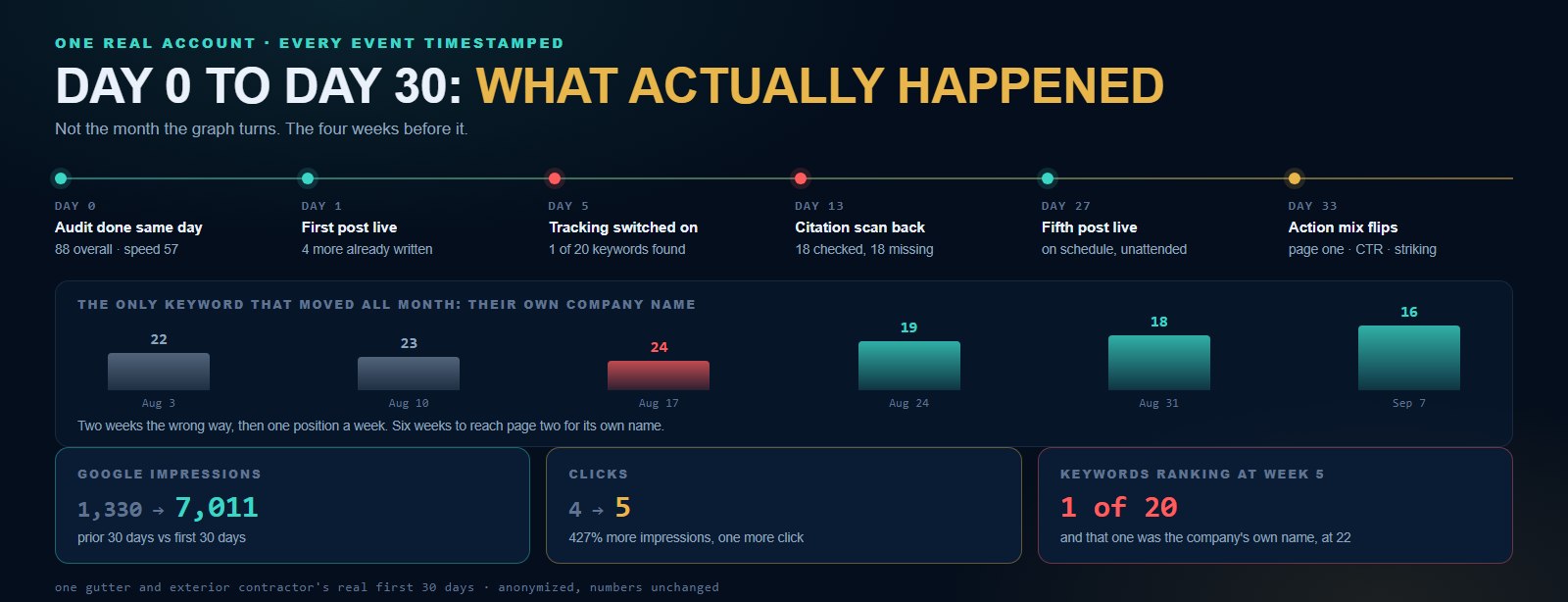
- Across days 1 to 30 the site pulled 7,011 Google impressions against 1,330 in the previous 30 days, more than a fivefold jump, and exactly one additional click. Impressions move first. Clicks are a later phase entirely.
- Five weeks in, 1 of 20 tracked keywords registered a position anywhere in the top 100, and that one was the company's own name at position 22.
- The action list changes shape as history accumulates. Week one items come from crawling your site. Month two items come from your own ranking and click data, which does not exist on day one.
- Judge month one on whether the machine is running, not on rankings. Audit done, tracking live, content shipping, citations scanned. Rankings are the month three conversation.
What actually happens on day one?
Everything that can be done from a crawl gets done immediately. In this account the full technical and AI readiness audit finished the same day the account opened, site access was confirmed 70 minutes after signup, four blog posts were written and scheduled, and the first one published the next morning.
The account opened at 2:37 in the afternoon on July 29. The audit had scores on the board before the end of that day: 88 overall, with technical at 100, on page at 92, security at 100, AI readiness at 93, and page speed at 57. That speed number is the whole first month's technical story in one figure. Everything else on this site was fine, and the thing dragging it was how slowly it loaded, which is a real fix with a real timeline attached.
Seventy minutes after signup, site access was confirmed. By the end of that same day four blog posts had been written and dated out across the following four weeks, and the first one went live the next morning, July 30. That is what a well configured start looks like: the parts that depend only on reading your site happen at machine speed, because there is nothing to wait for.
Here is the part nobody sells you on. Almost none of that day one work will show up in your rankings for months. It is the foundation, and a foundation looks like a hole in the ground for a while. What day one buys you is that the mistakes get fixed before three hundred pages inherit them, which is the cheapest that work will ever be.
When does rank tracking start telling you anything?
The first check gives you a baseline, not news. This account's first rank check ran on day five across 20 keywords on desktop and mobile. It found a position for exactly one of them. Real trend information needs three or four weekly checks stacked up, which puts it somewhere in week five.
On August 3, day five, the first check went out. Twenty keywords, checked on desktop and on mobile, every Sunday from then on. The result was one line long:
One. And that one was the company's own name, sitting at position 22 on desktop and 23 on mobile. An established business, in business for years, on page two for its own name. That is not a broken account. That is what a site Google has never had a reason to take seriously looks like from the inside, and if you have ever wondered why your competitor outranks you for a phrase you invented, this is the shape of the answer.
The useful thing is what happened to that single number over the following weeks, because it is the only signal in the account that moves at all in month one:
Two weeks of drifting the wrong way, then a turn, then a steady climb of about a position a week. If you had checked once on August 17 and drawn a conclusion, you would have concluded the work was making things worse. This is exactly why weekly checks beat daily ones: the noise inside a single week is bigger than the trend, and a trend needs several points before it is a trend. Five weeks of checks is roughly the minimum before your local rank tracker is telling you something instead of just showing you something.
See where your own site starts
The free KillerSEOx audit scores your site on the same 21 checks this account ran on day zero. About 60 seconds, no card.
Run my free auditHow long does SEO take to work?
Expect visibility signals in four to six weeks and click volume in three to six months. In this account, days 1 to 30 produced 7,011 Google impressions against 1,330 in the prior 30 days, a fivefold rise, while clicks went from 4 to 5. Google finds you long before it ranks you well enough to be clicked.
Those two numbers next to each other are the most honest answer to the question I can give you:
Impressions up 427 percent. Clicks up by one. Average position basically flat. If you brought that report to a client with no explanation, you would deserve the phone call you got. With an explanation it is a good month, and here is the explanation: an impression at position 21 is Google saying "I found this page and considered it." A click at position 21 is roughly a one in a hundred event. Five new blog posts went live in those 30 days, each one adding pages that could be found, and Google found and considered them. Nobody clicked, because nothing was near the top yet. That sequence is not a warning sign. It is the sequence.
Where it becomes a warning sign is if it persists. Impressions climbing with clicks flat for four or five months means you are producing pages that surface for queries you cannot win, and that is a targeting problem, not a patience problem. One month in, it is the expected picture. If you want to read your own version of this chart properly, the difference between what Search Console reports and what a tracker reports is its own conversation, and it trips up nearly everyone the first time.
Why does the to do list change shape in month two?
Because the earliest items are all a crawler can know, and the later ones need your own history. This account's day five batch was 3 backlink targets, 2 content topics, 1 striking distance keyword, and 2 technical fixes. The day 33 batch was 3 page one opportunities, 3 click through quick wins, and 3 striking distance keywords, none of which could have been calculated in week one.
This is the pattern I find most people have never had explained to them, and it changes how month one feels. On August 3, five days in, the action engine produced eight items. Every one of them came from reading the site and the web around it: fix these two technical issues, pursue these three link targets, write about these two topics, and one keyword already close enough to matter. That is the complete set of things you can know about a business on day five.
On August 31, day 33, it produced nine items of a different species entirely. Three page one opportunities, three click through rate quick wins, three striking distance keywords. Every one of those requires something that did not exist a month earlier: a ranking history to measure distance from, and enough Search Console impressions to know that a page is getting shown and not clicked. You cannot generate a click through quick win for a page with no clicks to compare against. On September 7 came five AI visibility fixes, which needed the first AI check to have run at all.
In between, on day 13, the citation scan came back: 18 directories checked, 18 listings missing. Not inconsistent, missing. That is a different kind of finding from the ones in the rankings data, and a much faster fix, which is the sort of thing a citation audit is there to surface early.
What should you judge at the 30 day mark?
Judge whether the machine is actually running. Audit complete, tracking collecting weekly, content publishing on schedule, citations scanned, Search Console connected. Every one of those is verifiable in month one. Rankings and revenue are not, and grading them at 30 days tells you nothing except how impatient you are.
We put a 13 step setup checklist in front of every account for exactly this reason. Six weeks in, this contractor sits at 9 of 13 done, which reads as 69 percent on their dashboard. Keywords added, rank tracking live, AI prompts configured, content preferences on file, business information locked, Search Console connected, blog engine configured, first audit complete, site access granted. The four still open are competitors, the Google review link, publishing preferences, and a kickoff call. None of those four block the work. All four make it better, and three of them take five minutes.
That checklist is the honest month one scorecard. It is entirely made of things that either happened or did not, and it is the reason a good first month and a bad first month look completely different from the inside even though they look identical in the rankings. A bad first month is one where nothing was connected, no content shipped, and the tracker has nothing stored. You find out about that one in month four, when there is no data to explain anything with.
One more number worth being blunt about. The first AI visibility check on this account ran 48 prompt and model combinations and returned zero mentions. A brand new player in the search picture is invisible to AI assistants for exactly the same reason it is invisible in Google, and it recovers on roughly the same timeline. We check that every week so the zero has a date on it and the eventual first mention has one too.
What does month two actually look like?
Month two is when the data starts working for you. The action queue refills from your own history, the rank trend becomes readable, and content published in month one begins to get indexed and tested. Expect movement on long tail and branded terms first, and expect competitive head terms to still look untouched.
By day 40 this account had picked up five AI visibility fixes on top of the ranking work, had a readable six week trend on its brand term, and had eight blog posts either live or queued with a real editorial pipeline behind them. The queue is the piece owners tend to underrate, because it is the only part of the system that compounds without anyone doing anything: topics get written ahead of their publish dates, sit as readable drafts, and go out on schedule whether anyone remembered or not.
What month two does not do is deliver the head terms. Nineteen of this account's twenty tracked keywords still had no position at the six week mark. Those are the competitive service and city phrases, and they are the last thing to move, not the first. Anyone promising you those inside 30 days is either working in a market with no competition or telling you something that is not true.
The reason I publish this account's numbers rather than a nicer one is that the nicer ones are misleading. Most SEO case studies start at the month where the graph turns. This is the four weeks before that, and it is the part everybody actually experiences and nobody writes about. If you want to see where your own site starts, the free tier runs the same audit and starts the same tracking, and you will have your version of the day zero line by tomorrow. What happens after that is mostly a question of whether you keep showing up for the boring middle.
Quick answers
How can you tell if your SEO is working in the first month?
Why did my impressions go up but not my clicks?
How long before I rank for my own business name?
Is SEO worth starting on a brand new website?
How long does SEO take to work for a local business?