SEO Proposal Template: What to Put In One That Closes
Most SEO proposals do not lose on the day they are sent. They lose in month four, when the client opens a report that does not match the sentence that sold them. Nothing went wrong with the work. The document wrote a cheque the search results were never going to cash.
So this is not a layout post. Nearly every page ranking for this query is published by a company that sells proposal software, which is why the advice you find is about templates, e-signature flows and how quickly a prospect can click accept. Good tooling, all of it. But a proposal closes on what it says, and it survives on whether what it said turns out to be true.
Below is the version I would send, section by section, with the number from our own platform sitting under each promise. Everything here was pulled this morning across eighteen managed client sites and 780 tracked keywords. No client is named.
- An SEO proposal closes on specificity. Name the keywords, the pages, the publishing cadence and the date the two of you will review it. A document that could be sent to any business in the same trade gets read exactly that way.
- Open with a real audit of their site, run before the call, with the failures named. It is the only section where you are showing instead of claiming, and it costs you nothing to produce.
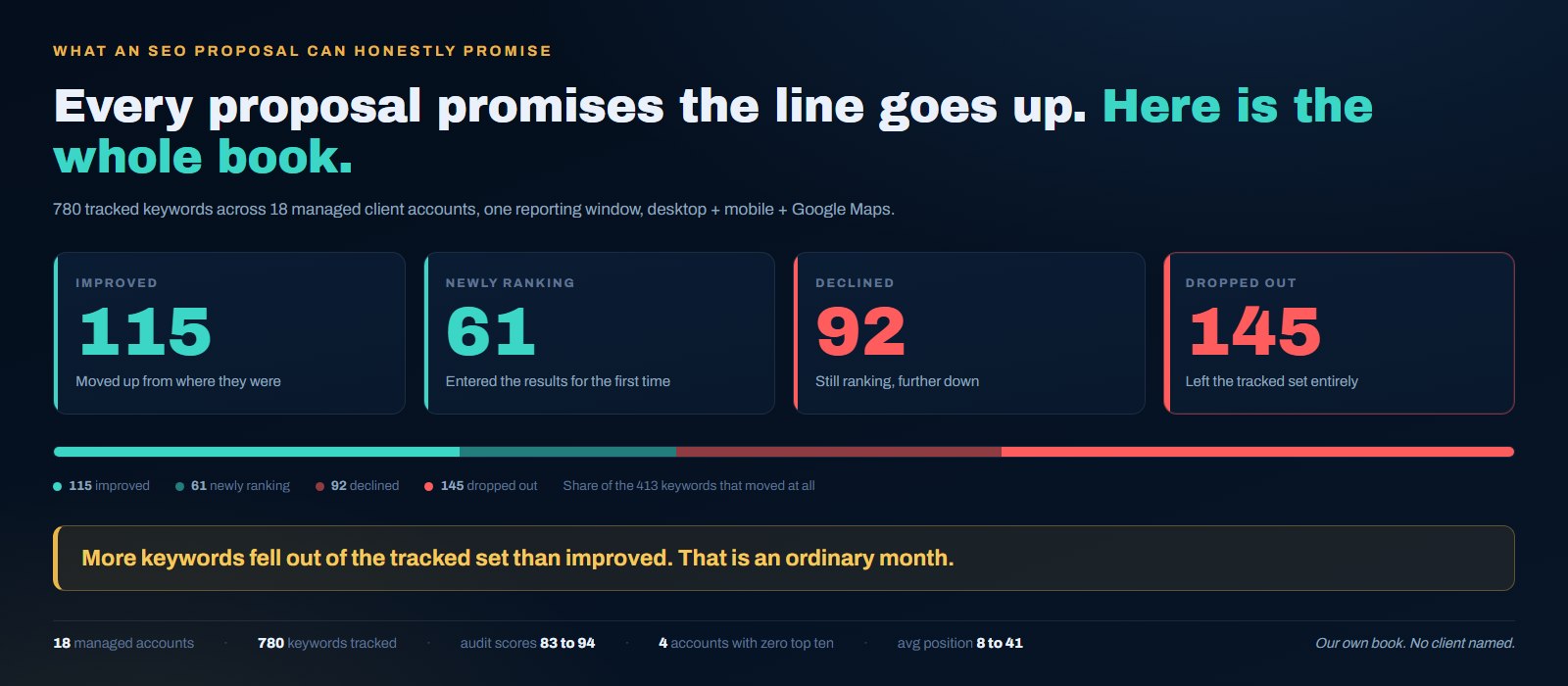
- Do not promise rankings. Across 780 tracked keywords on 18 live accounts in the current window, 115 improved, 92 declined, 61 started ranking and 145 fell out of the tracked set entirely. That is an ordinary month, and the proposal has to survive it.
- Promise the work and the measurement instead. Deliverables, cadence, the metric you will report and the review date are all inside your control. Position is not.
- State the price once and stop. Partner pricing here is $29 per site per month software only, or $99, $198 and $349 per site for fulfillment. The retail number on top is yours, and a proposal that argues with its own price teaches the client to argue with it too.
What is an SEO proposal actually for?
It converts a diagnosis into a scope, a price and a review date. Its job is not to prove you know SEO, because the prospect assumed that when they took the call. Its job is to make the next twelve months legible to somebody judging you on numbers neither of you controls, so it must name the numbers you do.
Two people read it and they read it differently. The person who wants the work reads the scope and the timeline, looking for reasons to believe this will be less painful than the last agency. The person who signs reads the price and the exit, looking for the clause that traps them. Most proposals are written entirely for the first reader, which is why so many of them stall for three weeks on a desk without a single objection being raised. Write for both: the scope answers the first, and a plain monthly number with a stated term and notice period answers the second.
The other thing worth holding onto is that a proposal is the first artifact of the reporting relationship. Whatever you promise becomes the thing you are measured against every month for a year, which is why the strongest section is almost never the one about you.
What should the audit section show?
One real audit of their site, run before you present, with the specific failures named and the score kept in its place. Every managed site on our platform scores between 83 and 94 this morning, and four of those accounts still have nothing in the Google top ten. The score reassures. The failure is what sells.
This is the section where a proposal stops being a sales document, and it is the cheapest advantage available to you. Run the audit on their domain before the call, not after the signature. It produces a list of things demonstrably broken on a site they look at every day, and the prospect can verify every line without trusting you at all.
What I would not do is lead with the overall number. Straight off our own book this morning: eighteen managed accounts, every one with a site audit on file, scores running 83, 84, 85, 87, 88, 89, 90, 91, 93 and up to 94. Not one is failing. Of those same eighteen accounts, four have zero keywords in the Google top ten right now, and three of the four score 88, 93 and 87.
An audit score is a hygiene measurement. It tells you whether a site is technically able to compete and it is close to useless as a prediction of whether it will. Present it as a verdict and the first time a client with an 89 fails to move, you have handed them the argument.
The line that does the work is the specific one. Largest Contentful Paint at nine seconds on mobile. No structured data on any service page. A robots rule blocking the AI crawlers. How to build that repeatably is in the white label SEO audit tool post, and the checks worth running are in the SEO audit checklist. For the proposal you want three findings, not twenty one. Three that are true, specific and fixable is a closing exhibit. Twenty one is homework you just assigned the prospect.
What can an SEO proposal honestly promise?
Work, cadence, measurement and a review date. Not position, not traffic, not a citation in an AI answer. In the current window across our eighteen managed accounts, 145 tracked keywords dropped out of the ranking set while 115 improved. Any promise indexed to position is a promise indexed to a system somebody else operates.
This is the section that decides whether the relationship survives its first flat quarter, so here is the number I would want in front of me before writing it. Eighteen accounts, 780 keywords tracked across desktop, mobile and Maps, one reporting window:
Read the last two columns again. More keywords fell out of the tracked set than improved. That is not a bad month and it is not a broken program. It is what a real book of local and regional accounts looks like when you measure across three channels instead of cherry picking the line that went up.
Average position says the same thing from the other side. Across those eighteen accounts the averages run from 8 on the best performer to 41 on the newest, and that is mostly an age and competition spread rather than a quality one. A proposal promising page one in ninety days is promising the 8 to a business that is about to become the 41.
So what do you write instead? Four things, all of which you can actually deliver:
- The work. Counted, with a frequency. Four posts a month, twenty five keywords checked three times a week, one citation scan, one audit.
- The measurement. Named metrics, named sources. Tracked positions across desktop, mobile and Maps. Impressions and clicks from Search Console. AI mention rate across the models you check.
- The reporting. A date, a format and a named recipient. Not "monthly reporting".
- The review. An actual calendar date, usually at ninety days, where you both look at the same numbers and decide whether the approach changes.
Notice none of those is a result. That is deliberate, and it loses you almost nobody. The buyer who walks because you would not guarantee page one was going to be a problem in month four anyway. What the honest version buys you is the ability to keep the account when the numbers go sideways, because nothing you wrote has just been proven false. For the timeline conversation, what actually happens in the first thirty days covers it with real dated data from one account's onboarding.
How should the scope section describe a month of work?
As countable units with a frequency attached. Four posts, fifty keywords checked three times a week, one audit, one citation scan, one report on a named day. A client can verify a count on their own. Nobody has ever been able to verify "ongoing optimization", which is why that phrase survives in so many proposals.
The test is simple. Could the client, without asking you, confirm at the end of the month that the thing happened? Four posts published is confirmable. Twenty five keywords checked three times a week is confirmable, because the timestamps sit in the dashboard. Content strategy and technical optimization are not, and a scope built from unconfirmable phrases is a scope you will be re-litigating by spring.
Our own plans are written that way. Local is 25 keywords tracked three times a week and one post a week, Growth is 50 keywords and two posts, Nationwide is 100 keywords and four posts, and every tier carries the audit, the citation scan and AI visibility across six models. Copy the shape rather than the numbers: quantity, frequency, verifiable.
The half almost nobody writes is what the work looks like when it is going well. Ours this morning: 577 open action items across those same eighteen accounts, from 2 on the newest to 98 on the busiest. That queue never empties. A proposal that implies a finish line is scheduling a conversation in month seven about why you are still invoicing, and saying now that the queue is permanent is far easier than saying it then.
The report is where the client experiences the scope, so decide its format in the proposal rather than in month two. What survives contact with a client is in the white label SEO reports post, and the short version is that a report should show the metrics the proposal named, in the same order, forever.
How do you present the price without defending it?
State it once, per site, per month, with the included work beside it, then stop writing. Your cost per client is the number you control, and the retail number is a decision rather than an argument. Partner pricing here is $29 per site software only, or $99, $198 and $349 for fulfillment. Whatever you charge above that is yours.
Proposals talk themselves out of deals in this section more than any other, and the pattern never changes: the price appears, three paragraphs of justification appear underneath it, and the prospect reads the justification as nervousness. If the scope section did its job the price needs no defense, because the reader has just finished reading exactly what they are buying.
Knowing where the margin comes from before you set the number helps. Software only white label SEO software runs $29 per site per month here, and the worked example on our own pricing section is ten sites at $299 retail, which is $2,700 a month and $32,400 a year. Take a fulfillment plan instead and the cost per site rises to $99, $198 or $349 while your delivery time drops toward zero. Both shapes work. Pricing the retainer before you know which one you are buying does not.
One caution worth writing down: treat gross margin as a delivery budget rather than profit, because your own hours come out of it. The full per client arithmetic is in the SEO pricing math post, and the current tiers are on the pricing section if you would rather read them than take my word for it.
Is a free SEO proposal template good enough?
A template is excellent for the frame and useless for the middle. Terms, process descriptions and pricing tables should be boilerplate you never rewrite. The audit findings, the keyword list and the review date have to be theirs, and those three are the only sections a prospect reads closely.
Everyone selling an SEO proposal template is selling you the eighty percent nobody reads, and that is a genuinely good purchase. Rewriting your terms section for every deal is wasted labour. The mistake is assuming the other twenty percent can be templated too, because the moment a prospect recognises a generic keyword list they stop reading as a buyer and start reading as an inspector.
The rule I use: if a sentence would be equally true for any competitor in their trade, it is boilerplate and belongs in the appendix. If it could only be true of this business, it goes on page one. That test alone usually cuts a fifteen page proposal to six, and the six closes better.
The custom research is a couple of hours at most and nearly all of it is free. Run the audit. Pull their Search Console if they will grant access, because their own queries sitting at position eight to twenty with real impressions are the most persuasive page in any proposal ever written. Then check what the AI assistants say when someone asks for their service in their city. That last one has closed more deals for us this year than anything else on the list, mostly because the prospect has never looked.
What should you cut from the proposal entirely?
The agency history section, the explanation of how search engines work, the stock team photography and every form of guarantee. The first three are pages the prospect skips. The fourth is the one that ends the relationship in month four, when the number it named did not arrive.
The history section is the hardest to let go of and the easiest to cut. Nobody buys an SEO retainer because your company was founded in a particular year. Move it to one line in the signature block and reclaim the page. The explainer is worse, because your reader has been pitched SEO six times already, and explaining what a SERP is reads as either padding or condescension.
The guarantee is the only one that actually costs money. Nobody controls Google's results, so a guaranteed position is a promise about somebody else's system, and the newer version of it, guaranteed mentions in AI answers, is exactly as unkeepable. On our own book the AI mention rate across eighteen accounts in one week ran from 77 percent down to three clients sitting at zero. A floor written into a proposal would be under defense within the quarter. The same logic applies when you are the one being pitched, which is the subject of what to check before you sign a reseller program.
Cut "results may vary" wherever it appears too. It only ever shows up underneath a claim the writer already knew was too strong.
The short version
Eight sections, in the order I would put them in the document.
- The findings. Three specific, verifiable problems on their site. No score on the first page.
- The opportunity. Their own Search Console queries at position eight to twenty, or the AI answer that names a competitor instead of them.
- The plan. What you will do about those specific findings. Named pages, named keywords.
- The scope. Counted units with a frequency. Everything confirmable by the client without asking you.
- The measurement. Named metrics, named sources, and what a normal month of movement looks like.
- The price. Once, per site, per month, with what is included beside it. No justification paragraph.
- The review date. An actual date, usually ninety days out, where the approach is allowed to change.
- The terms. Term, notice period, who owns the properties and the content. Boilerplate, and it belongs at the back.
None of this makes the document longer. It mostly makes it shorter, because specificity is compact and reassurance is not. If you want to build the first two sections on a live prospect without writing anything, run their site through the free audit or put them on the free tier and read what comes back. The audit findings and the AI answer are the two pages of the proposal you cannot fake, and they are the two the prospect will actually read.
Quick answers
What are the seven parts of an SEO proposal?
How long should an SEO proposal be?
Should an SEO proposal include a timeline?
Should you send an SEO proposal as a PDF or a link?
Can you use an SEO proposal template and still win the deal?