SEO Reseller Programs: What to Check Before You Sign
Every SEO reseller program is sold to you with the same artifact: a screenshot of one client who did well. It is always real, it is always the best one they have, and it tells you almost nothing about what your fourth account will look like in month five.
The asymmetry is the whole problem. Your logo goes on the dashboard, your name is on the invoice, and when the work is thin the client fires you and never learns the vendor exists. You are buying delivery risk and reselling it as your own reputation. So the questions worth asking are not about features. They are about what the vendor can prove, what they report when it goes badly, and what you walk out with if you leave.
Below is the list I would use. Writing it without answering it would be cheap, so every section carries the number off our own platform, pulled this morning across twenty client sites. No client is named.
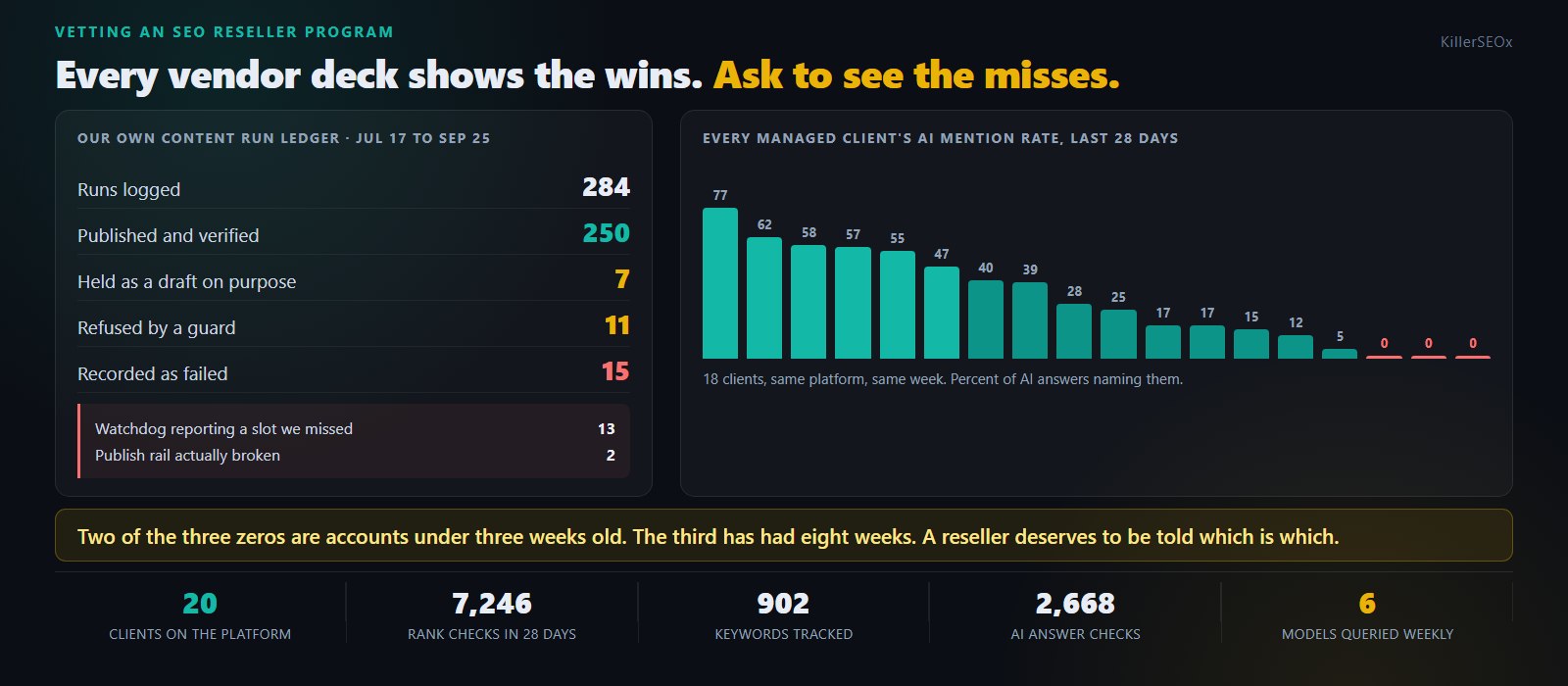
- Ask for the delivery log before the demo. Ours holds 284 content runs since July 17: 250 published and verified, 7 deliberately held, 11 refused by a guard, 15 recorded as failed. A vendor whose system cannot produce that view is not measuring delivery, it is remembering it.
- Thirteen of those 15 failures are a watchdog recording a slot we missed. The most useful thing an SEO reseller program can do is log its own no shows, because that is the failure nobody else will ever notice.
- Make them show the whole roster, not a case study. Across 18 managed clients in the same week, AI mention rate ran from 77 percent down to three clients at zero. That spread is normal and any vendor implying otherwise is selling you a number you will have to defend.
- White label is a set of surfaces, not a logo upload. Dashboard, login subdomain, sending domain, share links and report PDFs all have to carry your brand or the client eventually sees theirs.
- Settle data portability in writing before you sign. Historical rank data is the asset that cannot be rebuilt: our oldest tracked keywords go back to May 18 and no new vendor can recreate that history at any price.
What is an SEO reseller program?
An arrangement where a vendor performs some or all of the SEO work and reporting for your clients, under your brand, at a wholesale price you mark up. Programs split into three shapes: software only, where you deliver and the platform is yours to brand; fulfillment, where their team does the work; and a hybrid where you take the platform and buy in labor for specific pieces.
Those three shapes carry completely different risk, and half the confusion in this market is that everyone calls all three the same thing. A software only program is a tooling decision. If it disappoints you, you switch tools and your clients never know. A fulfillment program is a hiring decision wearing a subscription's clothes. If it disappoints you, the client sees it before you do, because they are the one reading the work.
Decide which one you are buying before you evaluate anybody. We worked the economics of the first shape in the math of reselling SEO software versus building your own stack, and the answer there was that tooling is the easy part. The rest of this is the hard part: trusting somebody else's delivery with your name on it.
Why ask for the delivery log before the demo?
Because a demo shows you what the software can do and a delivery log shows you what it actually did. Ask the vendor for a row per piece of work across their whole book for the last sixty days, with the outcome on each row, including the ones that failed. If that view does not exist, delivery is not being measured anywhere.
This is the question I would lead with now, and it is the one almost nobody asks. Here is ours, live, because asking for something I would not hand over is not an argument.
Every automated content run on this platform writes a row: which client, which machine, what it published, whether the hero image verified, which byline it used, and the exact error if something broke. Two hundred and fifty of those runs ended with a post live on a client site and checked. Two hundred and forty eight of the 250 carry a verified hero image, and the other two predate the field existing. Not one published row carries a failed hero check, because the publish script refuses to flip a post live without one.
The part worth stealing is the 15 failures. Thirteen of them are not a broken job at all. They are a separate watchdog noticing that an engine did not fire on a day it should have, and writing the miss down as a failure against us. Two are the real thing: a rail that broke under us, once when a client site migrated off WordPress overnight and once when a previously verified post started returning a 404 after a dependency upgrade quietly rolled the deploy back.
That is the actual test, because absence of work is invisible by default. Ask directly: what happens in your system when a scheduled job does not run? If the answer is a shrug, every report you hand a client covers only the work that happened to succeed, and you will hear about the rest from the client.
What does the whole roster look like, not the case study?
Ask for the same metric across every account they manage, on one screen, for the same week. A case study is a selection. The roster is the distribution, and the distribution is what your own book will look like in a year. Expect a wide spread and be suspicious of any vendor whose spread is narrow.
Here is ours for AI visibility, which is the newest and least flattering thing we measure. Eighteen clients, 2,668 answer checks across six models in the last 28 days, scored as the percentage of answers that name the business.
A pet waste removal company is at 77 percent. A pool retailer is at 62. Our own agency site is at 40, which is a useful humility check. Three clients are at zero.
Now the context that a vendor owes you and that a screenshot never carries. Two of those three zeros are accounts that started on September 9 and September 11, so they are two and three weeks old and a zero is exactly what a two week old account should read. The third started July 29. It has had eight weeks and it is still at zero, and that one is a real problem we are working. Those are three identical numbers with two completely different meanings, and if the vendor cannot tell you which is which on demand, they are not reading their own data either.
Same discipline on rankings. Over the last 28 days this platform ran 7,246 rank checks across 902 keywords for 20 clients, and a large share of those checks find nothing, which is the normal state of a keyword nobody has worked yet. The channel by channel breakdown is in what to demand from a white label rank tracker.
How do you tell real white label from a rebranded dashboard?
Count the surfaces a client can touch, then check each one for the vendor's name. The dashboard, the login page and its URL, the email address that sends sign in codes and reports, any shared report link, the PDF footer, and the support reply if a client ever writes in. A logo upload covers the first one. The other six are where it leaks.
Ask for a live demo account and look at it as a client would, not as an admin. In the order these usually fail: does the client log in at your subdomain or the vendor's; does the sign in code arrive from your verified domain or a noreply address carrying their name; what domain sits in the URL bar of a shared report link; and does the PDF carry your colors past the cover page.
One more that catches people: if a client replies to an automated report email, where does it land. Otherwise clean programs route that into the vendor's support desk, which means your client has a relationship with your supplier and does not know it. That is not a branding problem, it is a churn problem.
Our own answer is the boring one: your logo on the dashboard and the reports, sign in codes and reports sent from your verified domain, clients logging in at your subdomain, and our name on no client facing surface at all. The full surface list and the pricing sit on the white label SEO software page. What the reports themselves should and should not contain is a separate argument, and we made it in white label reports clients actually open.
Who owns the client, the data and the work if you leave?
Settle four things in writing before signing: a non solicit so the vendor cannot approach your clients, a full data export you can run yourself at any time, ownership of the content and pages produced, and access to the client's own Google properties in the client's name rather than the vendor's. Historical rank and visibility data is the asset that cannot be rebuilt.
The data point is the one people underrate. Our oldest stored rank checks go back to May 18, and the book holds tens of thousands of checks across hundreds of keywords. Move platforms tomorrow and current positions repopulate in a day while the history is gone for good. Nobody can sell you last quarter. That makes a self serve export a contract term, and "we can generate one on request" is a much weaker promise than a button you control.
Ownership of produced work is next. If the vendor writes posts or builds pages for your clients, say in the agreement that the client owns the output and nothing gets removed or redirected when the relationship ends.
Third, watch whose name is on the Google Search Console property, the Business Profile and the analytics account. These should belong to the client, with you and the vendor holding delegated access. A vendor who insists on owning the property itself has given you a very clear answer about what leaving looks like.
What margin should a reseller program actually leave you?
On software only, tooling should be single digit dollars per site per month against a three figure retainer, which leaves the retainer almost intact to pay for your labor. On fulfillment, expect to pay a real percentage of the retainer, and price it so your margin survives the work being done properly rather than only when the vendor underdelivers.
Our published numbers, so you have something concrete to compare against. Software only white label is $29 per site per month and you set your own retail price. At a $299 retainer that is $270 of gross margin per client before your own labor, and $2,700 a month across ten clients. Fulfillment plans, where our team works the account, run $99 per month per site for Local, $198 for Growth and $349 for Nationwide, and Done For You starts at $997 a month per account.
The trap is treating gross margin as profit. It is the budget you have left to deliver with, and the honest version includes your time: the call, the report walkthrough, the month somebody wants to discuss a competitor. The full per client version is in what to charge for SEO, the per client math, and when to automate versus hire is in past ten clients, automate, hire or raise prices.
One structural thing to check while you are reading a price sheet: is anything priced per report or per audit. Those line items get expensive at exactly the moment you are winning, because a growing roster runs more of them. Per site pricing scales with revenue. Per action pricing scales with effort, which is backwards for a reseller.
What happens when the work does not win?
This is the single best question to ask a reseller program, because every vendor has a rehearsed answer for success and almost none have one for a flat quarter. You want to hear a named threshold, a specific change of approach, and a report that shows the bad number rather than reframing it.
Some accounts will not move, and a vendor who will not say that before you sign will not say it afterwards either. Of the 22 site audits on this platform, scores run from 50 to 96 and average 86. The 50 is a real client site and a real problem. Publishing the 96 and calling it representative would be trivial.
What a good answer sounds like: we check position weekly rather than monthly so a decline is visible inside seven days, not thirty. When a keyword falls out of the top ten it raises a specific action rather than a note. When an account is flat for a quarter we say so in the report and change what we are doing. There are 625 open actions queued across our book right now and 170 closed, and both numbers appear in the client's own dashboard, including the fact that the open pile is much larger than the closed one.
That last part matters. Any vendor can show completed work; showing the backlog is what keeps a report honest. Same reason we argue for weekly checks over monthly in how often you should check keyword rankings: a monthly check on a local rank tracker cannot tell you whether a position moved on the 3rd or the 28th, so it cannot tell you what caused it.
When should you walk away?
Walk when you hear a ranking guarantee, when no delivery log exists, when the export is by request only, when links are sold as a volume package, or when the vendor will not put a non solicit in writing. Any one of those is enough, and they tend to travel together.
The guarantee is the clearest signal. Nobody controls Google's results, so a vendor claiming otherwise is either lying or about to do something to your client's domain that you will spend a year undoing. Guaranteed AI citations is the newer version of the same promise and just as unkeepable.
Link packages sold by the hundred are second. If the price is per link and volume is the pitch, you are buying a footprint, and it attaches to your client's domain and to your agency across every account you place it on.
The quieter flag is a vendor who cannot show you a failure. Every delivery system fails sometimes, and the ones claiming otherwise are not looking. Ours logged 15 failures and 11 refusals in ten weeks. A book of 284 runs reporting 284 clean ones would worry me far more.
The short version
Nine checks, in the order I would run them on any SEO reseller program.
- Which of the three shapes is this. Software only, fulfillment, or hybrid. They carry different risk and different margin.
- Show me the delivery log. Sixty days, every account, including the rows that failed.
- Show me the whole roster on one metric. Then explain the worst three accounts without me asking.
- Log in as a client. Check all seven surfaces for the vendor's name, not just the dashboard logo.
- Where does a reply to an automated email go. If it reaches the vendor, so does the relationship.
- Can I export everything myself, today. A button, not a request form. History cannot be rebuilt later.
- Who owns the properties and the content. The client, with delegated access, in writing.
- Is anything priced per report or per action. Per site scales with revenue, per action scales with effort.
- What happens after a flat quarter. Listen for a threshold and a change of approach, not reassurance.
Nobody answers all nine cleanly, us included on some days. What you are testing is whether the vendor reaches for data or for adjectives, because that reflex is what you are buying and your clients will experience it through you. To run the first check on us, put a client through the free audit or take a site onto the free tier and read the delivery log yourself.
Quick answers
What is the difference between white label SEO and an SEO reseller program?
How much does an SEO reseller program cost?
What should I ask an SEO reseller for before signing?
Can an SEO reseller guarantee rankings?
Will my clients find out I use a white label SEO vendor?